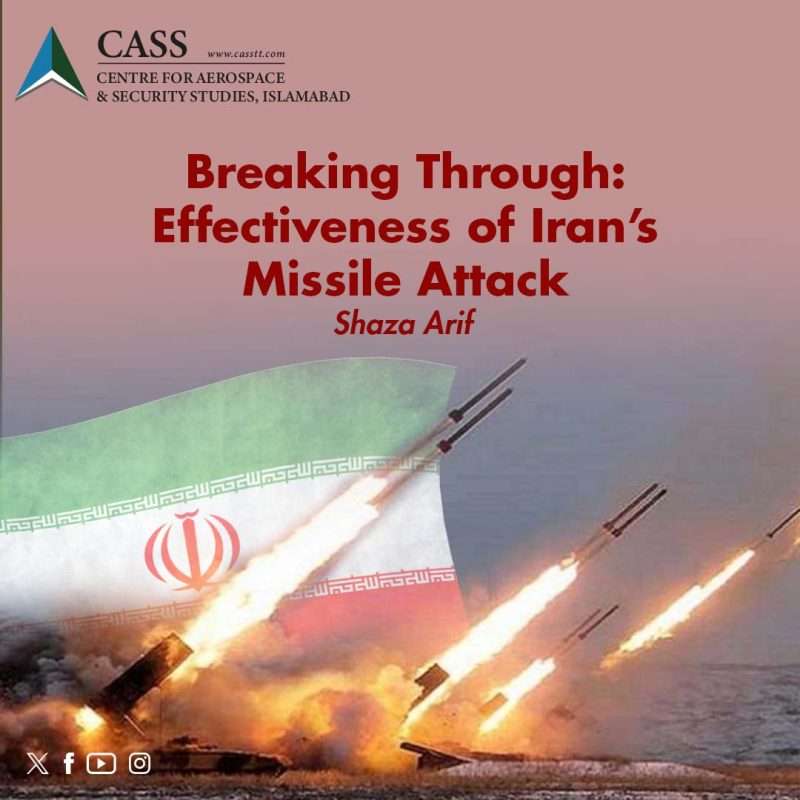
Instability and chaos define the current state of affairs in the Middle East, where long-standing rivalry between Iran and Israel continues to shape global politics. Tensions have once again taken centre stage in international relations. Amidst this turmoil, Iran threatened to punish Israel following the killing of Hamas leader Ismail Haniyeh. The situation escalated further after the assassination of Hezbollah leader Hassan Nasrallah, compelling Iran to respond to Israel’s actions. Resultantly, nearly 200 ballistic missiles were fired towards Israel, sending shock waves across the region and raising questions regarding effectiveness of the attack and its implications.
Initially, Israel denied any significant damage, claiming that majority of the missiles were intercepted. However, visuals show that at least two dozen missiles penetrated Israeli and Allied air defence systems. Once it became evident that air bases were impacted, Israel attempted to downplay the attack’s efficacy by claiming that no substantial damage had been done to aircraft or critical assets. Instead, it reported slight damage to peripheral infrastructure. However, video evidence suggests otherwise.
It is important to note that this is Iran’s second attack on Israel this year. An earlier attack using missiles and drones was conducted in April. The damage done by the recent attack surpasses the previous one. Previously, only two missiles were able to penetrate Israel’s air defence, whereas in the recent attack 20 missiles impacted the Nevatim Air Base, and three struck the Tel Nof base. Several missiles also dropped near headquarters of Israel’s intelligence agency, Mossad.Likewise, Nevatim air base sustained minimal damage in the previous attack. Half of the missiles had landed within three-quarters of a mile of the base, with the other half outside the radius. This time, commercial satellite imagery confirms impact on hangars, runway, taxiway, and the air base building. Interestingly, Israeli air bases are among the most heavily protected assets, given reliance on their Air Force superiority in conflicts. Furthermore, Nevatim is considered Israel’s most important airbase due to presence of two squadrons of stealth aircraft, F-35 Fighters. The presence of high-value targets amplifies its importance. Therefore, inability to stop the attack must be causing considerable angst to the IDF.
Rivalled only with Taiwan, Israel has the densest and most sophisticated air defence network among countries aligned with Western powers. However, penetration of ballistic missiles raises several questions and concerns about the effectiveness of Air Defence Systems. Historically, Israel ADS, comprising Iron Dome, David’s Sling, and Arrow 2 / Arrow 3 systems, has proved considerably effective in stopping incoming targets. In this context, intercepting ballistic missiles requires long-range Arrow 2 and Arrow 3 systems, given that Iron Dome can intercept low-flying, short-range missiles often used by Hezbollah and Hamas.
Penetration by Iran’s missiles leads to several conclusions. It is possible that Israel’s stockpile of Arrow 2/Arrow 3 interceptors is depleting and cost of interception is considerably high. Resultantly, Israel desires to use the systems for richly populated areas such as Tel Aviv in view of more incoming missiles from Iran. Such scenarios put pressure on Israel to prioritise critical areas under intense time constraints. Additionally, recent aerial incursion calls into question effectiveness of Israel’s systems, which might be overhyped in the wake of new technologies and strategies. In this case, saturation technique has apparently overwhelmed or exhausted Israel’s ADS.
It is also possible that Iran’s evolving missile technology has further augmented the lethality and accuracy of its arsenal despite sanctions and curbs on technological access. Iran maintains more than 3000 ballistic missiles. It is likely that Iran used a combination of Emad, variants of Shahab series, Ghadr and Kheibar Shekan in the latest attack. Iran claimed that it also used the latest Fateh hypersonic missile. However, employment of its newly launched advanced ballistic missile is unlikely, given that such an act would reveal sensitive information about the technology to Israel. Likewise, Iran would likely prefer the missile’s debut in a conflict larger in scope and complexity. If the episode resulted in any damage to F-35s present on Israel’s air bases, it could limit the latter’s capability and also raise national security concerns.
In future, decimation strikes on air bases could have notable repercussions. The recent damage inflicted highlights that Iran has the capability to attack critical Israeli infrastructure, such as airports, power stations, military sites etc., in the future. Furthermore, impact of the attack suggests that Israel may not be fully prepared to neutralise such attacks. Likewise, it has been reported that apart from military damage, the municipality of Hod HaSharon reported damage to approximately 100 homes. Likewise, the craters and damaged buildings further confirm the impact. Hence, heavily populated areas could also be targeted in future.
The recent attack provides important takeaways regarding the effectiveness of ADS against technological advancements and new tactics. This reinforces the idea that in the offence-defence game, offence often holds the advantage. Therefore, technological advancements will be key in shaping the future geopolitical landscape and the pursuit of dominance.
Shaza Arif is a Research Associate at the Centre for Aerospace & Security Studies (CASS), Islamabad. She can be reached at [email protected]