‘Now I am become Death, the destroyer of worlds,’ said J. Robert Oppenheimer after realising that his pivotal role in the making of atomic bomb could be ruination for humanity. In contemporary times, technologically driven Revolutions in Military Affairs (RMA) are increasingly displacing human roles in the military, paving the way for robotic systems. Though military robots may offer higher precision, efficiency and force multiplication, the associated risks compel one to wonder if these have entailed another Oppenheimer moment for the world.
The robots being developed, tested and deployed in militaries across the world are classified into three types: Unmanned Ground Vehicles (UGVs), Unmanned Aerial Vehicles (UAVs) and Unmanned Underwater Vehicles (UUVs). These may be deployed to administer multiple tasks such as logistics, search and rescue, mine clearance, surveillance and combat operations.
The Goliath is arguably the first prominent military robot that was deployed by Germany in WWII to carry explosives and blow up tanks. The German army produced multiple Goliath units but their effectiveness was constrained on the battlefield due to their large size and slow speed. Nevertheless, the colossal headways in both hardware and software, over the decades, have brought greater technical prowess, lethality and sophistication to military robots. These are now an integral feature of the RMA which is evident from their expanding market size. The size of the global military robot market is estimated to be around USD 24.37 billion in 2024, with growth projections of up to USD 34.12 billion by 2029.
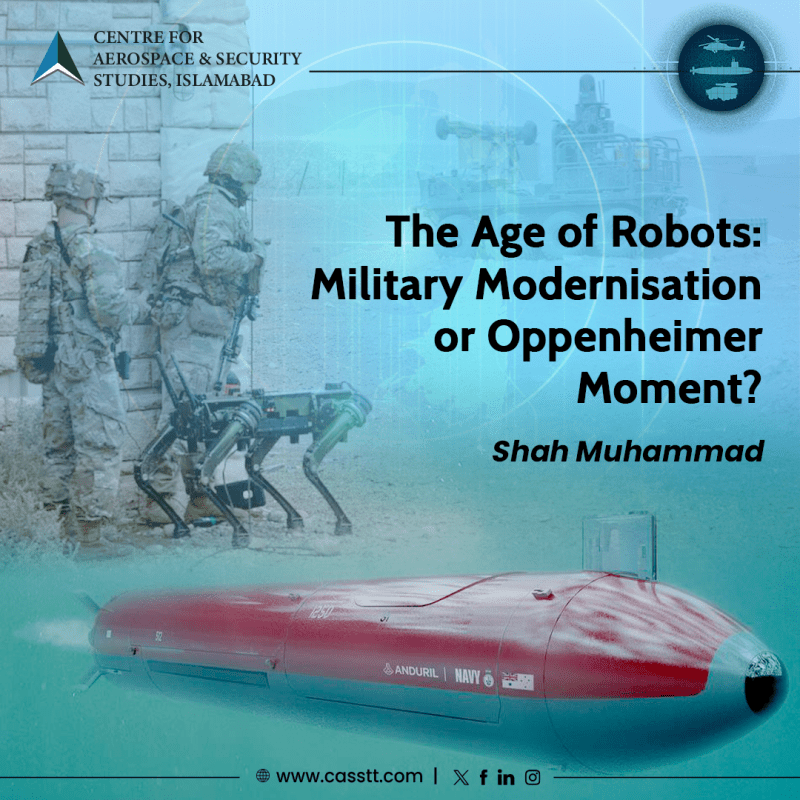
In 2020, the US Army started conducting multi-domain war games called ‘Project Convergence’ to test military robots. One particular exercise was the successful simulation of an urban environment where robotic dogs and UAVs operated effectively. In addition, Project Convergence is focused on integrating machines into all service formations and conduct trials for human-machine synergy on the battlefield. The involvement of allied foreign militaries, such as Japan and Australia, in these war games signals the military modernisation of the Asia-Pacific geopolitical alliance. This notion is further substantiated by the fact that the US defence company Andruil is building an AI-powered submarine called ‘Ghost Shark’ for the Australian navy which aims to be a highly potent UGV in naval warfare.
The geopolitical risks faced by China across the Asia-Pacific region are a major driver behind its military modernisation. In a recent military exercise called ‘Golden Dragon’, China exhibited robot dogs mounted with automatic machine guns. These signal advanced headway in the development of a robotic army. Furthermore, China has made a significant leap in UAVs by developing swarm drones that can split and multiply mid-air. These swarms may offer a tactical edge to Beijing by acting as force multipliers, with the potential to overwhelm an adversary’s air defence system.
Despite being a cornerstone of military modernisation, robotic transformations are not devoid of risks and challenges. In April 2024, a conference was convened in Vienna on the risks of robots and autonomous weapons, attended by high-ranking officials from over 140 countries. The conference called for regulation, stressing that these technologies could undermine accountability and increase the likelihood of conflict escalation. It culminated with the Australian foreign minister’s remark that growing autonomy in warfare is the ‘Oppenheimer moment of our generation.’
Greater autonomy and dehumanisation of warfare result in a lack of human control, making compliance with International Humanitarian Law (IHL) an arduous undertaking. In addition, the arms race in military robots may cause conflict escalation among great powers. For instance, the US has already made it clear that it is planning to deploy thousands of autonomous systems mainly to counter the growing military power of China. Given that the Asia-Pacific region has multiple geopolitical hotspots, any strategic miscalculation could turn a robotic arms race into a full-fledged conflict.
Such associated risks could be addressed through a series of pragmatic measures. International organisations and states may commence the process of revising IHL to enhance its legal adaptability to the technological and autonomous aspects of warfare. This could be materialised sooner if different stakeholders across the world work towards developing international consensus in that regard. Additionally, drawing on arms control treaties of the Cold War era, contemporary dynamics call for exigency of bilateral as well as multilateral treaties to curtail the robotic arms race underway among great powers. In line with the consensus of the Vienna conference, human control over autonomous systems should not be lifted completely. Decisions as profound as those related to life and death should not be left to mechanical algorithms.
To conclude, robotic transformations are reflective of significant shifts in the character of war. Stakeholders at the national and international level should exercise prudence and foresight to minimise the downside of military robots. Failure in this regard might revive the spectre of ‘Now I am become Death, the destroyer of worlds.’
Shah Muhammad is a Research Assistant at the Centre for Aerospace & Security Studies (CASS) in Islamabad, Pakistan. He can be reached at [email protected].