With every passing day, the race towards space exploration is becoming more intense. The domain’s importance has grown exponentially, fueled by the remarkable expansion of space-based applications. It has become critical in growing global connectivity, driving economic growth/development, enhancing warfare tools, refining research, improving disaster management and technological innovation. Beyond that, we continue to rely on various applications such as Global Positioning Systems and weather forecasting apps for daily use. Resultantly, efforts are in full swing to reap maximum benefits. In the Pakistani context, two recent developments underscore the country’s effort to advance its space-based capabilities.
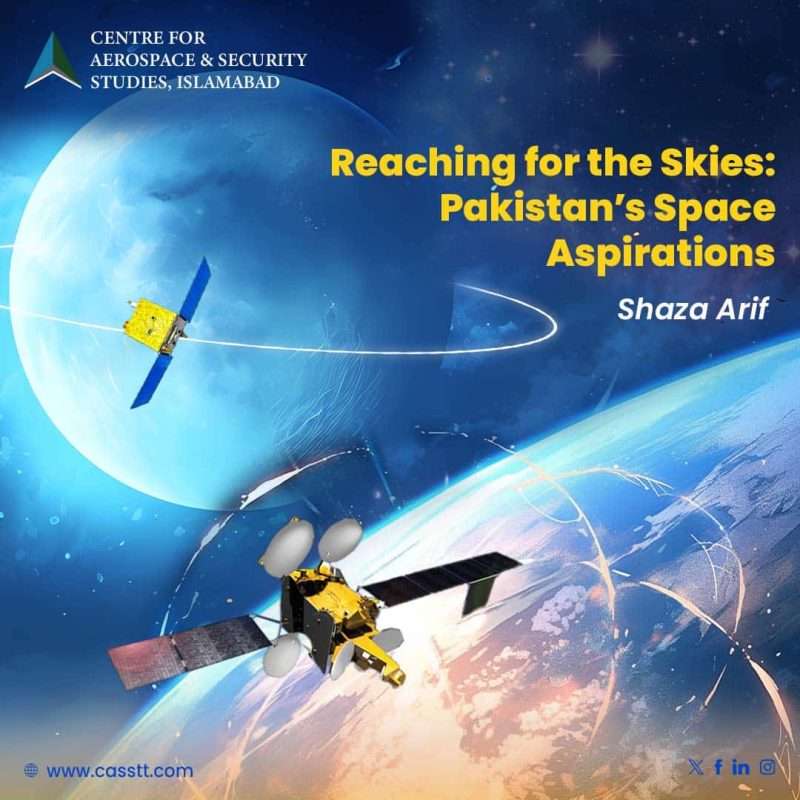
On May 3rd, Pakistan launched its first lunar satellite named ‘iCube-Qamar’ from China’s Hainan Space Launch facilities. The initiative is a collaboration between the Institute of Space Technology (IST), Shanghai University and the Space and Upper Atmosphere Research Commission (SUPARCO) in Pakistan. It is part of China’s Chang’e 6 mission, designed to land on the far side of the moon to collect different samples for scientific exploration. Five days later on May 8th, the satellite entered the moon’s orbit. As its name suggests, the Pakistani satellite is a CubeSat which is small in size and has a standardised design. It is typically lightweight (iCube-Qamar weighs approximately 7 kgs) and constructed in cube shape, tailored to meet different size requirements. The utility of such satellites can vary from remote sensing to Earth observation, technology demonstration, communication, and research. Two optical cameras have been placed on the satellite to capture images. In the next three to six months, the satellite will transmit images back to Earth as it orbits the moon. In fact, after completing three orbits of the moon, on May 10th the satellite sent its first picture from orbit.
Following the success of the lunar satellite – iCube-Qamar, Pakistan is all set for another mission. On 30th May, Pakistan will launch its multi-mission communication satellite, PakSAT-MM1 from China’s Xichang Satellite Launch Centre. The initiative marks another collaboration with China, underpinned by a joint effort of SUPARCO and the Chinese aerospace industry.
The two initiatives mark important chapters in Pakistan’s quest for advancements in space. In case of iCube-Qamar, the relatively low cost of the mission as compared to other satellites offers considerable opportunities for a broader range of collaborators, including research institutions, educational institutes and other concerned private institutions. Moreover, the involvement of Pakistani universities such as Institute of Space Technology (IST) in such initiatives is noteworthy.
It is encouraging to note that students and faculty of IST were involved in the design and development phase of the satellite. Their involvement can help strengthen the academic base in related subjects, promote practical training and encourage students to pursue relevant subjects/careers in the field.
Likewise, the deployment of PakSAT-MM1R is expected to enhance the communication infrastructure by meeting the requirements of the telecom sector. Furthermore, it is also expected to enable high-speed internet and connectivity. Hence, such measures can expedite the digitalisation process. These collaborative efforts can help cut down costs of accessing advanced technologies, offer further opportunities, and establish a strong foundation for future space endeavours.
While these initiatives might not manifest immediate results, these steps have the potential to drive long-term progress. The critical aspect is to remain consistent, build a streamlined human resource infrastructure, and increase the associated funding. Moreover, establishing efficient working mechanisms involving the public and private sectors is essential. Most importantly, these initiatives need to be underpinned by coherent national policies to ensure sustainable results. Without collective effort, such initiatives might not be able to yield productive results or fail to reach their full potential. Likewise, it is vital to review past successful as well as unsuccessful ventures so that existing gaps vis-à-vis technology and logistics can be identified. A notable case in this regard is the 2020 initiative to send a Pakistani citizen in space by 2022 – a venture that could not materialise. If such ventures can be resumed, it can have a positive impact by inspiring national pride and motivating individuals to pursue studies and careers in the field of space exploration and technology.
Initiatives such as ‘iCube-Qamar’ and ‘PakSAT-MM1’ should not be seen in isolation; instead, they must be seen as incremental steps towards further advancements and innovation in Pakistan’s space capabilities. In light of rapid technological advancements and increasing reliance on space-based technologies, it is imperative for the government to address the challenges and opportunities of space exploration. This entails developing a robust legal framework and establishing a capable organisational structure for space activities. Key steps include crafting a National Space Policy (NSP), bolstering military capabilities in space, integrating space assets into national strategies, and maximising civil applications of space for socioeconomic progress and effective governance. Additionally, policies should be devised to encourage private sector involvement in commercial space endeavours, along with initiatives for national space capacity building and human resource development.
Shaza Arif is a Research Associate at Centre for Aerospace & Security Studies (CASS), Islamabad, Pakistan. She can be reached at [email protected].