The foundation of a nation’s progress lies in its robust industrial sector, shaping its economic vitality and strategic influence. China, having a formidable industrial base, has secured a prominent global standing across diverse sectors. Its ‘Made in China’ (MIC) 2025 project marks a paradigm shift with a primary focus on becoming a global leader in high-tech industries through a dual-pronged approach. First, to indigenise strategic technologies for self-reliance and second, to upgrade China’s high-tech industrial capabilities through innovations. With government support and synergizing Public-Private Partnerships (PPPs) throughout the development and production life cycle – from raw materials to end product – the plan aims to ultimately position China as a ‘manufacturing superpower’.
The MIC 2025, which was initiated in 2015, is planned in three phases. During the first phase (till 2025), indigenisation and upgrade of industries with a focus on smart manufacturing technologies is planned. During the second phase (till 2035), the focus would be on improving global innovations and ownership of intellectual property. In the third and final phase, China aims to establish itself as a global leader in high-tech manufacturing by 2049. This aligns with the broader objective of its Centennial 2049 plan, which aims to create a modern, prosperous, strong, and technologically advanced China.
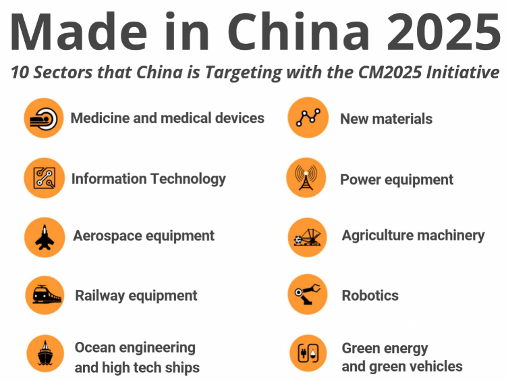
Under the MIC 2025 initiative, the emphasis is on the development of ten key industries, i.e., Electric Vehicles (EVs), Information Technology (IT), Aerospace Technologies, Ships and Maritime, Advanced Railways, Robotic Machines, Precision Agriculture, Advanced Materials, Power Equipment, and Bio-medicines. China is actively digitalising these industries, aligning them with the requirements of the Fourth Industrial Revolution (IR4), emphasising the incorporation of Artificial Intelligence (AI), Big Data, cloud computing, automation, virtual simulations, robotics, and other nascent technologies into manufacturing supply chains.
One notable example in the realm of indigenous development is Electric Vehicles (EVs) technology. China has strategically invested in the Research and Development (R&D) of EV technologies, aiming to establish its dominance in the rapidly growing electric vehicle market and environmental sustainability. Chinese corporations have successfully advanced in the fields of power battery technologies, electric propulsion systems, and charging infrastructure. This concerted effort has not only propelled the domestic electric vehicle industry but, has also positioned China as a global leader in EV manufacturing and technology showcasing the country’s commitment to reducing dependence on foreign technologies and fostering self-sufficiency.
Source: Focus-Economics.
Another example of innovation in the existing sector is the Aerospace Industry, where cutting-edge initiatives, such as the integration of AI, robots, simulations, and new materials like lightweight composites and alloys, have been launched. These initiatives have led to the development of advanced aircraft and UAVs that are fuel-efficient and technologically advanced. Moreover, new manufacturing techniques like 3D printing is revolutionising processes by enabling the production of intricate components with reduced material waste. The integration of Internet of Things (IoT) technologies enables the real-time monitoring of systems, while the utilisation of big data analytics aids in the optimisation of flight operations and predictive maintenance. China’s emphasis on space exploration and satellite technology reinforces its dedication to advancing its aeronautical capabilities.
In the context of Pakistan, there is a significant need to advance the industrial sector through the adoption of digitalisation. Through the cultivation of an environment that encourages innovation, allocation of resources towards state-of-the-art technology and the prioritisation of digital infrastructure, Pakistan can unleash its capacity for industrial development.
To achieve the goal of digitalisation, two pathways are suggested. First, formulation of a comprehensive national policy framework in alignment with the Sustainable Development Goals (SDGs) is important. SDG-9 emphasises the promotion of resilient infrastructure and sustainable industrialisation through innovation, science and technology. To effectively realise these aspirations, Pakistan should strategically align its industrial upgradation with the SDGs, encouraging innovation through targeted awareness programmes, policy-level initiatives, and the incorporation of new technologies in design and production processes. Encouraging PPPs and strengthening academia-industry linkages, exemplified by the Triple Helix Model, can further catalyze innovations aligned with the nation’s commitment to the 2030 Agenda for Sustainable Development. Second, Pakistan has a unique opportunity to utilise the platform of the China-Pakistan Economic Corridor (CPEC) to bolster its Science, Technology, Engineering, and Mathematics (STEM) related projects. Collaboration with China under CPEC can facilitate the acquisition of R&D expertise in emerging technologies along with practical integration of these technologies with the local industry for production capacity and capability enhancement. This strategic partnership has the potential to advance not only Pakistan’s position in STEM fields but also to contribute significantly to the overall economic and technological progress of the nation. These measures collectively underscore a proactive approach towards achieving inclusive, sustainable, and innovation-driven industrial growth in Pakistan.
Air Commodore Raza Haider (Retd) is currently serving as Director at the Centre for Aerospace & Security Studies, Islamabad, Pakistan. The article was first published in Islamabad Post. He can be contacted at: [email protected].
Design Credit: Mysha Dua Salma