
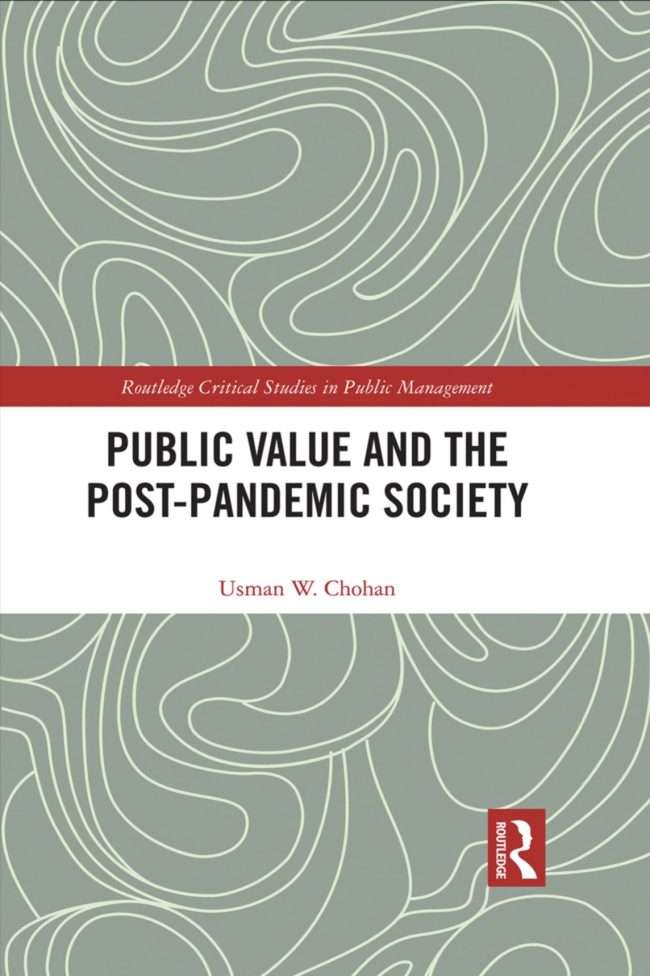
Usman W. Chohan, Public Value and the Post-Pandemic Society (New York/Abingdon: Routledge Taylor & Francis Group, 2023)
Reviewed by Zahra Niazi
In the book Public Value and the Post-Pandemic Society, author Dr Usman W. Chohan discusses the ‘post-pandemic’ era through the prism of Public Value (PV) scholarship. The first section of the book, titled ‘Changes and Transitions,’ examines the notions of value transition and value stability in the context of the post-COVID era and discusses the two most salient manifestations of challenges to the post-pandemic society, including stagflation and the great resignation. Exploring the value transition/stability debate, the author concludes that although individual values remain stable overall, they exhibit a certain degree of variability (p. 27). As such, like the Pandemic years, the post-Pandemic era also wields the potential to influence value preferences and prioritisations, which public managers must remain attuned to. Further in the section, he notes that ‘stagflation’, marked by a combination of slow economic growth and high inflation, is a significant cause of PV destruction in the post-Pandemic era (p. 44). According to him, the re-emergence of stagflation has also dispelled certain myths, such as the idea that it would likely not be repeated or that the post-Pandemic inflationary surge was only transitory, among others. Another salient feature of this era is the public’s disenchantment with contemporary workplace conditions and cultures, leading to mass voluntary resignations. The author suggests that along with being a worker and a regulatory agent, the public manager is also a responder to the public’s values and should, therefore, act upon and respond to the public’s emphasis on transforming labour relations and workplace cultures (p. 27).
The second section, titled ‘Asymmetries and Inequalities,’ assesses the inequalities in the post-COVID era. The author contends that inequality within the public worsened during the Pandemic and continues to exacerbate in the post-COVID era (p. 8). Similarly, the post-Pandemic era has aggravated extreme inequalities among the public internationally, as nations such as Sri Lanka have suffered disproportionately due to the current crises, such as the war in Ukraine, despite not being directly involved in the war. These inequalities and heightened vulnerabilities have also contributed to PV destruction and necessitate higher levels of coordination and cooperation within and between societies for its creation and preservation.
The last section titled, ‘Resilience and Learning,’ emphasises the need to learn from crises and embed resilience against future calamities. The author notes that the logic of ‘Necropolitics’ or ‘letting others die’ for the sake of a perceived broader interest, the economy, or normalcy that persisted during the Pandemic years has continued into the post-Pandemic era (p. 108). He calls for countering ‘necropolitics’ with a reorientation towards the ‘value-seeking imagination’ propounded by the PV scholarship (p. 105). Moreover, the author suggests that the post-COVID transformations of society have highlighted the necessity of sustainable approaches to create and preserve PV (p. 117). As such, building sustainable PV necessitates that the public manifests and embodies healthy values, public managerial architecture and the political system are driven towards creating value through sustainable projects, and all nations manifest and act upon concern for the larger, planetary public.
Further in the section, the author shows that the risk of another merciless pandemic in the future cannot be underplayed (p. 133). He points out that the International Panel on Pandemic Preparedness and Response (IPPPR) has made worthwhile recommendations to effectively prepare for a global pandemic to create and preserve PV, which should be implemented. These, for instance, include establishing a ‘Global Threats Council’ under the auspices of a global pandemic treaty, developing novel technologies for better pandemic preparedness and response, or creating a pre-negotiated platform to produce therapeutics, diagnostics, vaccines, and other supplies.
The author’s efforts in exploring how PV can be created and preserved are commendable, making it a valuable contribution to both its literature in particular and society in general. However, at certain points, a reader may feel that some of the suggestions are over-optimistic, such as the assertion that all nations must think in terms of the larger, planetary public when looking at the existential risks to PV (p. 128). Yet, it’s still worth quoting the author’s own words from the end of the book: ‘It isn’t too late for us to guide societies toward such lofty stars, and such must be the quiet optimism with which we march, against despondence and against despair, into the second quarter of the 21st century’ (p. 153).
The primary strength of the book lies in the author’s unbiased approach. In none of the sections is the author’s advocacy to create and preserve PV bound to the public of a particular part of the world. Instead, the author’s worldview reflects a cosmopolitan perspective, which considers every human being equally worthy. Similarly, throughout the book, the author continues reiterating the responsibilities of governments and public managers but is cautious not to absolve the public from its responsibilities in helping create and preserve PV. For instance, in the chapter on ‘Necropolitics and Public Value,’ the author asserts that brutalising policies, such as against migrants, may be a response to what the public values (p. 113), suggesting, then, that the public can play a vital role in fostering as well as countering necropolitics. As another example, in the chapter on ‘Sustainability and Public Value,’ the author asserts that sustainable PV creation necessitates that the public also manifests and embodies healthy values (p. 127). Additionally, the author gives ample room to contrasting viewpoints before drawing conclusions and supports his claims with numerous references, minimising the likelihood of biases in his findings.
The book is highly recommended to practitioners and academics of public administration and public policy, including healthcare policy and economics, scholars in the field of Public Value Theory (PVT), and academics interested or engaged in research on individual values. Overall, this book is highly recommended for anyone committed to building a better world, both for today’s generations and for future ones who deserve to inherit a planet as good as, if not better than, the one we have now.
Zahra Niazi is a Research Assistant at the Centre for Aerospace & Security Studies (CASS), Islamabad, Pakistan. She can be reached at: [email protected]



