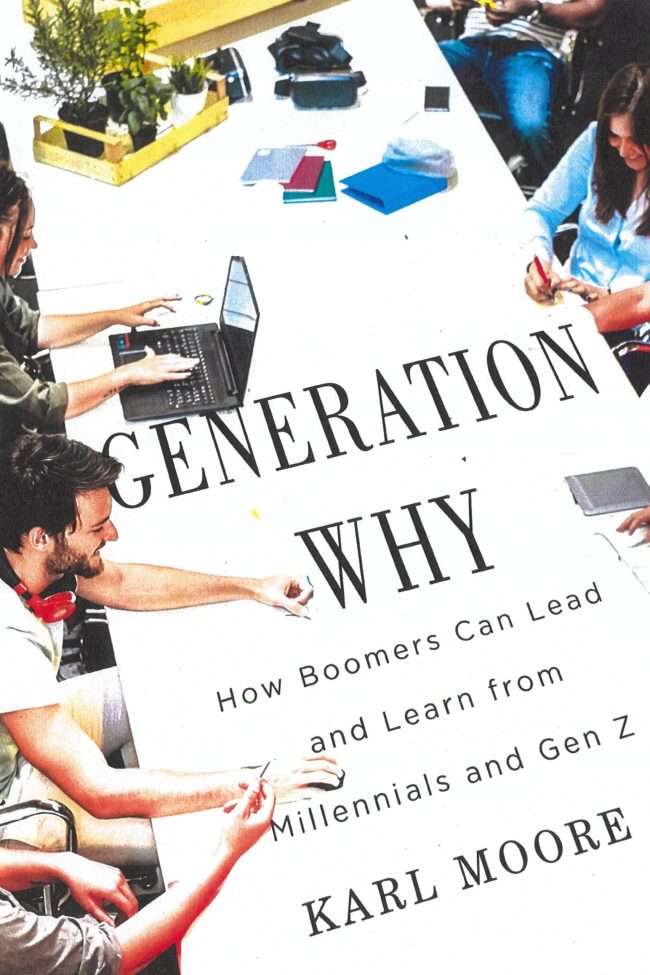
Karl Moore, Generation Why: How Boomers Can Lead and Learn from Millennials and GenZ (McGill-Queen’s University Press, May 2023)
Reviewed by Bakhtawar Iftikhar
We live in an era of generational transition, where a new cohort of GenZ (b.1997-2012) are entering the workforce, Millennials (b.1981-1996) are rising to middle management, and the Senior Boomers (b.1946-1964) are retiring. As a result, there is a mix of generational traits and values found in organisations today. Given the tensions that arise from divergent value systems, is there anything the old can learn from the young? Professor Karl Moore seeks to examine this question in Generation Why: How Boomers Can Lead and Learn from Millennials and GenZ.
Prof. Moore sets out to navigate the generational differences, hoping to not only bridge but also capitalise on these for an effective workplace-management strategy. He draws upon his experience as a Boomer who has spent ample time with younger generations while serving as an Associate Professor at Oxford, Cambridge and McGill; as a radio-show host interviewing GenZ CEOs; and as a travel companion to them exploring fast-growing economies around the world. The book is enriched by extensive fieldwork involving interviews with over 800 under-30-year-olds as well as 750 C-suite executives to explore ‘the joys and challenges of working with Millennials/Generation Zers’ (p. 6). Thus, the book offers abundant advice – from one Boomer to another – regarding how to understand the new cohort’s post-modern worldview, marked by a ‘globalist mentality and digital nativity’ (p. 129).
The writer acknowledges the importance of young people as drivers of innovation and as replacements for Boomers who are retiring. Given that around a quarter of the world’s population comprises Millennials, the author anticipates that their ‘ethos, social values and beliefs will dominate the next decade’ (p. 12). Therefore, it is crucial to recognise their regard for values like equality, diversity and inclusion. Redesigning corporate culture through ‘environmentally sustainable practices, ethical business codes, inclusion of minority groups, and an open-door supportive community approach’ (p.73) can help organisations align with the younger generation’s desire for purpose and authenticity.
Prof. Moore holds that the challenge faced by senior managers today is akin to the example of a four-star general, Martin Dempsey, former Chairman of the Joint Chiefs of Staff in the United States. Dempsey was of the view that the guidance from his senior officers had become outdated, and his personal experiences as a lieutenant were not applicable in the later wars he engaged in. Resultantly, he had to ‘set aside’ past lessons to ‘command effectively under new and radically different conditions’ (p. 8). Likewise, senior managers today cannot depend on strategies that were effective in their earlier years, simply because the times have changed. Prof. Moore maintains that much like Dempsey, Boomers are more flexible and willing to adapt than they are given credit for. Moreover, he dispels the myths of Generation Z being self-absorbed complainers by providing a balanced analysis, linking their behaviour to the social, economic, and technological factors that shaped their upbringing. Similarly, to how Boomers moved away from their predecessors’ strong adherence to traditions or religion (in certain regions) due to the impact of scientific progress on contemporary thinking, Generation Z had also been shaped by the significant characteristics of their era. Accordingly, the book explores several facets underlying the GenZ mindset in detail.
Chief among these factors is the Internet and readily available information, bringing about a shift in behaviour and perspectives. According to the writer, information is power, and its easy availability has led to a decline in hierarchy (p. 46)z. This manifests in workplaces just as it does in classrooms where the author’s students refer to him as ‘Karl’ instead of ‘Professor Moore’. Hence, even in organisational settings, superiors have to ‘work with’ this new generation – not ‘lead’, nor ‘manage’ – as these words are ‘too strong’ (p. 4) for a generation that views their predecessors as equals. Managers can be more successful if they provide encouraging guidance, as opposed to outright orders in order to comfortably exchange and co-create ideas.
Moreover, due to social media, GenZ is accustomed to customised care and personalised feedback, continuously received through likes and comments. Therefore, managers can benefit from personalised mechanisms to both provide and receive meaningful feedback from GenZ workers. Prof. Moore mentions an SKS (Stop/Keep/Start) framework to do so, which answers the following questions:
- What should I STOP doing?
- What should I KEEP doing?
- What should I START doing?
Another interesting example found in Chapter 3 titled ‘Doc, I Have Three Theories about What Is Wrong with Me’ (p. 24), discusses how GenZ patients commonly google symptoms, read scientific papers and even explore alternative medicine instead of solely relying on a doctor’s diagnosis. Subsequently, while interacting with a doctor who has superior medical education, GenZ patients still feel a strong need to express their opinions. Even if doctors disagree, they have begun to actively listen to, accommodate and even embrace postmodern views in their communication. ‘So too must managers,’ says Prof. Moore (p. 26).
Despite focusing on the older generation’s vantage point, the book also offers brief insight for young workers in the concluding chapters. Though Prof. Moore could have been more critical of my generation given our shortcomings, he gently advises the GenZ worker to understand the boss’ motivation and goals; to bring solutions, not just problems; and to maintain consistent communication ensuring that there are ‘no surprises.’
To conclude, Prof. Moore’s reflection on fluid wisdom may be an apt analogy to summarise the key message in his book: each generation has something to offer, and it would be most beneficial for both to capitalise on each other’s collective wisdom and learn from one another. The necessary skill is to ‘row in unison’ (p. 146) and ‘appreciate and adapt to people with different perspectives, priorities and personalities’ (p. 143).
Overall, Generation Why is a well-researched, thought-provoking, easy-to-read and practical collection of insights on intergenerational work dynamics. Although references to North American culture and business throughout the book may resonate less with non-American, non-business readers, it is highly recommended for senior management across various organisational settings, especially in Pakistan where older generations dominate senior positions and political office.
Bakhtawar Iftikhar is a Research Assistant at the Centre for Aerospace & Security Studies (CASS), Islamabad, Pakistan. She can be reached at [email protected].