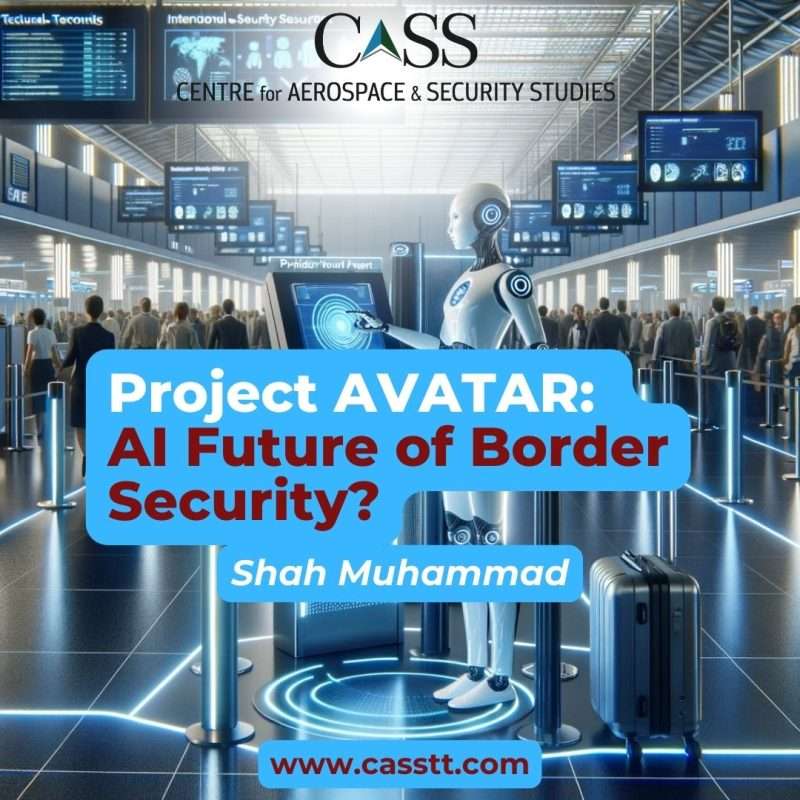
Artificial Intelligence (AI) seems to be on the cusp of automating border security protocols and customs operations. The National Centre for Border Security and Immigration at the University of Arizona has developed an AI prototype called the ‘Automated Virtual Agent for Truth Assessments in Real Time’ (AVATAR). Funded by the US Department of Homeland Security (DHS), it has been designed on the principles of Machine Learning (ML), computer vision, and Natural Language Processing (NLP). Its essential purpose is to enhance border security and expedite the operational efficiency of Customs Authorities in order to counter security threats arising out of immigration, crime, and terrorism. The existing border security regime in the US is helmed by the US Customs and Border Protection Agency, with law enforcement officials monitoring and screening entrants at over 300 land, air and sea ports.
Employing AI and sensor technologies, AVATAR is able to detect, identify, and screen individuals travelling across the border. It examines speech, posture, tone and facial expressions while asking questions via an interactive AI agent. The anomaly detection is coded as green (low risk), yellow (medium risk), orange (medium-high risk), and red (high risk). Anomalous or suspicious behaviour is subsequently flagged, leading to further follow-up investigation by customs officials. Although the project is still undergoing design and development improvements, the DHS is hopeful that it has the potential to enhance the operational efficiency of Customs Authorities who usually endure long queues and backlog at the border.
AVATAR was successfully tested in a real-world setting at the US-Mexico border in 2012. It then caught the attention of Frontex, a European Union (EU) border control agency. It underwent field trials at Bucharest Airport in Romania where it was used to interview travellers in their native language and analysed their posture, tone, and facial gestures. According to Aaron Elkins, one of the developers of the system, AVATAR has an average deception detection rate of 60 to 75%, whereas that of humans as judges is 54 to 60% at best.
The indigenous development of similar AI system may be of significance in other countries as well. For instance, Pakistan has been reeling from terrorism which was responsible for 65% fatalities in 2023, with a total of 586 terror attacks recorded in the same year. Pakistan attributes many of these attacks to cross-border terrorism along its Western border. Apart from the routine checks by customs authorities, Pakistan has fenced the Pak-Afghan border which has reached 98% completion. In this regard, an ML-based detection system could serve as a counter-terrorism AI tool for the country. It could be deployed at domestic customs checkpoints for the purpose of screening miscreants who cross the border in the guise of civilians.
However, AI systems are susceptible to recurrent cyber-attacks and data breaches. Similarly, in the absence of robust cyber security defences, AVATAR or any similar AI detection system might fall prey to an adversarial attack or cyberterrorism that could manipulate its algorithm and ML processes. Consequently, it might misidentify and misjudge individuals during the screening process, entailing far-reaching implications for border security and data privacy. It remains to be seen if these issues could pose a threat to such AI systems once they are fully deployed in the future. If such an eventuality does transpire, the algorithm might get manipulated as a result, allowing terrorists to travel across a border without getting flagged by the system. In the case of Pakistan, this might ensue exacerbation in cross-border terrorism. Any potential effort in the future towards automation of border security may first require a push towards cordiality and mutual trust in Pak-Afghan relations. Installation of an AI system for border security at the Pak-Afghan border would also need to account for the sociopolitical and security context of Pak-Afghan relations. Locals may need more exposure and understanding to get used to such technology. Pakistan’s economic woes are further hurdles in terms of funding such a project. Thus, the government would need to wait for the right time to initiate such a project once it acquires adequate technological grounding, economic stability and normalisation of Pak-Afghan relations. Albeit, developing an indigenous AI detection system for national security is possible in the future as the government has already announced adoption of AI in the development sector.
AVATAR has not been fully deployed in the US yet as it is undergoing Research and Development. However, field tests of this system exhibit an idea of the future of border security which will most likely be characterised by intelligent systems and ML interfaces. Pakistan is marred by multifaceted challenges which might hamper efforts towards automating border security. However, the country may be in a position to indigenously develop such systems once it acquires the requisite a strong technological and economic base.
Shah Muhammad is a Research Assistant at the Centre for Aerospace & Security Studies (CASS), Islamabad, Pakistan. He can be reached at: [email protected].
Design Credit: Mysha Dua Salman