
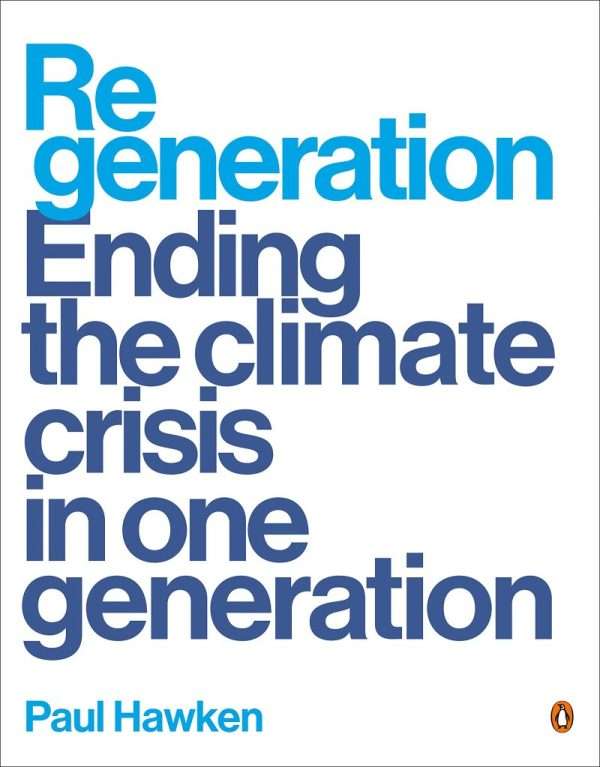
Paul Hawken, Regeneration, Ending the Climate Crisis in One Generation (Penguin Random House, 2021)
Reviewed by Zainab Iftikhar
Paul Hawken, a renowned environmentalist, entrepreneur, and author, has long been at the forefront of advocating for sustainable solutions to some of the world’s most pressing challenges. He is not only an influential thinker but also the founder of Project Drawdown, a comprehensive plan to reverse global warming. In his latest work, ‘Regeneration: Ending the Climate Crisis in One Generation,’ he offers an inspiring and persuasive vision for tackling the climate crisis. Drawing on his extensive expertise in environmentalism, he shares the concept of regeneration, positioning it as a key strategy in the global effort to combat climate change.
‘Regeneration’ unfolds as a comprehensive blueprint for mitigating the climate crisis, offering a nuanced perspective that extends beyond conventional narratives. Hawken begins by reframing the conversation around climate change, shifting the focus from despair to hope. Drawing on the term ‘regeneration,’ he proposes a radical yet practical approach that emphasises the potential for renewal within the natural world and human societies. This is examined in the book through a number of subjects, including cities, industry, food, land, forests, and oceans. Within each theme, particular remedies are then discussed in greater detail, accompanied by real-world examples to demonstrate that these are not just theoretical concepts rather workable solutions that are actually in use in certain settings. Each subject offers a series of essays that serve to inspire.
The fundamental role of forests in global warming and carbon sequestration cannot be overlooked. In the first section of the book, titled ‘Forests’, the author highlights their critical importance for life on Earth. Covering one-third of the planet, forests not only provide habitats for the vast majority of plant and animal species but also play a crucial role in purifying and regulating the air we breathe. Recent studies have even suggested that trees are sentient beings, capable of communication and collective defence. As more consumer product companies commit to community impact, regenerative agriculture, and tree planting, there is a growing need for these initiatives to adhere to recognised global standards. This trend is juxtaposed against the practices of some major global corporations that superficially engage in the climate movement by purchasing unused carbon credits. These companies project an image of responsibility while continuing their environmentally harmful activities. For instance, Monsanto persists in selling glyphosate, the most dangerous herbicide known, while buying carbon offset certificates to mitigate its environmental impact. The book also discusses Pepsi Co., highlighting it as an example of a corporation that promotes its support for renewable energy without fully grasping the broader implications of its actions. Despite using ‘eco-friendly’ vehicles for distribution, Pepsi Co. continues to spread sugar-laden beverages and salty snacks worldwide. Simultaneously, it lobbies against soft drink taxes and the regulation of extra-large soda servings, thus undermining its purported environmental commitment. This approach exemplifies the complex and often contradictory nature of corporate responses to climate change and underscores the need for a more holistic and authentic engagement with environmental issues.
The section on ‘Land’ includes essays on regenerative agriculture, animal integration, degraded land restoration, compost, vermiculture, rainmakers, and biochar. Hawken begins by outlining the detrimental impact of conventional agricultural practices, deforestation, and land degradation on the environment. These activities contribute significantly to greenhouse gas emissions and disrupt ecosystems, accelerating climate change. The section unfolds with a detailed exploration of regenerative agricultural practices as a key strategy for drawdown. Hawken sheds light on innovative farming methods that not only increase soil health and fertility but also enhance carbon sequestration. By highlighting the success stories of farmers and communities adopting regenerative practices, he paints a compelling picture of the potential for positive change within our existing agricultural systems. Throughout the section, he weaves together scientific insights, case studies, and practical solutions to illustrate the regenerative capacity of land. By fostering a deep connection between humanity and the environment, he contends that we can transform our relationship with land from one of exploitation to one of regeneration.
In ‘Action + Connection,’ the final chapter of the book, the author presents a comprehensive road map, outlining actionable steps for individuals, collectives, and institutions to engage in meaningful environmental activism. This chapter stands out not only for its clear guidance but also posing reflective questions to the reader and aspiring activist, prompting them to evaluate whether their chosen course of action aligns with the ultimate goal of regeneration. Questions like ‘Does the action create more life or reduce it?’ and ‘Does it serve human needs or manufacture human wants?’ are examples that encourage readers to critically assess the impact and intent of their environmental efforts. This approach fosters a deeper understanding of effective activism and underscores the significance of thoughtful, life-affirming actions in the pursuit of ecological regeneration.
‘Regeneration’ is a tour de force that not only elucidates the dire reality of the climate crisis but offers a roadmap for hope and action. Paul Hawken’s vision is rooted in pragmatism, demonstrating that solutions to the climate crisis are not only achievable but already underway. Through the idea of regeneration, Hawken changes the story’s perspective from one of approaching catastrophe to one of rebirth and change.
The book serves as a call to action, imploring readers to adopt a regenerative way of thinking on a personal, community, and national level. Through diligent research, captivating narrative, and a strong dedication to environmental stewardship, Hawken ushers readers into a future in which humanity plays an active role in the regeneration of the environment rather than just being a passive viewer of its fate. This work is a monument to the strength of group effort and the enormous impact that can be made when people tackle the climate issue with imagination, tenacity, and a sincere faith in the ability of nature and humankind to heal and grow collectively.



