Yet another Conference of the Parties (COP) to address the existential challenge to planet Earth and the human species in the form of climate change concluded in the United Arab Emirates (UAE) on 13 December 2023. It had to be extended by one day as the required consensus on phasing out of fossil fuels could not be achieved on the final declaration due to the intransigence of oil-producing countries. Eventually, the President of the conference facilitated the participants of the UN climate summit in reaching a final consensus, leading to what was termed as a ‘historic’ climate deal. Ironically however, he himself is head of the Abu Dhabi National Oil Company (ADNOC) whose appointment as COP28 President was strongly criticised by environmentalists.
Twenty-seven years have passed since first COP on climate change was held in 1995 in Berlin, Germany under the United Nations Framework of Convention on Climate Change (UNFCCC) to address the issues of climate change. In 1997, COP3 adopted the ‘Kyoto Protocol’ to establish legally binding obligations for developed countries to reduce their greenhouse gas emissions. In subsequent conferences, United Nations and environmental scientists continuously warned the world that being the biggest polluters, not enough is being done by rich and developed countries to mitigate climate change and its subsequent effects.
Poor and developing countries, despite contributing minimally to climate degradation, face the most severe adverse effects. Lacking sufficient financial resources, they struggle to implement essential measures and projects crucial for their survival amidst rapidly changing climatic conditions.
In an effort to provide much-needed funding, developed countries made financial commitments to the Green Climate Fund (GCF), established in 2010. The twelfth report of the GCF, covering the period from 1 August 2022 to 31 July 2023, reveals that the total pledges and contributions during the initial resource mobilisation period (2015-19) amounted to USD 10.31 billion. As of April 2023, for the GCF 1 phase focused on replenishing funds, pledges reached USD 9.87 billion. At the recently concluded COP28, within the first four days, wealthy nations pledged an additional USD 57 billion to the GCF. However, a UN report indicates that developing nations will require USD 5.8-5.9 trillion before 2030 to effectively mitigate the impacts of climate change.
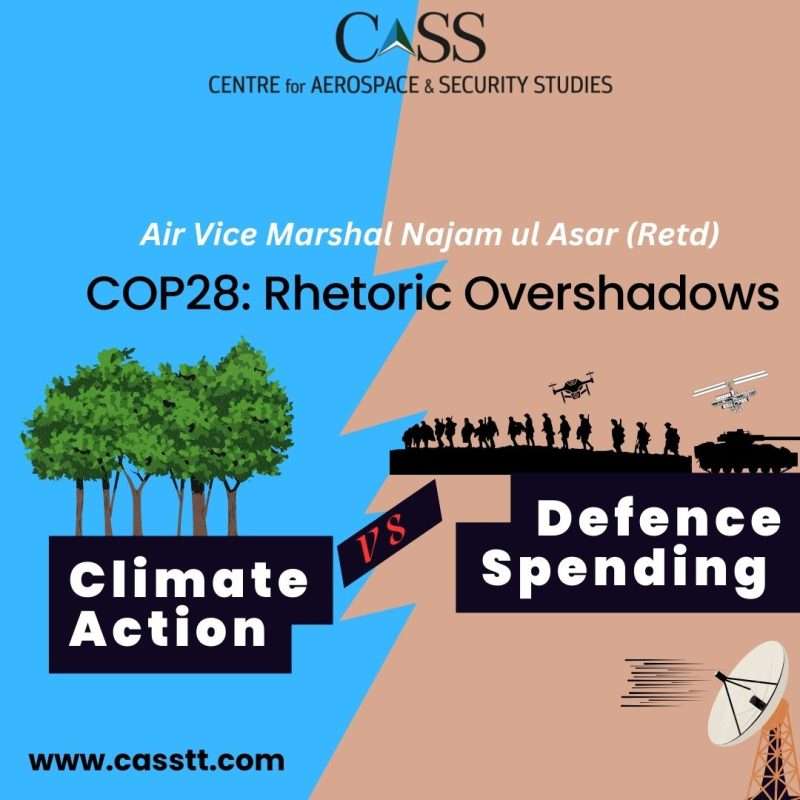
Despite being the worst polluters, developed countries are not contributing substantially to the GCF; instead, they allocate significant funds to defence expenditures. Regrettably, developing countries, despite their limited resources, are also investing heavily on defence. This global arms race consumes a colossal amount of funds annually, resources that could be more effectively used for environmental conservation. Current international tensions, such as the US-China confrontation and the war in Ukraine, have further escalated this trend, leading to a significant increase in global defence spending. When this defence expenditure is compared with the allocation of funds for climate change projects, a stark and troubling contrast emerges, highlighting a disparity in global priorities.
In 2022 USD 1.92 billion were disbursed for 28 low carbon emission and climate resilient development pathways projects around the world. In the same year (2022), Stockholm International Peace Research Institute (SIPRI) reports that a total of USD 2240 billion (USD 2.24 trillion) were spent on defence worldwide. The US, China and Russia together constituted 56% of global defence spending. Individually, USA spent USD 877 billion which is 39% of global spending and three times more than China which spent USD 292 billion on defence. The US also provided USD 19.9 billion as financial military aid to Ukraine which alone is almost double the amount pledged for GCF 1 on 31 July 2023 and even in initial resource mobilisation period (2015-19). In the same period, Central and Western Europe spent USD 345 billion; Russia USD 84.6 billion, India USD 81.4 billion, Saudi Arabia USD 75.0 billion and Ukraine USD 44 billion on defence.
In COP28’s much acclaimed ‘historic’ deal, phase-down of fossil fuels has been included albeit in a watered down language. But again, it’s more of a rhetoric to pacify the environmentalists and portray it as the historic achievement of the conference. The sincerity of the purpose can be gauged from the fact that COP28 was attended by 2400 delegates who were associated with fossil fuel industries. This figure is seven times larger than the Indigenous People delegation and four times more than last year’s 636 delegates – lobbyists from fossil fuel industry. Similarly, global oil and gas exploration will see an investment of USD 22 billion annually over the next five years. To maintain a temperature rise of 1.50 Celsius, the world needs to reduce the CO2 emissions by 43% of existing figures, however, it is likely to increase by 9% – needing no imagination of its consequences.
In conclusion, a straightforward comparison between the massive expenditures on defence and fossil fuel exploration versus the funds pledged for climate change mitigation starkly highlights the priorities of developed countries. These nations, primarily responsible for the current environmental crisis, demonstrate a concerning lack of seriousness in addressing the very disaster they have largely contributed to. It is not difficult to fathom where the world is heading with no fault of poor nations who, like always, continue to bear the brunt of the selfishness of rich and powerful countries as well as corporations. God save planet Earth.
Air Vice Marshal Najam ul Asar (Retd) is Director at the Centre for Aerospace & Security Studies (CASS), Islamabad, Pakistan. He can be reached at: [email protected].
Design Credit: Mysha Dua Salman