Resistance has many forms. At its core, it reflects how inaction towards injustice is synonymous to complicity. In this regard, the Armed Conflict Location & Events Data project has recently analysed the Israel-Palestine conflict, offering insightful data. According to their report, mass mobilisations have been observed, with approximately 7,283 pro-Palestine protests, from 7th October to 24th November, in 118 countries and territories. While widespread opposition to Israeli genocide has been manifested in the form of these protests, many have simultaneously opted to express their condemnation using their purchasing power. For example, a trend was previously observed in the form of boycotts of products hailing from Denmark, Netherland and Sweden in response to disrespectful content against Prophet Muhammad (PBUH) and desecration of the Holy Quran, respectively. The boycott, as a tool of protest, has resurfaced again, targeting products and services perceived in any capacity to support Israel or trivialise the plight of Palestinians. In fact, this has been a key facet of the ‘Boycott, Divestment and Sanctions (BDS)’ movement. This movement was established by Palestinian civil society members in 2005. However, it has garnered renewed attention following the onset of Israeli genocide in Gaza since October this year.
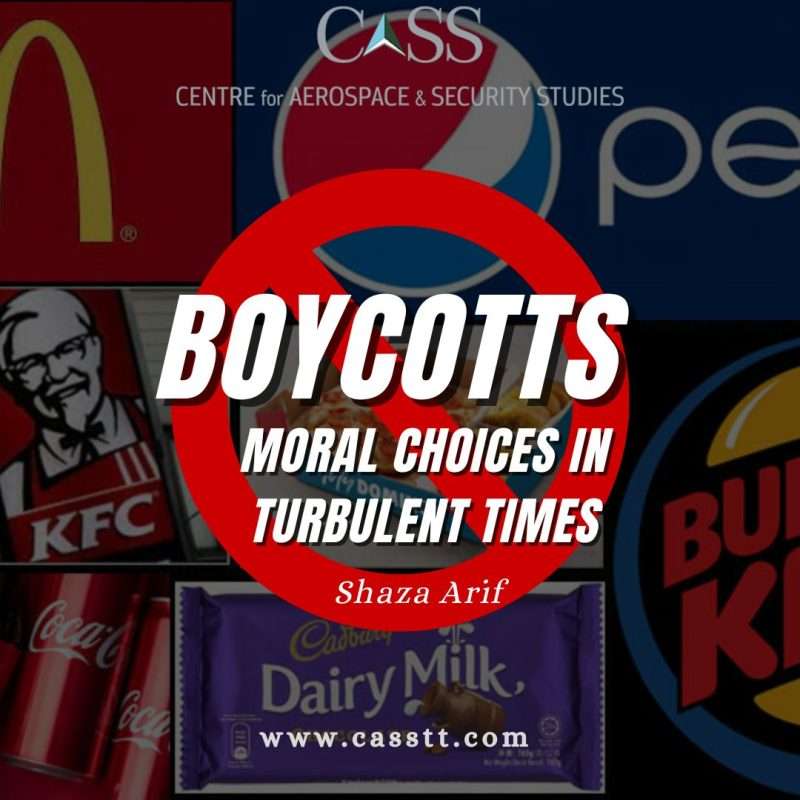
Strong social media activism has fuelled the boycott of major brands like McDonald’s, Starbucks, and KFC across various countries. This widespread backlash led to local franchises in Egypt, UAE, Pakistan, and Oman issuing official statements to dissociate themselves from the ensuing controversy.
The internationally recognised fashion brand Zara faced criticism for launching a clothing campaign that many perceived as insensitive. The campaign, featuring images of rubble and figures resembling casualties, drew unsettling parallels to the scenes of destruction in Gaza. This sparked widespread condemnation on Zara’s social media channels and led to protests at its retail locations, culminating in calls for a boycott. Consequently, Zara was compelled to withdraw the entire campaign from its digital platforms and provide an official statement addressing the controversy. Likewise, British retailer Marks and Spencer had to issue an apology, after it drew criticism due to its Christmas post which featured burning paper hats which evoked colours of the Palestinian flag. Most recently, Kim Kardashian became the centre of a new controversy when she shared her recent gift-wrapping ideas on Christmas. The reality TV star faced scrutiny about her choice of wrapping style which many noted bore a striking resemblance to the traditional covering used in Muslim funeral customs.
It has been more than two months since the Israeli aggression and subsequent calls for boycott. A survey conducted across 12 major Pakistani cities found that 80% of respondents supported boycotting multinational and Western brands, while 70% reported already engaging in such boycotts. According to the head of the Trade Development Authority of Pakistan (TDAP), local businesses have seen a significant uptick in activity during this period. This trend, however, is not unique to Pakistan; similar patterns have been observed in Malaysia, Jordan, Egypt, and Kuwait.
While the economic impacts of these boycotts are often a subject of debate, it is equally important to consider their effects beyond mere financial metrics. Firstly, the boycott movement holds considerable potential to challenge dominant narratives regarding the conflict. Expanding boycott movements signal a rising public awareness of the complexities of the conflict, alongside a growing trend of conscious consumerism. These boycotts exemplify the ethical considerations influencing consumer choices. By choosing to boycott Israeli and Western products, a powerful and resounding message is being conveyed to the governments and international organisations regarding the outright disapproval of such atrocities. Explanations coming from leading brands underscore the formidable power of public sentiment.
These boycotts also underscore the significance of Corporate Social Responsibility (CSR). Global brands like McDonald’s, Zara, Starbucks, Marks and Spencer, and others, due to their international reach, are subject to heightened scrutiny for their perceived political stances, especially in times of crisis. Consequently, their policies and marketing strategies need to be attuned to these sensitivities. From an economic angle, such boycotts not only catalyze the promotion and adoption of local brands, a positive shift that should be actively encouraged, but also bolster local economies and nurture a culture of self-reliance. Additionally, these developments underscore the role of modern-day activism, particularly through social media platforms, in maintaining the momentum of such movements and ensuring they remain visible in the public discourse over time. It is also important to note that in light of recent protests, the BDS movement has gained renewed attention and may attract new supporters, increasing its impact. Moreover, emergence of Apps such as ‘No Thanks’, designed to increase customer awareness’ is likely to amplify the boycott’s reach and impact in the digital age.
In the ever-dynamic global marketplace, trends usually influence consumer practices. The ongoing wave of boycotts has marked a new trend. It emphasises how resistance permeates beyond the battlefield into citizen choices. Such ‘consumer-driven embargoes’ stem from a deep emotional response to the oppression faced by Palestinians. It transcends mere alterations in spending habits, embodying a moral alignment of consumer choices that serve as a powerful form of protest against Israel’s ongoing atrocities and injustices.
Shaza Arif is a Research Assistant at the Centre for Aerospace & Security Studies (CASS), Islamabad. She can be reached at: [email protected].
Design Credit: Mysha Dua Salman