With the global world adapting rapidly to digitalisation, the education sector is also transforming by inculcating various digital practices for making knowledge accessible and consequently bridging the educational access divide between different socioeconomic groups. Governments around the world have created favourable policy environments to facilitate such transformations. Pakistan, in this regard, has been declared as a country with the least favourable policy environment when compared to other states by the Asian Development Bank’s 2023 ‘Digital Education Readiness Framework Report’. This evaluation is a cause of concern given that such a situation will not only widen the gaps in existing inequalities but also lead to the loss of massive learning opportunities required to create skilled labour in a technology-driven world.
The ADB report is based on various indicators which need improvement in Pakistan to create a viable environment for digital education. Among these indicators, five major macro-level indicators are the most significant – physical and digital infrastructure; readiness of schools and teachers; readiness of students and parents; national-level policy and/or governance; and the presence of digital education service providers.
Pakistan has 36% internet penetration rate, which indicates that about two third of the population does not have access to the internet. As per the ADB report, internet quality in Pakistan is below-par as compared to the report’s model country Uzbekistan with 70.4% internet penetration rate. The average internet speed in Pakistan is 10.28 Mbps, whereas in Uzbekistan, the average speed is 36.23Mbps, which implies that domestic internet connectivity is not fast and stable for online pedagogy. The ICT infrastructure, such as educational institutes’ WiFi access, Learning Management System (LMS) platforms, IT-trained teachers, and fully functional computer labs remains insufficient given the expense involved. Television is the only most widely accessible medium in Pakistan, with a 62.8% household coverage rate which is still low when compared to regional countries, for instance Uzbekistan has 100% household television access.
Such infrastructure gaps largely persist due to lapses in the policy environment for digital education. For instance, the framework at the national level for funding, curriculum and performance management in the digital space, teacher training, and access to ICTs determines the readiness for digital education. While Pakistan’s National Education Policy 2017–2025 does focus on the provision of access to ICT in schools, it does not explicitly address how such devices will be accessed. Also, there is an absence of a digitalised curriculum and digital training of teachers pre-service and in-service in Pakistan.
In this regard, Pakistan has taken a conducive step called ‘TeleSchool’. This platform broadcasts material on various subjects aligned with the provincial curricula. This initiative has been a success so far in digital learning as 7-8 million children were introduced to TeleSchools in its introductory phase in 2020 according to Gallup. Around 47% rural respondents were found in the survey to be satisfied with the transmission as compared to 46% urban respondents.
The need for placing required infrastructure and implementation of a good policy directed towards achieving digital learning at a broader scale needs to go hand in hand with teacher trainings in educational institutions. Teachers’ capacity in EdTech; their training in digital learning; proportion of teachers with access to devices and the internet; and government IT support determine the level of digital teaching readiness within a country. In Pakistan, the focus on teacher training in ICT skills remains low, and teachers predominantly rely on social media like WhatsApp to interact with students. Digital education content creation also remains basic in the form of documents and presentations. Internet quality is also not suitable for downloading heavier files except for teachers working in higher education. Schools continue to remain paper-dependent for data collection and analysis of pedagogical content and the absence of concrete IT support further acts as a push for this system.
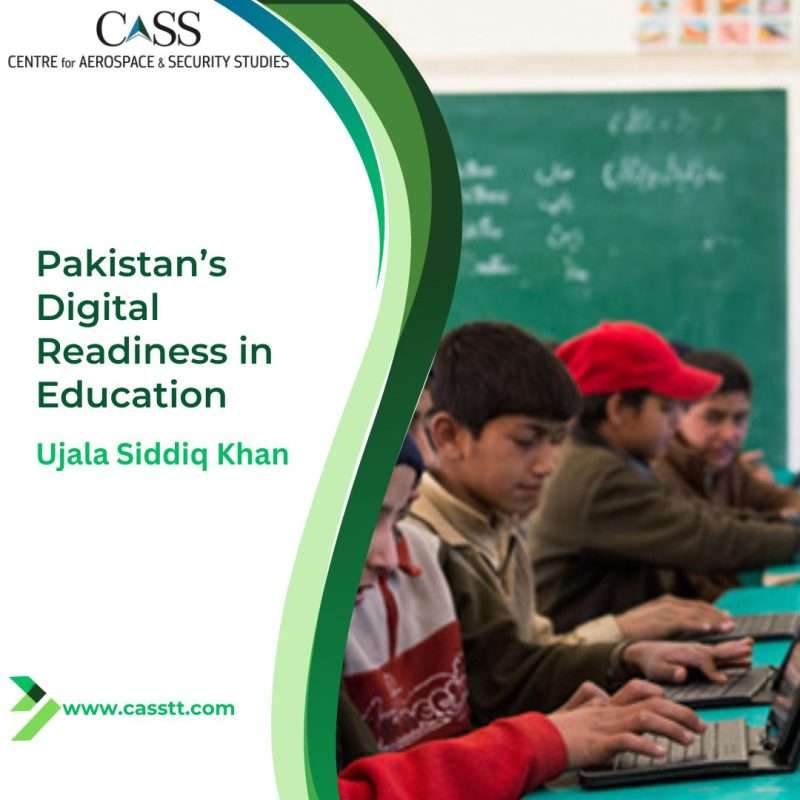
Likewise, the digital capability of students and their access to connectivity, devices, and curriculum content measures digital readiness at their level. According to the ADB, while a majority of students are proficient in digital skills from basic to advanced ones, including the efficient use of LMS systems; the problem lies in accessibility of devices. Only 43% students have access to computers or laptops at home. In Pakistan, students are mostly self-taught in digital tools, which demonstrates their interest in education technology necessary for digital learning. Hence, government initiatives towards making digital education accessible will always be welcomed by the masses.
In doing so, the government can also rely on educational technology solutions such as testing platforms, teacher platforms, and digital hubs (Google Classroom, Edubuntu, and Edmodo) hosting content such as those developed by private EdTech companies. For instance, in Indonesia, Uzbekistan, and Philippines, the education sector has partnered with these EdTech platforms and have managed to obtain high ranking in the digital readiness scale in the region. Pakistan can also create a medium to high-tech learning environment through Public-Private Partnerships (PPPs) by providing private companies with incentives to design such solutions. However, to create a viable domestic environment for digital learning, the approach should be holistic. An approach that will not only address the student-teacher access to devices, but also focus on digital education delivery training modules within the pedagogy.
Ujala Siddiq Khan is a Research Assistant at the Centre for Aerospace & Security Studies (CASS), Islamabad, Pakistan. She can be reached at: [email protected]
Design Credit: Mysha Dua Salman