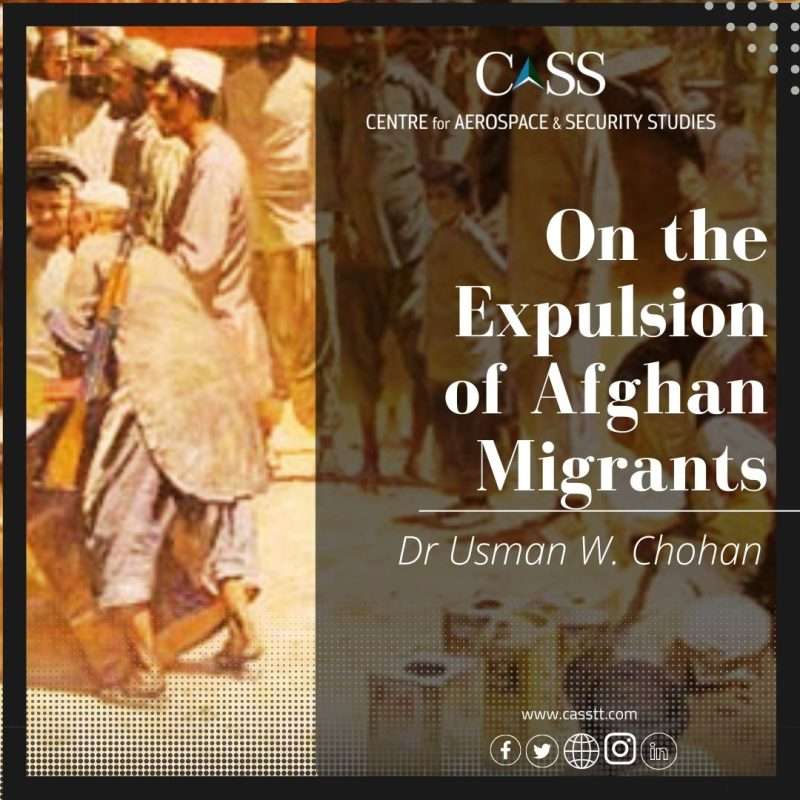
There was a time when Peshawar, City of Flowers, really was a beautiful floral abode. The same is true for Karachi, the City of Lights, which was once a great beacon of the East. Today, both cities are characterized by ghettoism, crime, a drug problem, and squalor. There are many factors underpinning that advanced degradation, but one thing that local residents point to without equivocation is the “Afghan problem,” by which they are referring to the vast presence of unregistered Afghani refugees in their cities, “strutting about like they own the joint,” I am told.[1] If one confronts these Afghanis, they will indeed act as if they own the joint, so brazenly do they in fact act that one feels one is the outsider stepping on their land, some locals have commented.
Such contemptible behavior by the Afghans foments a deep-seated resentment among Pakistanis, who have opened their hearts in a brotherly and selfless manner to Afghans for forty years. What do they get in return? Not even the gratitude. This is why the vast majority of Pakistanis feel that sending these people back to their homes is a necessary action. Things are hard enough for the locals, and seeing the Afghans run amok while the Pakistanis bear the brunt of economic hardship is a sure sign of the desire for their expulsion. In addition, Pakistanis are well aware that their economic migrants abroad are being mistreated at best, and drowned at sea at worst. They have the worst of both worlds, seeing their people suffering while also seeing others come and benefit from their local generosity.
This is why the government’s recent order of a deadline for illegal aliens to leave had been met with positive reception. If illegals stay on afterwards, there will be tough actions against them. This is causing considerable disruption among the migrant communities, but it is a policy decision that enjoys broad popular agreement, and is completely in-line with international practice, as the interim Foreign Minister has stated. There is no country today that lets foreigners reside illegally, and so Pakistan would simply be conforming to international norms, while also improving its security and economic conditions in a meaningful way.
Indeed, there are at least nine different problems that are resolved through the policy of expulsion. First, there is the drug problem, which was a product of the original Afghan exodus, and has left large swathes of addicts lying by the wayside of major cities even today. Second, there is the crime problem, as various estimates of criminality in cities such as Peshawar attributes at least half of the problem to the migrants. Third, there is the environment problem, in the sense of environmental degradation through urban and semi-urban sprawl, as well as through unregulated commercial activities. Fourth, there is the terrorism problem, which has been foremost on the government’s mind. Fifth, there is the housing problem, both in terms of rental and purchase, where migrants have driven up prices for locals and crowded out the already short supply. Sixth, there is the currency problem, stemming from unchecked and unaccounted flows, as well as hoarding and smuggling issues. This problem in particular has been meaningfully and boldly addressed by the government, much to their credit. The seventh problem is the jobs problem, where migrant labor has undercut local wages and taken daily-wager gigs away from the locals, affecting their livelihoods. The eighth problem is that of low-quality goods, which when brought in through smuggling, put consumers at risk with substandard quality. The ninth problem is that of diseases, as the Afghan migrants are a vector for various dangerous pathogens such as leishmaniasis and polio, with the latter having been eradicated elsewhere which still continues to persist in the wild strain along the border as a rare case in the world.
If one can solve nine different problems with one policy decision, it should certainly be pursued, the Pakistanis reckon. Rightly so, because the relationship between Pakistan and Afghanistan has been of an asymmetric, parasitic nature, with the Afghans living off Pakistan’s kindness (and for a time, America’s kindness too) as a modus vivendi. The visceral hatred that many, but by no means all, Afghans bear towards Pakistan is sometimes astounding. It has its roots in pre-1947 tensions, where the Afghan king and his henchmen knew that the emergence of a new and large country with access to the sea would leave Afghanistan permanently dependent on it. After all, the only two major economic activities of the Afghans for the past millennium were (1) the production of narcotics, and more significantly (2) the consistent pillaging of the Hindustan in near-constant waves of banditry.
At the time of Pakistan’s independence, Afghanistan was the only country to vote against Pakistan in its accession to the United Nations, which is hostile gesture to say the least, and one that Pakistanis have forgiven but not forgotten. Many Afghans have never recognized the sanctity of the border, the Durand Line, and therefore never shown due respect for another country’s sovereignty. These are not trifling matters, and Pakistanis ask, is this what Pakistanis get in exchange for their kindness? The acrimony and venom are compounded by persistent gestures of mean-spiritedness at the social level. Perhaps the most incendiary and grotesque of these is that, following a cricket match between India and Pakistan, in the event that Pakistan loses the match, there are fireworks of jubilation from Afghan-migrant majority neighborhoods. How would a Pakistani family feel if, watching a cricket magic ending tragically, one hears unwelcome foreigners parading in the streets to add insult to the injury.
This Afghan meanness swells to even greater proportions when they get lucky and snatch an asylum in a Western country. In that case, they get on forums thanking the West and bad-mouthing Pakistan, as if they would have gotten to the West without the mercy of Pakistan. Those Afghans ingrates show a degree of vicious ungratefulness that is difficult to stomach, and this character trait indeed explains why Afghanistan is in the condition that it now is.The greatest victims of all this Afghan viciousness are the Pathans (the Pashto-speaking Pakistanis), who have suffered the most along all of the nine problems enumerated above. In my consistent interviews with Pathans to understand their experience over the past 40 years, the pain of Afghan thanklessness and selfishness is absolutely clear. For too long the Pathans have suffered quietly, and the greatest beneficiaries of the new policy of expulsion will be the Pathans, getting back more of what has always been theirs.
It is worth noting, however, that the despicable attitudes of the Afghans that one has witnessed over the past 15 years did not always exist. After the Soviet invasion in 1979, the Afghans were allowed to move to special camps such as Nasser Bagh in Peshawar. They were kept there and the local Peshawaries extended an extraordinary amount of generosity towards Afghan “brethren,” and degree of kindness shown by the Pakistanis was of a magnitude rarely witnessed in modern history (the recent Polish assistance to Ukrainians being a rare comparator). At that time, the Afghans could generally be described as meek and docile. When the camps such as Nasser Bagh were demolished, the refugees had to disperse into mainstream society, and they had to start at the bottom. The Afghans at this time would say to local hosts that they would do anything and everything to serve, which was matched by gracious assistance of Pakistanis.
Gradually, however, the mindset began to change among those who had started to earn. They began with small wages, moved to impermanent housing, and then on to permanent housing. They built small business that were lucrative and reinforced by a mafia-like in-group cooperation, as well as by sustained largesse of the local community. They worked hard, even their staunchest critics will concede. By the time of the mid-2000s, they also developed an arrogance and contempt towards the locals, or more precisely, they let their true feelings surface to the fore, shedding their meek exteriors to reveal their seething sentiments within. They were also buoyed at this time by the dollar inflows coming into Afghanistan after the US invasion. Yet despite that enormous flow of foreign funds, the Afghans could not develop an economy of their own, and some that ventured back to Afghanistan after having spent years ended up returning to Pakistan where there was a natural, sustainable economy. Their arrogance would not dissipate, and they began to spread tentacles of interest well beyond Peshawar and Karachi, but as deep as Interior Sindh and South Punjab. The Afghans maintained a two-faced approach during the two decades of US occupation, blaming Pakistan incessantly for Afghanistan’s own failures, while also profiting off of Pakistan in the meantime.
The Americans had come with a vision of building democracy in the most godforsaken country on earth. They expended not billions but trillions of dollars to attain the impossible. But their endeavor was precisely that: impossible. As subsequent hearings, testimonies, records, and books demonstrate, the magnitude of culture shock for US personnel living in Afghanistan was greater than anything they could imagines, greater than that of Montezuma seeing see Spaniards. The sad thing is, despite the laudable rhetoric of the Americans, they were not fully sincere, by their own postwar admissions, and nor were the Afghans.
During this time, the Afghans maintained a frenetic arbitrage effort, taking from America what they could, and taking from Pakistan what they could too, without giving back to either, by simply building their own country. The dejected Americans left in 2021 in a humiliating manner for President Biden, in a flurry of disturbing visual imagery that will haunt Biden and the Democrats in the 2024 election. Many Afghans who sided with the West were abandoned in a warzone. After the Fall of Kabul there was a period of grave tumult in which even greater numbers of Afghans were flooding into Pakistan. But due to the timely measures taken by the Pakistani government at the time, the country was able to prevent the full floodgates from opening. Since 2021, Afghanistan has been in a sort of limbo. Its government is not recognized by anyone, and its dependency on Pakistan has only grown. Yet Pakistan itself has been victim to post-Covid global economic turbulence, and along with political upheaval domestically, its people are themselves seeking to flee. Up to 1.4 million people have left Pakistan since April 2022, with many young people attempting to find some opportunity abroad. The poverty rate is growing, the economy is fundamentally imbalanced, and the population continues to grow incessantly.
As such, there is little patience left in Pakistan for extending its long-drawn hospitality towards Afghan migrants. In various global rankings conducted over the years, Pakistanis have been surveyed as amongst the most charitable and welcoming in the world. Anecdotally, one knows this to be true, and it is particularly impressive because this kindness and rectitude does not derive from some form of derided “wokeness” but from ordinary people’s old-school value systems. Yet even these warm-hearted people of Pakistan have had enough, they say, and they generally laud the government’s initiative. There are a couple of caveats to bear in mind, however, as the process of expelling migrants goes into full force. First, there are legitimate residence with legal status, and that should be differentiated (at least initially) from illegal aliens. Second, and more importantly, there is a generation of people born in Pakistan who are of Afghani migrant descent. They speak Urdu and they speak a Pashto indistinguishable from that of Peshawaris, and they identify as Pakistanis, while being citizens according to jus solis law. These are not, of course, the targets of the current initiative, nor should they be.
Nevertheless, as part of a series of measures to bring normalcy to Pakistan economically and socially, the migrant-expulsion initiative is being undertaken with sobriety and the utmost priority. Given the list of problems enumerated earlier, such a policy is a long time coming. For all the hospitality that has been extended as a consequence of Afghanistan’s tussles with global superpowers, Pakistan has to concentrate on its own people. The question of how to deal with migrants is a universal issue, infused into the political discourse of countries as diverse as the UK, Japan, the US, Canada, South Africa, Malaysia, Germany, Hungary, Italy, Mexico, Spain, Singapore, Sweden, Finland, Denmark, Turkey, Jordan, Egypt, Iran, Australia, Saudi Arabia, New Zealand, the UAE, Israel, Poland, Kenya, and still more. Pakistan is grappling with the same issue, and in ways that might redirect its energies towards addressing problems that afflict its people.
Dr. Usman W. Chohan is Advisor (Economic Affairs and National Development) at the Centre for Aerospace & Security Studies, Islamabad, Pakistan. He can be reached at [email protected]
[1] I conducted 5 interviews with lifelong residents of Peshawar to glean their views on this subject