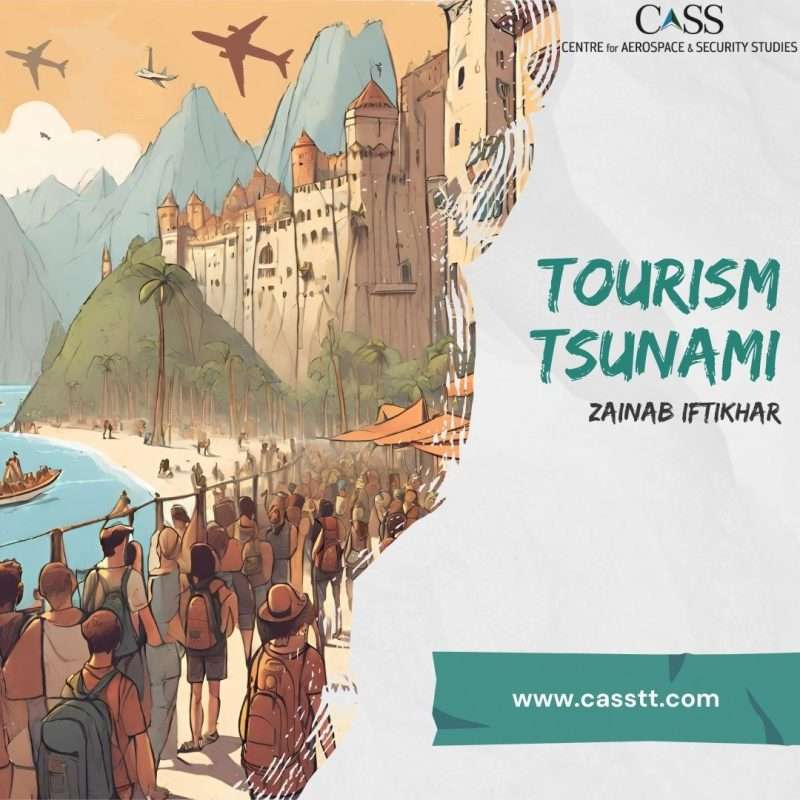
In a world more connected than ever, the allure of travel has become irresistible, transforming once-hidden gems into bustling tourist magnets. However, as the global tourism industry expands at an unprecedented rate, the shadow of ‘overtourism’ looms large over the most cherished destinations. Tourism involves the movement of people to places outside their usual environment for leisure, business, or other purposes. It can be domestic (within the traveler’s own country) or international (outside the traveler’s country). ‘Overtourism’, on the other hand, is a situation where there are too many visitors to a particular destination, resulting in negative impacts on the environment, infrastructure, historical sites, local residents, and even the visitors’ experience. Hence, it’s important to explore and dissect the multifaceted consequences of overtourism on destinations, residents, cultures, and ecosystems and come up with sustainable tourism practices.
Tourism undeniably injects vitality into local economies, creating jobs, boosting businesses, and contributing to the overall prosperity of specific areas and countries. Yet, the question is: at what cost? The economic boon often comes hand in hand with economic inequality. Tourism Economics research shows that ‘developing nations encourage international travel to spur rapid economic growth, even though a substantial portion of tourism employment is still low-paid seasonal labour. The same holds true for developed nations as well because big businesses in the service sector typically have better benefits than their employees.’ For example, Cox’s Bazar in Bangladesh because of overtourism is faced with economic disparities as tourism benefits only a few companies and individuals, while many locals remain impoverished, hence, broadening the gap between the classes.
One of the most conspicuous consequences of overtourism is the environmental toll it takes on destinations. Popular tourist spots frequently suffer from overcrowding, leading to degradation of natural landscapes, pollution, and stress on local ecosystems. For instance, the Shandur Polo Festival in Gilgit-Baltistan, a much loved and celebrated sports event celebrated annually has started to leave an alarming mark on GB’s ecosystem. ‘Your three days of happiness at the Shandur Polo Festival cause us to endure 362 days of horrible suffering due to illnesses, livestock mortality, toxic air, polluted streams, and piles of waste everywhere’ lamented Jamati Khan after the 2023 Polo festival.
In the face of global climate change, around ‘8% of the carbon emissions produced worldwide are attributable to tourism in the shape of boat voyages, souvenirs, air flights, and lodging’ according to the Sustainable Travel Organisation.
As tourists flock to experience the authenticity of different cultures, the very essence they seek can become diluted. While adapting to cater to mass tourism, destinations may inadvertently compromise their unique cultural identities. Indigenous customs and local traditions risk being eclipsed by a homogenized, tourist-centric culture. A Pakistan Institute of Development Economies (PIDE) research shows that in Gilgit-Baltistan, tourism has a considerable social and cultural impact. The surge in tourist numbers is altering the authentic character and practices of the location causing subtle transformations in the local community’s clothing, dietary habits, and daily routines due to cultural integration.
The World Tourism Organisation has estimated that ‘the number of international tourists will exceed two billion by the end of this decade.’ As iconic destinations attract millions, the challenge of overtourism extends beyond geographical limits, affecting places globally. In response, regions like Europe have begun implementing ‘anti-tourism strategies’ to deter mass tourism. Venice has implemented a charge for entry ranging from €3 to €10 to visit the city and its islands since it is so overrun by tourists. To manage overcrowding, Greece has put in place a time-slot system for Acropolis tourists.
Governments play a crucial role in overseeing travel destinations. As such, they should advocate for and enforce sustainable tourism practices that emphasise environmental conservation, responsible visitor behaviour, and the welfare of local communities. These practices entail eco-friendly lodging, less consumption of environmental resources, and the use of public transport. Off-peak travel should be promoted by developing campaigns and incentives to encourage tourists to explore destinations during non-peak seasons. This can help distribute tourist flows more evenly throughout the year, reducing the strain on infrastructure and minimising the impact of overtourism during peak periods. Technology and data analytics should be utilised to monitor and manage tourist flows. The implementation of smart destination management systems can provide real-time information on visitor numbers, allowing for proactive measures to control crowds and mitigate potential issues. For instance, ‘the Feel Florence app in Italy recognises the stream of tourists in real-time and proposes routes to the user in line with that information. Its ‘Skip the Line’ feature, meanwhile, steers travellers to destinations that are less congested.’
In essence, while tourism in itself can be beneficial and sustainable if managed properly, overtourism represents an excessive and often damaging influx of visitors that exceeds the carrying capacity of a destination. The challenge for many popular tourist spots is to find a balance that allows for tourism growth while minimising the negative impacts of overtourism. The latter necessitates reimagining the ways of collective wanderlust, urging a shift from quantity to quality, from unchecked growth to sustainable exploration. Navigating the consequences of overtourism requires a shared commitment from policymakers and businesses to travellers themselves to forge a path where the wonders of the world can be enjoyed without compromising the very essence that makes them extraordinary.
Zainab Iftikhar is a Research Assistant at the Centre for Aerospace and Security Studies (CASS), Islamabad, Pakistan. She can be reached at [email protected]
Design Credit: Mysha Dua Slaman