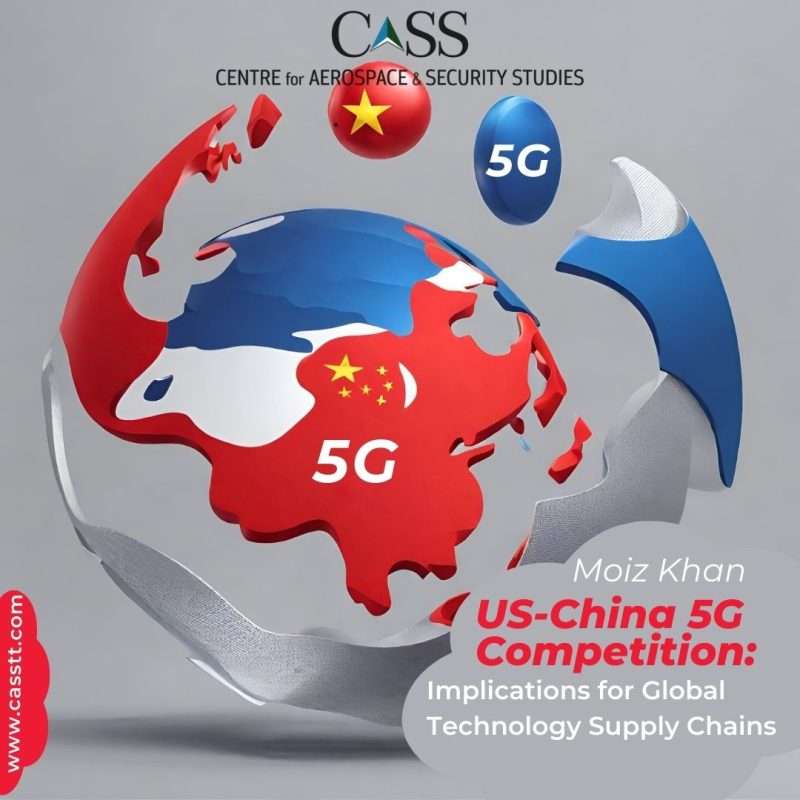
The Fifth Generation (5G) cellular network is the latest telecommunication system with significant implications for various sectors. Compared to its previous generations of 4G, 3G and 2G, 5G offers higher radio frequencies and speed that enables swift data transmission. It has low latency, which implies that it can connect a large number of devices. It can, therefore, serve as a fundamental component for emerging technologies like autonomous vehicles, Internet-of-Things, and Cloud computing. This technology will significantly affect individual and corporate life by improving productivity in industries such as manufacturing, logistics, retail, entertainment, and security.
With these applications, 5G is becoming increasingly significant for the global economy, impacting trade relations, technology innovation and geopolitics. This can be seen in the competition between the United States (US) and China. The US sees China as a major geopolitical challenge, particularly in the realm of emerging technologies.
Since global mobile subscriptions for 5G reached approximately two billion in 2022, China has been leading in terms of total 5G connections. China had 480 million 5G connections by the end of 2021. It made significant progress in expanding its 5G base stations, reaching nearly 2.31 million by the end of 2022, and aims to surpass six million by 2024, further enhancing its extensive coverage capabilities. As of 2022, Huawei, a Chinese company that dominates the market, currently holds a global market share of around 22.8%. It is expected to experience an annual growth rate of about 38.5%. In comparison, the US operated only 119 million 5G connections by 2022, with a mere 100,000 5G base stations in place by the end of 2021. Projections indicate that the number of 5G connections in the US is expected to reach 181 million by 2023, and the 5G market is poised for an annual expansion of 17% within the global 5G market.
These numbers indicate a lag in the US compared to China. This can be attributed to China’s more comprehensive and centralised policy, while the US has a fragmented and seemingly inefficient approach. Chinese lead has led to unease in the US and Western countries. In 2020, the US launched ‘Clean Network Programme’ and encouraged NATO and its Asia-Pacific allies to limit and ban Chinese 5G services and related systems. In 2022, the US imposed sanctions on import of Chinese companies including Huawei and ZTE, citing risk to national security. It also has trust issues with other Chinese firms and suspects that they will infiltrate their devices and conduct surveillance and steal sensitive data, given their close ties with the Chinese government. Several EU countries have also banned Huawei and ZTE from the EU’s 5G networks.
However, one may argue that such measures are driven by economic and strategic interests rather than legitimate security reasons. While the Chinese government and Huawei have denied espionage allegations, the US has also not provided clear and compelling evidence of Huawei’s or other Chinese companies’ involvement in spying or sabotage activities. Furthermore, there is insufficient demonstration regarding how 5G equipment or networks pose an immediate and distinct threat to national security for the US. On the other hand, the US’ National Security Agency (NSA) has been paying American telecom companies to gain access to their communications networks for surveillance and extraction of data.
This geopolitical tussle between the US and China has led to a polarisation of emerging technologies, resulting in significant consequences. Restrictive policies have had detrimental effects on global commerce and innovation by fragmenting technology supply chains, limiting data flow, and impeding collaboration. Enforcing national barriers and non-interoperable standards is undermining the economic benefits of emerging technologies and will dissuade companies from engaging in cross-border Research and Development (R&D) collaborations. In essence, these constraints would force firms into exclusive partnerships for 5G system and infrastructure development, hindering their ability to switch partners and cultivate healthy competition.
To fully unlock the potential benefits of 5G technology, nations must look beyond their individual interests and foster an environment conducive to fair competition. Without creating a level playing field, countries risk stifling the innovative potential of emerging technologies. One promising avenue to address these challenges is the adoption of Open Radio Access Network (Open RAN) standards. Open RAN enables global firms and markets to utilise diverse systems, components, and infrastructure from a wide array of providers, reducing reliance on specialised network equipment firms. Policymakers worldwide should prioritise the establishment of global standards and regulatory frameworks that promote a harmonised technological ecosystem. This approach will not only preserve healthy technological competition but also facilitate the realisation of the benefits of integrated global emerging technologies.
Moiz Khan is a Research Assistant at the Centre for Aerospace & Security Studies (CASS), Islamabad, Pakistan. He can be reached at [email protected]
Design Credit: Mysha Dua Salman