All eyes are once again on Afghanistan as the future of the country remains uncertain after the US withdrawal. It appears that instability will prevail in the country since the situation has become extremely complicated due to the involvement of several regional, international as well as state and non-state actors. The question remains: Who will be blamed for the chaos that is likely to follow?
The traditional blame game has already started. Addressing the international regional connectivity conference hosted by Uzbekistan, President Ashraf Ghani stated that the Pakistani government has failed to influence the Taliban to “negotiate seriously” in order to end the Afghan war. According to him, Pakistan needs to use its “influence and leverage” to convince the Taliban to cease hostilities in Afghanistan.
These comments are surprising since it is Pakistan which has been the primary external victim of this war and has suffered extensively. The spillover effect of the conflict has adversely impacted Pakistan economically, politically and militarily. Having lost nearly 70,000 lives and millions of dollars, it is shocking that it is being discredited by its neighbor and blamed for the mess created by others, in Afghanistan.
For many years, Prime Minister Imran Khan advocated for a non-military solution to end this long war. History is now witness to how important it was to reach a political settlement back in the day. Negotiating a peace agreement when there was a sizeable presence of US troops and weaponry in Afghanistan was the most suitable window to end the conflict with minimum compromises and limited turmoil. Pakistan’s Prime Minister is not wrong when he asks “Why would they [Taliban] listen to us when they are sensing victory?” This statement accurately sums up the current status of the conflict in Afghanistan.
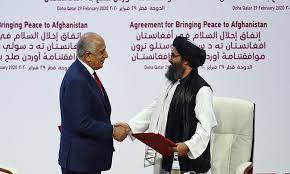
Today, the Taliban see themselves as the sole stakeholders of Afghanistan. They speak from a position of relative strength and appear to have learned lessons from the past. The extensive fighting over the past two decades has trained them significantly. They are now better organized and have emerged as a self-sustaining, independent entity. They have their own office in Doha. They have been negotiating the peace agreement directly with the Americans. Their calculated statements are indicative of their political and diplomatic prowess. While Pakistan has facilitated the peace talks and made tireless efforts to bring the Taliban to the negotiation table, the agreement in February 2020 was signed directly between the Taliban and Washington which speaks volumes about their position and influence.
The Taliban have their own military strategy and foreign policy. Hence, they do not rely on any other country for decision-making. Giving an interview to a Pakistani news channel earlier this month, Suhail Shaheen, the spokesperson for the Tehreek-e-Taliban Afghanistan stated that “Pakistan is welcome to help the Taliban arrive at a negotiated settlement in Afghanistan but it cannot dictate to us or impose its views on us.” Their actions are aligned with such statements.
Over the past few weeks, the local Afghan defense forces have been seen forfeiting in front of the Taliban without even putting up a fight in many areas. Since May, several Afghan troops have fled to Tajikistan in the wake of the series of offenses launched by the Taliban. On 26 July, 46 Afghan soldiers, including 5 officers crossed into Pakistan after fleeing the Taliban offenses. They were later repatriated back to their country.
Taliban groups have taken control of a number of major districts, key border crossings and important trade routes/roads. They also have access to extensive weaponry to achieve their various objectives. Apparently, the armaments, which were to be used against the Taliban are ending up in their own hands having captured weaponry from the Afghan security forces. This also includes around 700 trucks and Humvees which they have been blatantly showing off.
Such victories have made them more reluctant to sit and negotiate with the Ghani government as that could open the gates for power-sharing which is not on their priority list. On the contrary, they are bent on showing the world that they are the only representatives of Afghanistan, and the international community should treat them accordingly.
The sole superpower of the world has spent more than $2trn on the Afghan war. Despite having the latest technologies, thousands of troops on the ground, and unlimited resources, they have not been able to dominate nor overcome the Taliban in 20 years.
Given such circumstances, how can Pakistan exercise control over them? Neither Pakistan nor any other country can pressurize them to act rationally. As victors, they can only be convinced and motivated not dictated.
Pakistan has played an important role as a peace facilitator. However, the future of Afghanistan will be shaped by how the intra-Afghan equations play out. It is the Afghans themselves who will decide the fate of Afghanistan and Pakistan cannot be blamed for the fallout that awaits.
A stable Afghanistan is a prerequisite for regional stability. Pakistan is aware of this. If chaos prevails, it will directly impact Pakistan in the days to come. The country has already provided shelter to 3 million Afghan refugees. It will be a mammoth challenge if there is another massive influx of refugees. This will also put the security situation at a greater risk. Hence, Pakistan’s first and foremost priority has to be its own national interest. It has neither the desire nor the leverage to influence the Taliban.
Shaza Arif is a Researcher at the Centre for Aerospace & Security Studies (CASS). This article was first published in Eurasia Review. The author can be reached at [email protected].