In recent months, it has been frequently discussed in economic and media circles across South Asia that Bangladesh has surpassed India and Pakistan on the basis of GDP per capita. Having recorded many years of high GDP growth, driven largely by an export-oriented garment sector, its incomes have risen on a population-adjusted basis.
Although this has led to bravado in the social media narratives of Bangladesh and jealousy in those of India, given its arrogant pre-pandemic presumptions of economic buoyancy, the wide-ranging tenor of social media in Pakistan has been positive towards this development, wishing their Bangladeshi brethren even more success going forward.
This is an appropriate tone of fraternal encouragement, while it also raises questions about where West Pakistan’s 70% higher GDP per capita 50 years ago has culminated in a 40% lower relative income today. There are many causal factors which characterize the past 50 years of economic trajectories among the three successor states to the British Raj and the Mughal Empire, and a definitive singular account is unlikely to be found.
Yet there are three important things for the citizens of all three countries to remember: the scale of comparisons by world standards; the distribution of developmental gains; and the historical economic preeminence of Bengal as a default surplus region within South Asia.
The first point is one to calm bravado, jealousy, and premature verdicts, all of which are defects of the larger Subcontinental psyche. Bangladesh’s current GDP per capita is still no better than African countries such as Kenya or Nigeria, or even Haiti, which is the poorest country in the Americas. There is still a long way to go for all major South Asian countries to develop adequate economies but, as with their penchant for T-20 cricket, a mentality of short-termism and sloganeering remains pervasive in the Subcontinent.
The second point is that of the gains from development and the class to which they have accrued. The bourgeoisie of Bengal has always had a strong Hindu predominance. Out of the 18% of the population of Hindu extraction that resided in Pakistan in 1948, 17% percentage points were based in East Pakistan. It was precisely from this demographic that a class of neo-“Jagat Seths” reigned behind the shadows. They most undermined the security of East Pakistan in plots with collaborators in Calcutta and Delhi, and it is they who have disproportionately gained from multiplying their capital on the backs of the musulman’s labor today as well.
In both India and Bangladesh, the musulmans’ economic prospects are inferior to those of their Hindu counterparts, even as they comprise the majority in Bangladesh. The historical record of rulers shows it: Nawab Aliverdi Khan gave way to Siraj ud Dawla, who was replaced in betrayal by Mir Jaffar, who was in turn supplanted by Mir Qasim – but the “Jagat Seths” held their sway all along, and their equivalents still do. While Muslims might feel resentment in Dhaka today, and the Calcutta presidency before this, there is little they can do about the narrowed distributional effects of economic gains.
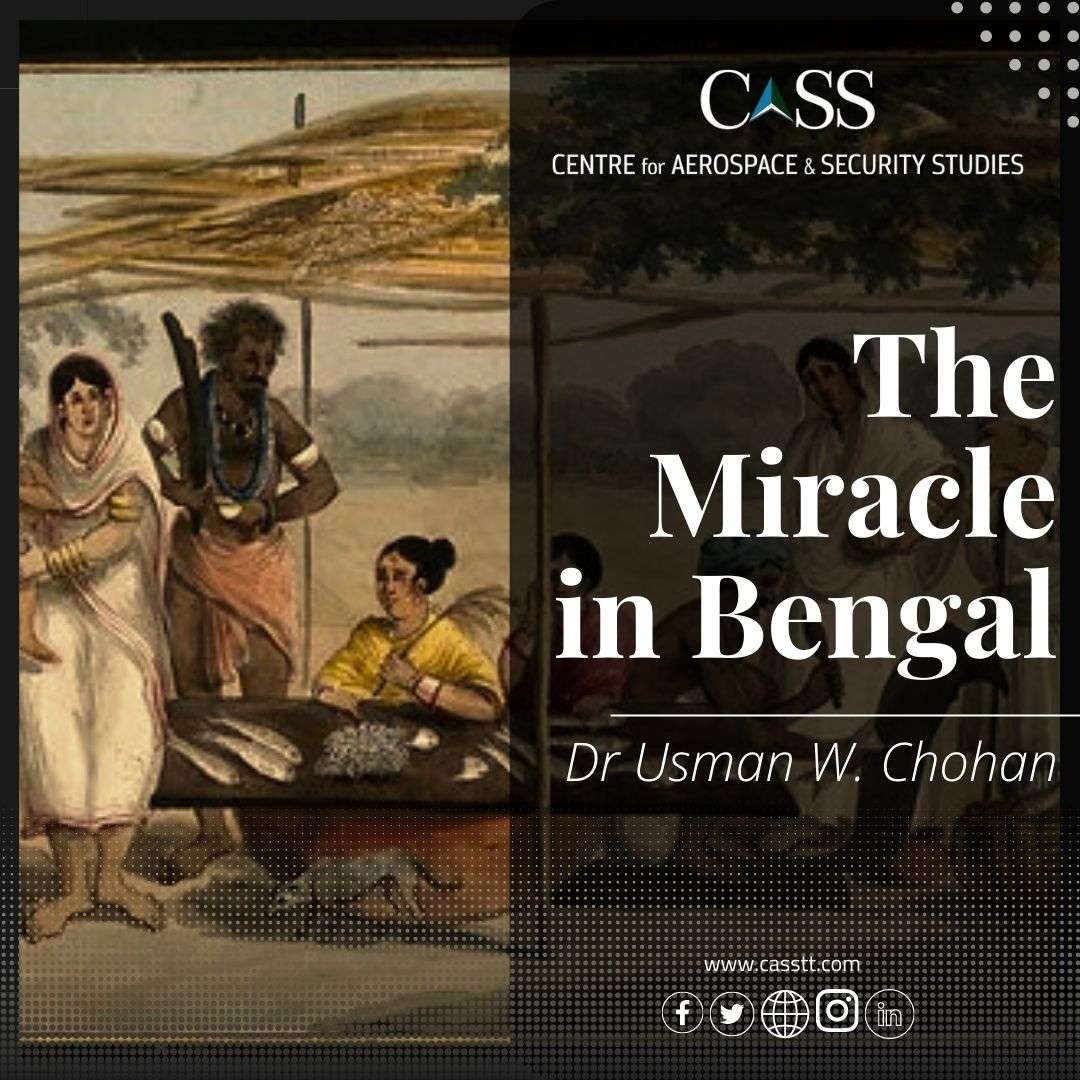
The third, and arguably most important point, is that any economic renewal in Bengal is by no means a surprise when taken in the longer historical context. Their work ethic, industriousness, and enterprise throughout the past 1000 years, and long before that as well, meant that Bengal being the richest and most productive region of the Subcontinent was and would be the norm.
For Pakistanis above the age of 50, this all appears to be a shock, because the East Pakistan they observed was a destitute place, ravaged over two centuries by the colonial regime of Britain. The British decimated Bengal’s industrial base utterly, so that their own competing goods could finally gain a foothold against the superior production of Bengal. The renowned weavers of Bengal famously had their thumbs cut off so that they would no longer conduct their artisanal excellence, ceding way to export dumping of inferior European manufactures. That is the dark underbelly of globalist conceits of “free trade” even today.
The British then extracted all other forms of wealth from Bengal, and subsequently from the rest of the Subcontinent. Perhaps in their most heinous of acts, the European colonialists engineered the famines of Bengal where people died in colossal numbers, and even the most tepid estimates put the cumulative toll of their crimes in the millions. Since that is the husk of a sister that West Pakistan had with her, she at times saw East Pakistan’s prospects as deficient – but they weren’t.
Because the mussalman of South Asia oftrn suffers from an ahistorical lack of perspective, the East Pakistanis felt that their treatment 1947-1971 was the worst they had ever seen, despite having confronted European-concocted famines in the mere decades prior. If the East Pakistanis compared the period 1947-1971 with that of 1847-1871 (acute desperation and anarchy), or even more strikingly, 1747-1771 (precipitous decline), they would have perhaps not militated against their own kin, realizing that much more would be possible in cooperation.
Meanwhile, West Pakistanis would have seen Bengal’s economic role in the Subcontinent as that of surplus producer for the region in the longer run. During the Mughal period, every emperor from Akbar to Shah Alam II saw their most prized economic region as the Eastern Province i.e. Bengal and adjacent Orissa and Avadh. Once again, despite the turmoil of 300 years, it is the dynamism of Bengal that is making headlines.
In due course, so long as South Asia can become a more peaceful and economically integrated region (which depends largely on India’s establishment letting go of its jingoist psychosis), Bengal will regain its economic heft. For Pakistanis, it is right to continue to wish their Bangladeshi brethren well, and to bolster efforts to spur the local development required on this side of the Subcontinent.
Dr. Usman W. Chohan is Director of Economics and National Affairs at the Centre for Aerospace & Security Studies (CASS). The article was first published in The Nation. He can be reached at [email protected].