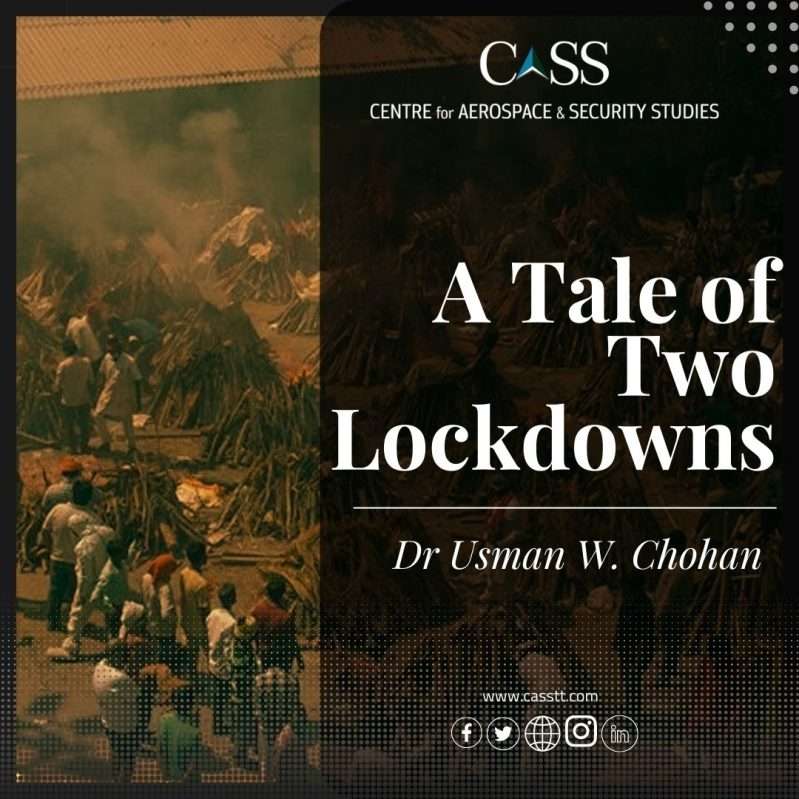
The Modi government is culpable for two separate lockdowns over the past two years, one in the occupied territory of Kashmir and one on the Indian mainland. Hardly six months apart, both lockdowns have exacted a monstrous toll on innocent populations. The lockdown of Kashmir was part of an orchestrated social engineering programme that typifies fascist regimes, while the lockdown of the mainland was a botched move that equally typifies fascist governments in its disregard for lives and livelihoods. Yet it is difficult to tell which of these lockdowns will have the more damaging long-term effects on both the Indian polity and its psyche.
On August 5, 2019 the Modi government announced the unilateral and illegal annexation of the disputed territory that India had been occupying through abject violence for 70 years. The government repealed articles 370 and 35A which conferred a “special status” on Jammu & Kashmir, and thus revoked a covenant that earlier Indian regimes had made with the petty vassals of Srinagar who had sold their people for a song. The perfidy of these vassals would do them no good, as Delhi would jail them all, and then jail the entire 8 million-strong population of Kashmir. This open prison of unprecedented scope would then be held down mercilessly by nearly a million troops on the ground.
It has been more than a year since the lockdown was imposed on Kashmir by a foreign occupation force. Now more sinister moves are underway, including demographic and social engineering to make the Kashmiris a minority in their own home. The distress of confinement has driven many to madness, to self-harm, and worse still. This is the nightmare that the fascists in Delhi have let loose, and yet it is but one of two atrocious acts within the span of less than a year. In late March 2020, the Modi government decided to declare a complete shutdown of the country at a notice of just four hours. Speaking at 8pm, he warned the nation that the whole country would be closed after midnight for a span of 21 days in response to the COVID-19 pandemic.
Who in their right mind would ask one billion people to make arrangements for three weeks at the whim of a late-night notice four hours before lockdown? Yet “every state, every district, every lane, every village will be under lockdown,” Mr. Modi said on television. The Indian public was worked into a pandemonium, not knowing how to grapple with such an abrupt declaration. Many rural migrants decided they could not live in the cities because they would simply starve. They could not count on civil society or the help of others to survive, and so millions of people began long and arduous treks back to their ancestral villages. Some commented that this was the largest migration on foot since 1947.
Many people who took flight in this hurried manner were carriers of the coronavirus, and so they spread the pathogen along the large groups that travelled far across the rural landscape, where public health facilities are either extremely poor or altogether non-existent. As New York Times reporters Gettleman and Schultz warned, “long lines of migrant workers streamed out of recently closed railway stations, with thousands of men, almost none wearing masks, marching close together to far-off villages, potentially spreading the virus deep into the countryside.” The untold misery of trudging the long-haul back home led many to fall sick, go hungry, and even die. As P. Chidambaram regrets, “we will never know how many people died of starvation, because no state government will admit to starvation deaths.”
The mass exodus imposed by Modi’s lockdown is in fact the single biggest reason why India and Pakistan have such different coronavirus outcomes. In Pakistan, smart lockdowns and tight mobility restrictions kept the virus confined to urban centres, where the poor were also assisted by a significant civil society effort. Rural transmission would have been devastating in Pakistan as well, but it was not allowed to happen. The exodus in India, however, meant that coronavirus had spread to sufficiently large pools of individuals through community transmission that its effects would then be multiplicative, and this is what is now wreaking havoc in India’s cities because those migrants have since returned in droves.
India now has the second highest number of cases and third highest number of deaths in the world, with no signs that the pandemic’s horrific toll will subside. This is the result of the second lockdown that Modi has imposed in the last two years, a measure that was both hurried and unsparing. Not only has it had devastating public health consequences, but it has also generated an economic catastrophe: the second-quarter 2020 GDP for India was a colossal -23 percent lower than a year earlier. Economic paralysis and social dysfunction are in fact endemic to both lockdowns imposed by Modi, for even in Kashmir there is no semblance left of a functioning society.
Although both lockdowns continue to create immense distress for the subject populations, the question persists regarding which of these lockdowns will ultimately exact the heavier toll on the Indian polity and its psyche. As the coronavirus outbreak continues to rampage through Indian states, and while the people of Kashmir continue to stare at the bleakness of their predicament, the tale of two lockdowns has yet to completely unfurl.
-Dr. Usman is a Director at Centre for Aerospace and Security Studies (CASS). This article was first published in The Nation newsaper. He can be reached at [email protected].