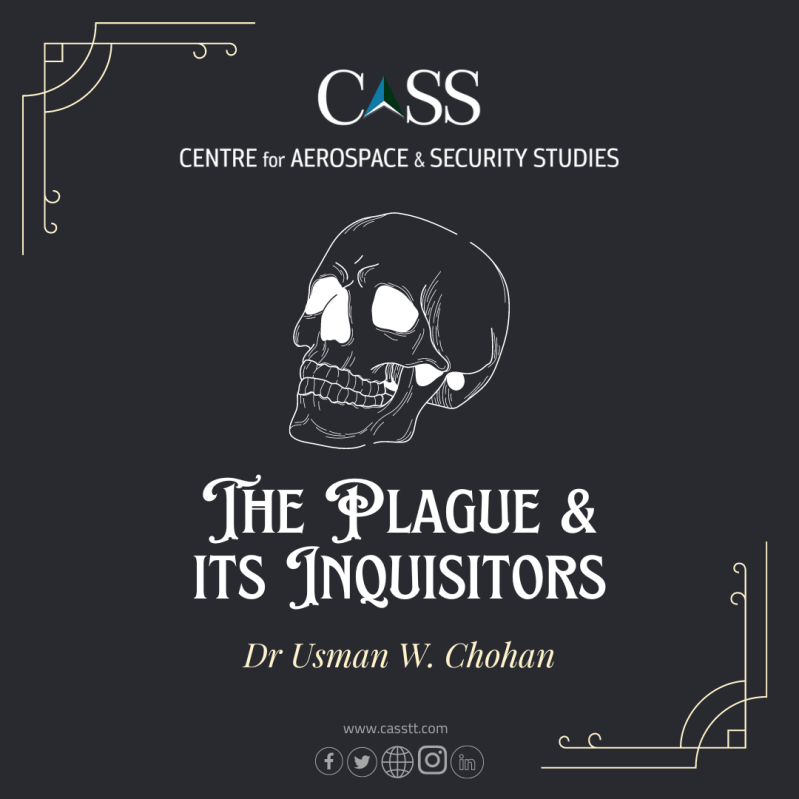
A common literary motif in Americana, notably in science-fiction narrative, portrays the people of the world putting aside their petty squabbles during a period of world crisis, so that they might unite under the steady and able leadership of the Americans and combat the alien threat head-on.
However, the coronavirus (COVID-19) pandemic offers some very unsettling foreshadowing on how things might instead come to pass, contrary to the heroism of American lore.
Rather than the setting aside of differences, the powers-that-be are in fact using this pandemic to up the ante on one another, and many are either downplaying the global threat or proclaiming one other’s culpability in the problem.
The World Health Organization’s recent gathering and the to-and-fro between the US and China is indicative of just how dismal global (mal)coordination and (mis)governance can be. In particular, the US-led pressure to punish China for a novel coronavirus, with smaller nations such as Australia jumping on the blame-game bandwagon, demonstrates the disunity in the world during such a testing hour. The accusatory remarks, particularly from Washington, create an environment that is not conducive to a coordinated global response both during the peak of the pandemic, and in its aftermath when a vaccine may be discovered. In fact, there have been notable instances of mercantilism, and of collusion between Washington and Big Pharma, that raise much concern about how and when (and at what price) a vaccine will be distributed once discovered.
Contrary to the mythologized motif of uniting in times of difficulty, the American administration of spiteful Republicans has turned an epidemiological concern into a political axe in an attempt to detract from the public health crisis and glaring leadership deficit shown domestically.
The US became the global epicentre for the coronavirus and the American public was left at the mercy of an invisible enemy due to a governance failure that cannot be imputed onto any foreign country. The early apathy and denial that characterized Trump’s leadership has had a devastating toll on the American public. It has also had a disproportionate effect on people of colour in America.
This pattern of disinterest in the coronavirus has been echoed in other Western countries such as Brazil and the UK. For them to act as inquisitors during a plague, even before a vaccine has been discovered and inoculations can take place, presents a damning rebuke to the message of hope that a constant literary motif of uniting in difficult times had proclaimed.
Yet the problem of hostility during the pandemic is not uniquely attributable to Washington. In India, there has been an even greater upsurge of rabid Hindu nationalism and Islamophobia since the pandemic struck. The thin veil of liberal conceit in New Delhi has been shorn with the warpath that the Modi regime has taken against the Muslims in both the mainland and in Occupied Kashmir.
Although the UN has called for a worldwide ceasefire during this period of hardship, many vengeful regimes are paying this lofty goal short shrift. The violent disarray fuelled by man is indeed far worse than the wrath of nature itself, for the disunity among world leaders worsens the pandemic’s scope far beyond what it may have been.
This is the world in which a new demographic boom is being conceived. The UN estimates that 20 million births will occur nine months after the pandemic’s onset in India, while 5 million births are expected in Pakistan.
The world that these children are to inherit is a grim one in the display of petty squabbles among inquisitors who cast a grim shadow over the lives these unborn children are yet to live.
At least one should do this oncoming generation a favour by reminding them that the spirit of solidarity, truly an element of fiction alone, is one they can only access in the mythology of Hollywood, and not in the bully pulpit of Washington. After all, they are to born in a time of plague, and worse still, one of inquisitors.
–The writer is the Director for Economics and National Affairs at the Centre for Aerospace and Security Studies (CASS). This article was first published in The Nation newspaper. He can be reached at [email protected].