Since the first use of nuclear weapons by the United States (US) during World War II, the acquisition of nuclear technology has emerged as a significant determinant of great power politics and the international security architecture. Despite fears of the spread of nuclear technology dominating post-war global politics and the resultant international security environment, the Soviet Union, United Kingdom, France, and China soon caught up and acquired nuclear weapons capabilities of their own. While some countries pursued nuclear weapons capability, not all were successful.
Meanwhile, the US came up with the ‘Atoms for Peace Program’ of which states like Pakistan, India, and Iran, among others, were the beneficiaries. The main purpose of this initiative was to promote nuclear technology for peaceful purposes and curtail its military use. Although many early adopters of nuclear energy benefited from this programme, few countries ended up utilising nuclear technology for military purposes. For instance, India acquired nuclear technology for peaceful purposes but ultimately developed military nuclear capability by cheating on its safeguard arrangements.
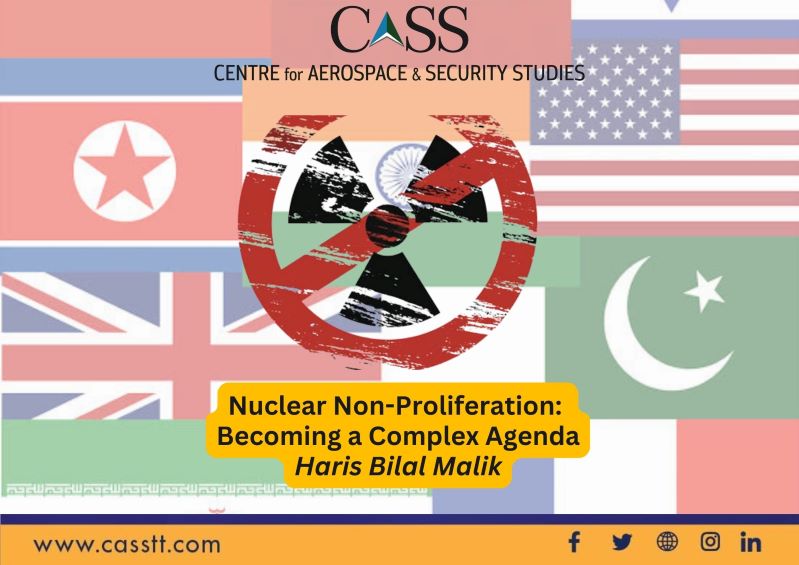
The concerns surrounding nuclear proliferation by major powers have played a significant role in shaping the direction of international political and security discussions. In response to these concerns, efforts were undertaken to prevent the further spread of nuclear technology. One of the most notable endeavors in this regard was the establishment of the Nuclear Non-Proliferation Treaty (NPT), which came into effect in 1970. The NPT designated the states that had conducted nuclear tests before 1 January 1967, as legitimate possessors of nuclear capabilities, these states being the P-5 (the five recognized nuclear-weapon states). The primary objective of the treaty was to prevent other countries from acquiring nuclear weapons, while also committing the P-5 to pursue disarmament and encouraging civil nuclear cooperation. While the NPT has been remarkably successful in preventing further proliferation; the non-proliferation agenda has become much more complex with nuclear weapon possessor states outside the treaty (India, Israel, and Pakistan), the case of North Korean withdrawal, and non-compliance concerns vis-à-vis Iran.
As the Nuclear Non-Proliferation Treaty (NPT) reaches its 53rd year, a noticeable rift has emerged between Nuclear Weapon States (NWSs) and Non-Nuclear Weapon States (NNWSs). This division is primarily driven by an asymmetrical emphasis on nuclear non-proliferation, which has impeded advancements in disarmament and equitable access to civil nuclear cooperation. The prominence of this perspective has become increasingly apparent, evident in the lack of consensus document adoption during the NPT’s Review Conferences of 2015 and 2022. These conferences showcased disagreements regarding disarmament, Nuclear Weapon Free Zones (NWFZs), and discriminatory access to civil nuclear cooperation. Amidst these challenges, the younger Treaty on the Prohibition of Nuclear Weapons (TPNW) has gained momentum, assuming a central role in disarmament discussions as an alternative framework. However, it is important to note that due to the non-participation of NWSs, the full impact and implementation of the TPNW remains limited.
In the last consensus document of NPT RevCon 2010, state parties agreed to pursue the establishment of a Middle Eastern NWFZ. When, in a follow-up, a resolution calling for Israel to join the NPT and open up its nuclear programme to the IAEA was tabled at the IAEA General Conference; Israeli officials commented that the IAEA was overstepping its mandate. Israel continues to demand more on the part of Iran when it comes to its compliance with the NPT obligations. Over the past decade, significant efforts have been made in negotiating, abandoning, and re-negotiating the Joint Comprehensive Plan of Action with Iran and the P-5 + 1. Comparable efforts on a regional NWFZ could have returned more substantive and enduring results.
Discriminatory access to civil nuclear technology is another issue that has complicated the non-proliferation agenda and deepened the divide between the NWSs and NNWSs. This discrimination is most pronounced in the export control regimes related to nuclear and missile technology – i.e., the Nuclear Suppliers Group (NSG) and the Missile Technology Control Regime (MTCR). In NSG, despite its poor non-proliferation record (such as diversion of civil nuclear technology and materials, and cases of nuclear materials’ theft), India has been able to secure a waiver and aspires for full membership with the active support of various Western benefactors. On the other hand, Iran, despite being a party to the NPT has been subject to certain restrictions and discrimination vis-à-vis its civil nuclear programme.
Likewise, MTCR, which seeks to curtail missile proliferation, has extended its membership to India. The Indian missile programme – especially the longer-range systems – has greatly benefited from foreign support. Even today, India is collaborating with foreign suppliers on the BrahMos cruise missile which is capable of carrying nuclear weapons. The missile system made headlines when it was ‘accidentally’ fired and landed inside Pakistan – an event that could have triggered hostilities between the two neighbouring nuclear weapon states.
Nuclear non-proliferation and disarmament are important components of international security. Non-proliferation efforts have remained effective for years. However, the combination of a complex international security environment and a selective approach has come in the way of achieving non-proliferation objectives. Today, there are greater concerns about nuclear proliferation than in previous decades. Today, more NNWSs are considering nuclear weapons as a solution to their security and geopolitical compulsions. Without earnestly addressing underlying hurdles, the ambitious goals of nuclear non-proliferation and disarmament will remain distant and difficult to achieve.
Haris Bilal Malik is a Research Assistant at the Centre for Aerospace & Security Studies (CASS), Islamabad, Pakistan. The article was first published in Pakistan Observer. He can be reached at [email protected]
Image Design: Mysha Dua Salman