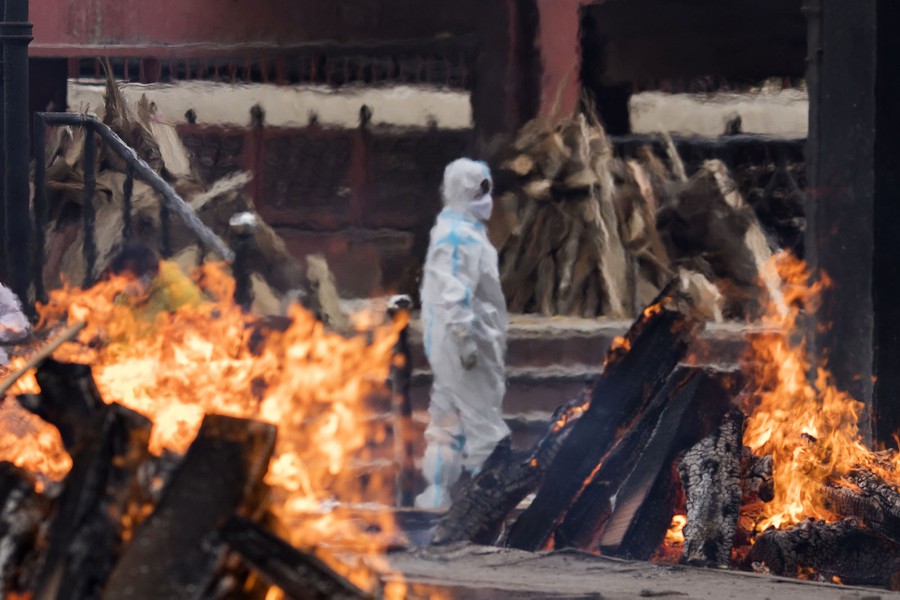
The funeral pyres are burning brightly across India these days, as 3 lakh daily cases and nearly 3000 daily coronavirus deaths are being reported in the official statistics. Given that there is persistent under-reporting and a chronic manipulation of the coronavirus statistics, one should multiply the official figures many times over to get an estimate of the wanton destruction that the BJP government has wrought upon India, even as it proceeds with super-spreader events such as election rallies and massive politico-religious gatherings.
After having been lulled into a false sense of victory against the Covid-19 plague when cases began to fall in September, India has now set a world record for Covid-19 cases for a third consecutive day, and one person is (officially) dying every four minutes in the country. Mutated variants of the original Covid-19 strain are more virulent and are attacking much younger cohorts in population, with people in their mid-30’s falling dead in droves. Yet the Modi government authorized the Kumbh Mela which was attended by an estimated 10 million people – an extraordinary gathering for which “super-spreader” is too mild a term. Although the Indian media wanted to blame Tablighi groups in 2020 for letting religious sentiments cause viral contagion, it is this mother of all gatherings on earth which has breached the limits of congregation and of sanity.
There is a flurry of movement across India’s cities as families carry around dying loved ones towards hospitals, only to be turned away. Many people are repeating the exodus of 2020 by fleeing the cities altogether, but they are finding that their villages are already grappling with pools of community transmission. Although Indian keyboard warriors were earlier on boasting of the arrival of vaccines, and 120 million doses of CoviShield have indeed been administered, all this is but a rounding error in a country so chaotic, large, and roiled up. The funeral pyres are filling the crematoriums too quickly, and the iron-caste grills of the furnaces are melting because so many bodies are being forced in to be burned. It is an apt metaphor for the BJP government, whose failings are sending everyone straight into the flames up to the point that the grills of society themselves melt away.
Pakistan’s government and civil society alike have urged for solidarity with the plight of Indians suffering from the utter failure of their government. This sense of compassion and solidarity reflects the generally amicable disposition of the Pakistani psyche across all social strata. They have been urging for regional peace for a very long time, only to be turned away by the seething and arrogant BJP government. Not only has the Indian government sought to undermine the security of neighboring countries, but it has also now let its own people succumb to an unseeable and unknowable scale of devastation within India itself. This is a supreme embodiment of what the scholars have termed administrative evil [1], and it adds to the litany of sadistic crimes of the BJP regime that includes anti-Muslim pogroms and the illegal annexation of Occupied Kashmir on August 5th, 2019.
The scope of devastation wrought by the administrative evil of the BJP government is unknowable because of the draconian censorship that they impose upon the Indian media landscape, which is littered with sock puppets and televangelists who pretend that (1) nothing is wrong, or (2) Pakistan is somehow to blame. But their tentacles extend beyond their boundaries now, as the EU DisInfo Lab’s extensive findings in 2020 revealed. Very recently, and equally telling: the Indian government has even pressured Twitter to censor many tweets, including those made by Indian lawmakers, as it seeks to continue its denialism. The government issued an emergency order to suppress the tweets, according to a disclosure made to the Lumen database of Harvard University by Twitter itself.
But how long will the BJP’s veil of deceit be waved over the world? The smoke of their funeral pyres has already risen too high for this. Although ordinary folks are falling victim in the urban and rural areas of the country without being able to articulate their voices, but now even the privileged, exploitative class of India is busy begging for oxygen on platforms such as Twitter. Yet it is all to no avail. Pakistanis must be prepared so that such a contagion does not spread to them. The lag time in the previous major wave of 2020 was roughly 2 months before the crisis in India also began to manifest in Pakistan. Pakistan’s solidarity with the plight of ordinary Indians, ravaged as much by their government’s wickedness as by the virus itself, must now be complemented with strict preparedness and caution that such a fate does not befall them too.
[1] Balfour, D. L., & Adams, G. B. (2014). Unmasking Administrative Evil. Routledge.
The writer is the Director for Economics and National Affairs at the Centre for Aerospace and Security Studies (CASS). The article was first published in The Nation. He can be reached at [email protected].
Image Source: Taylor Alan. “Photos: A Deadly Second Wave of Covid-19 in India.” The Atlantic, 20. April.2021, https://www.theatlantic.com/photo/2021/04/deadly-second-wave-of-covid-19-in-india/618648/