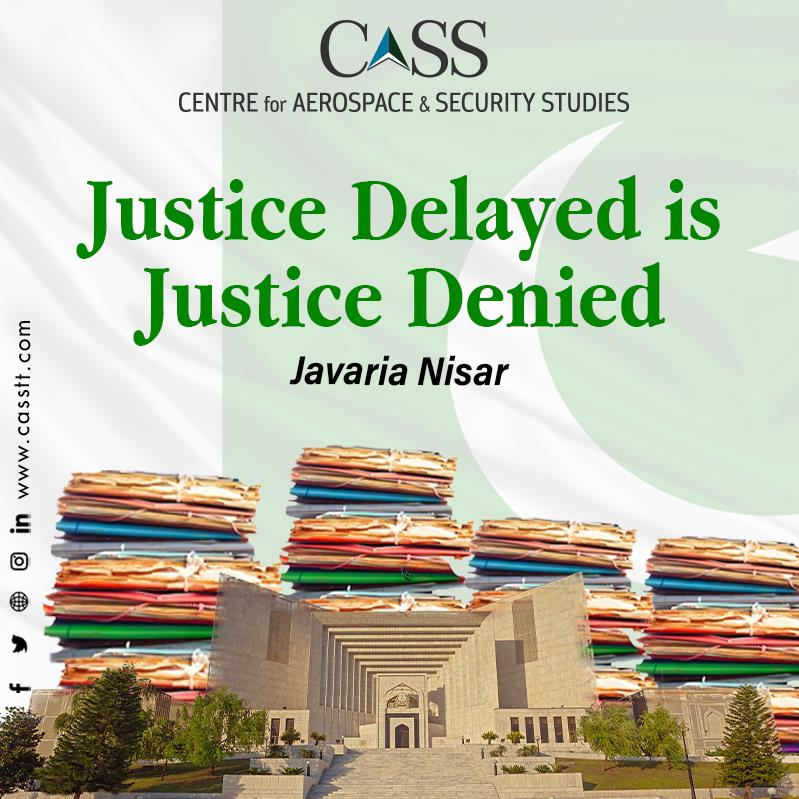
Justice delayed, they say, is justice denied, but sadly, this is the only form of justice known to Pakistanis. Recently, it was reported that 1.86 million cases are still pending in various courts for the last five years. The state, as well as the judiciary, is familiar with this exigent problem. Still, it has failed to address delays and lapses in the criminal justice system. According to the Rule of Law Index 2022 released by the World Justice Project, Pakistan is 129th out of 140 countries, whereas regionally it ranked 5th out of the six countries in South Asia, an indication of the justice system’s utter failure to dispense justice and maintain law and order.
Two questions arise from this predicament. First, what factors inhibit the dispensation of timely and speedy justice? Second, how does it affect society’s willingness to adhere to the rule of law?
Lack of trust in Law Enforcement Agencies (LEAs) is one of the major dilemmas in Pakistan’s criminal justice system. The Police, for example, are not trained in modern investigation techniques needed to examine forensic evidence effectively. Similarly, Pakistan has a multi-tiered judicial system meant to ensure fair trials, but instead, it causes unnecessary delays at each stage. These delays undermine society’s willingness to obey the law and discourage the aggrieved parties from following the legal course of action. Eventually, lack of trust in the criminal justice system increases hotheadedness, frustration, and violence among the public leading to vigilantism.
Besides, loss of faith in the fairness and speed of justice has encouraged citizens to resort to other unofficial or informal institutions like local panchayat or tribal councils for the provision of quick resolution of their disputes. This is because it is not only an efficient and inexpensive way of seeking justice but also an easy way out of the complexities involved in the proceedings of formal courts. Moreover, the deplorable Thaana (policing) culture in Pakistan displays complete apathy towards people’s problems and a general unwillingness to help the public. All these factors undermine rule of law. The end result is anarchy and mobocracy.
Pakistan can learn from the judicial systems of Scandinavian countries, especially Denmark which has ranked the highest on the Rule of Law index for the seventh consecutive year. Danish courts have gradually started to modernise their judicial system by incorporating digital technology, which has increased transparency and speedy dispensation of court cases.
On its part, Pakistan can adopt a number of measures to improve its judicial system and ensure fair and speedy justice. Firstly, the problem of judges being overburdened with cases could be solved by filling all judicial vacancies on a priority basis. The institutions responsible for selecting judges should also ensure an impartial nomination process to uphold the public’s trust in the judiciary. Moreover, ‘evening courts’ should also be established to reduce pendency and enhance speedy trials. At the same time, the government needs to enact laws to penalise lawyers who adopt delaying tactics for vested gains. In addition, challan registration should be digitalised and the police department must be trained in modern investigation techniques. Forensic laboratories also need to be modernised and necessary funds should be allocated for improving the judicial infrastructure.
In a civilised society, laws are enacted to ensure that citizens live together peacefully without encroaching upon the rights of others. The dispensation of speedy justice is an essential pillar of a progressive society because the erosion of confidence in the administration of justice and the deferral of penalties can contribute to the disintegration of the entire fabric of the rule of law and social harmony. Such a situation encourages people to take the law into their own hands and seek ‘vigilante justice’ instead of waiting for long and cumbersome trials to conclude, for which they often have to wait for generations. Anarchy and social crime are the inevitable consequences of such circumstances. To prevent such dire circumstances and uphold the fundamental pillars of rule of law, social harmony, and peaceful co-existence of citizens, it is imperative for all stakeholders to collaborate and work towards the improvement of Pakistan’s judicial system.
Javaria Nisar is a Research Assistant at the Centre for Aerospace & Security Studies (CASS), Islamabad, Pakistan. She can be reached at [email protected].