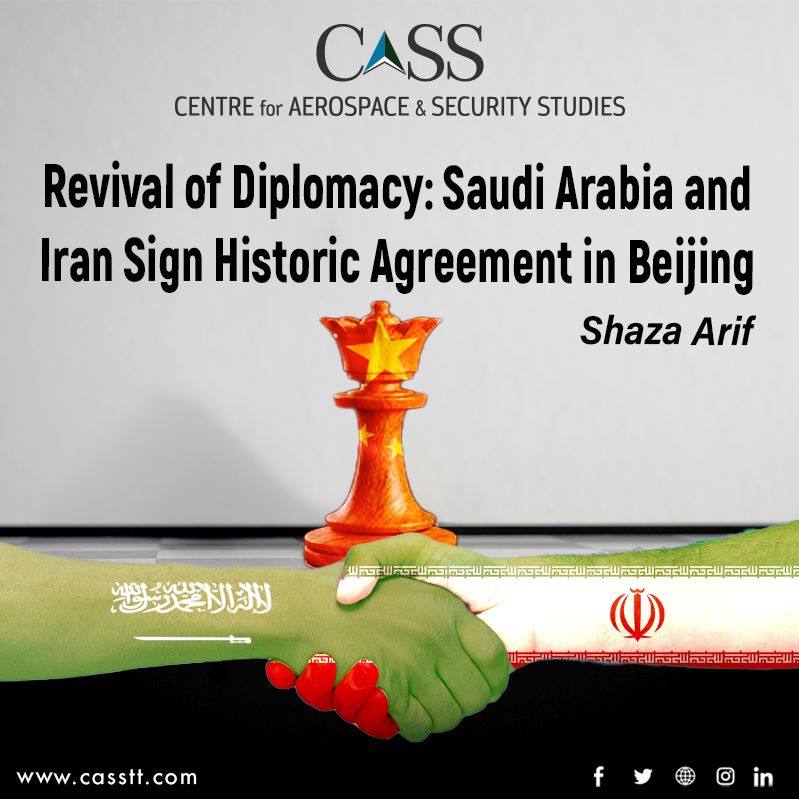
Over the past few weeks, international headlines and blogs were focused on the now ‘one- year war Ukraine’, but then, surprising developments occurred in the Middle East. After several rounds of negotiations brokered by China, talks between the Kingdom of Saudi Arabia (KSA) and the Islamic Republic of Iran have finally yielded results. On 10 March 2023, it was announced that an agreement between the two sides had been reached with a signing ceremony in Beijing. In 2016, the two sides severed diplomatic ties following the execution of a Shiite cleric in KSA and subsequent storming of the Saudi embassy in the Iranian capital.
The agreement involves resuming bilateral relations, re-opening embassies and missions in a time period not exceeding two months, and arranging a return of their respective ambassadors. The two acquiesced to respect each other’s sovereignty and practice non-interference in internal affairs. The agreement also aims to strengthen cooperation in diverse fields, including economy, investment, sports and cultural exchange, etc.
The re-opening of embassies in the respective countries marks a major breakthrough at multiple levels. Iran has been isolated for years due to sanctions and this normalisation can provide more economic opportunities vis-à-vis China and Saudi Arabia. Better relations with Iran are also vital for the Saudi kingdom to achieve its larger Vision 2030 under Crown Prince Mohammad bin Salman. A more cooperative regional environment benefits the mediator, China which has invested in ensuring the free flow of resources across the region.
The development is significant for the Middle East, given the magnitude of escalation that has hit the region due to the Iran-KSA rivalry. Protracted conflicts in Syria, and Yemen, as a result of proxy wars between the two rivals, took a toll on regional stability and have led to great human suffering. Earlier in January, in a press conference, the Saudi Minister of Foreign Affairs, Prince Faisal bin Farhan Al-Saud had revealed progress on ending the conflict in Yemen and called for a new truce and transitioning to a permanent ceasefire.
The far-reaching implications of this historic development go beyond the region. In fact, they reverberate across the global landscape, potentially catalyzing significant geopolitical repercussions at a time of heightened sensitivity. Chinese mediation efforts to bring the two Middle Eastern giants onto the table herald a new role for China as a leading power broker. Traditionally, the US has been the main external power in the region. However, its role in the Middle East has declined in recent years, partly by choice. This vacuum has been gradually filled by China, whose inroads in the region have largely been economic. The latter’s pivotal role in brokering this deal could be perceived as a challenge to US influence in the region, further enhancing China’s strategic importance in the Middle East.
As far as Pakistan is concerned, it is worth noting that Pakistan has made efforts to facilitate rapprochement between the two states. While these efforts could not materialise into tangible progress, nevertheless, Pakistan enjoys fraternal relations with Riyadh and Tehran, as well as Beijing. Hence, this detente could provide a favourable environment for Pakistan to bolster its economic ties in the region.
Lastly, the deal also brings some relief for the Muslim world. The Iran-Saudi rivalry was worrisome for Muslim countries, given that the headquarters of Sunni and Shiite Islam opposed each other on a range of critical issues. The prospects of peace in the Middle East hold the promise of renewed momentum for the Organization of Islamic Cooperation (OIC) and could pave the way for more cooperation on issues of mutual concern, such as sustainable economic growth and progress.
As China flexes its diplomatic muscle and clout in the Middle East, it remains to be seen how the Western world, especially the US reacts in the long term. While this deal may not instantly resolve all other regional conflicts and divisions, it does offer potential breathing space for regional integration and stability. This positive development has the potential to unleash economic activities, not just in the Gulf but as far as South and Central Asia, which will surely bring a wave of hope to a region prone to conflicts and marred with enduring hostilities.
The writer is a Research Assistant at the Centre for Aerospace & Security Studies (CASS), Islamabad, Pakistan. She can be reached at: [email protected].