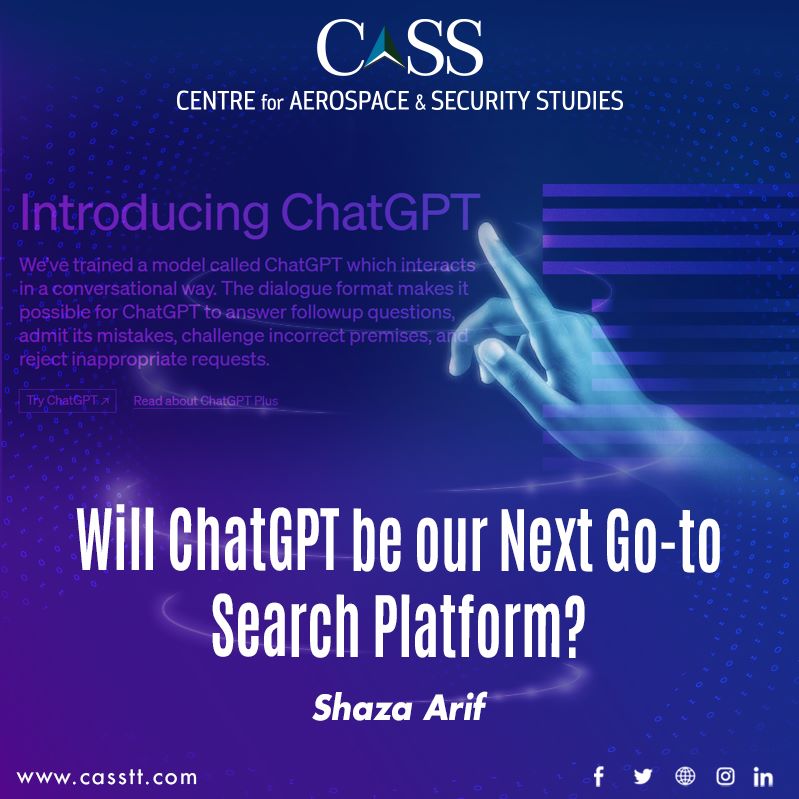
The power of a conversation should never be underestimated. OpenAI’s recently-launched chatbot, ChatGPT has certainly exemplified this sentiment, garnering widespread attention since its launch. It has reached a record 100 million active users in just two months. People from all around the world have been exploring the chatbot due to its incredible capabilities in a variety of text-based tasks. As per a response from ChatGPT regarding its functions, it can answer questions related to diverse fields, generate and complete text, summarise lengthy documents, rephrase information, make recommendations, translate various languages, compose poems and stories, and converse regarding various issues, amongst other tasks. It is worth noting that although ChatGPT is a chatbot, while Google search is a search engine, the two are being discussed together and compared at various platforms such as CNBC, The New York Times, PC Mag, and Live Mint, etc. Hence, it is important to explore whether ChatGPT could emerge as the next go-to platform in future.
Having used the chatbot over the past few days, here are some observations. Firstly, similar to Google search, the software is impressive given that it quickly provides relevant and factual information, making it an excellent source of knowledge. Furthermore, even when grammatical errors are present in the queries, the software still manages to respond effectively.
While it mirrors Google’s efficiency in providing timely information, numerous factors set the two apart. ChatGPT provides human-like information in language form, whereas Google search navigates us to different websites and provides data with pictures, sources, applications, etc. Additionally, when it comes to providing information, ChatGPT’s capabilities are somewhat limited. For example, when asked to provide details of opinion articles of Dr Maleeha Lodhi, it provided only brief information regarding her and was unable to find her academic work as opposed to Google search, which offers vast information with the same question.
When it comes to up-to-date information, ChatGPT again has its limitations. When asked about the Prime Minister of Pakistan, the Chabot gave information regarding former PM Imran Khan, revealing that its knowledge cutoff date is September 2021. As a result, the chatbot cannot be relied upon to provide the most recent and updated information, unlike Google search, which is updated every second and provides the latest information available.
ChatGPT’s limitations extend beyond the realm of knowledge and information. For example, the chatbot is not capable of real-time internet searches. When asked about the likelihood of rain in the coming week, the chatbot’s response was limited to the data it had been trained on, and it was unable to make a prediction about the weather forecast. Similarly, it cannot track a flight in real time nor provide the live run rate of a cricket match, both of which Google search can do efficiently.
With regards to reliability, it can be inferred that Google search is more reliable than ChatGPT. This is because the information provided on Google search is traced from a specific website or source. In contrast, when asked to provide the source of an answer regarding ‘Role of Airpower in South Asia’, ChatGPT was unable to do so and instead stated that the information was based on widely accepted concepts and principles related to the topic at hand. Interestingly, when asked whether ChatGPT considered itself to be more reliable than Google search, it admitted that Google search was currently more reliable. However, the bot noted that it had a unique advantage over Google search in its ability to understand context and provide more relevant information to the user.
ChatGPT demonstrates greater capabilities and creativity than Google search when it comes to composition. For example, when asked to compose a poem on Pakistan’s economy, the chatbot was able to draft well-crafted couplets within seconds. It also generated structured and engaging stories on various themes such as truthfulness, hope, and robots. Moreover, it can also draft customised letters and applications tailored to the user’s requirements.
Another distinguishing feature that sets ChatGPT apart from Google search is its conversational mode, which offers a more personalised touch. When asked to explain the phenomena of machine learning, the response generated was similar to conversing with a subject expert. The chatbot could recall previous questions and answers, which enabled it to generate more relevant and engaging responses. In contrast, Google search provides comprehensive and factual information, but lacks the ability to provide tailored feedback or interact with the user in a conversational manner.
ChatGPT and Google search are two different tools with unique features and capabilities. While both platforms provide valuable information to users, ChatGPT offers a more personalised and conversational approach, making it an excellent choice for those seeking human-like interactions. On the other hand, Google search excels in providing more up to date (at least so far), live, diverse, comprehensive, and reliable information. Ultimately, the choice of the go-to platform will depend on a user’s needs and preferences, as well as the specific task at hand. As AI technology continues to evolve, it is likely that we will see further advancements and improvements in both ChatGPT and Google search, making them even more powerful and useful tools in the future.
The writer is a Research Assistant at the Centre for Aerospace & Security Studies (CASS), Islamabad, Pakistan. She can be reached at: [email protected].