14th August holds great significance for the Pakistani nation. Marking a new chapter in the history of the subcontinent, the state of Pakistan came into being on this day in 1947. The importance and relevance of the Two-Nation Theory pushed the Indian Muslims to demand their own state. The Muslim leadership was significantly aware that being a minority in an independent India dominated by a Hindu elitist majority, Muslims would be deprived of equal rights and pportunities. Consequently, demand of autonomy in Muslim majority states (later for a state) was put forward by the Chief Minister of Bengal, A.K. Fazl ul Haq in the historic convention of All India Muslim League in 1940, famously known as the ‘Lahore Resolution.’ This event served as a major milestone for the Indian Muslims, and was a great setback for the Gandhi-Nehru duo who considered themselves the sole representatives of the subcontinent.
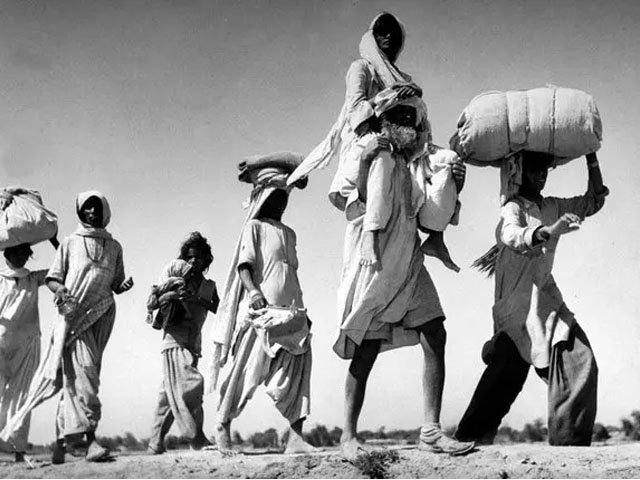
After a long struggle by the senior leadership and Muslims of the subcontinent, a separate state was carved out despite all odds. Pakistan, being a young state, inherited a number of challenges – economic, political, administrative, defense and infrastructural. The new government had to manage the country’s two wings separated by 1600 km, with most of the subcontinent’s industrial infrastructure handed over to India by the British. Pakistan also had to accommodate 6 million refugees who left everything behind at the time of partition – another major administrative challenge. The greatest setback was that the founder of Pakistan, Muhammad Ali Jinnah passed away shortly after independence leaving a political vacuum in the newly formed state. These challenges were further exacerbated by our eastern neighbor who left no stone unturned to destabilize the state by deliberately delaying the transfer of financial and material resources.
That anger of the then-Indian leadership continues to resonate until today. In this regard, not much has changed after seven decades of Partition. India has still not accepted the Partition. It openly negates the ideology on which Pakistan was created, and continues to put obstacles in our prosperity. It is the resentment of the Partition that fuels India’s desire to make use of every opportunity to target Pakistan.
Today, India has resorted to new tactics and tools in order to impair our national identity and integrity. It aims to weaken us internally and isolate us internationally. It has adopted a hybrid strategy evident from its recent disinformation campaigns to spread propaganda against Pakistan. It is even influencing international institutions against us. The recent statement made by the Indian minister which openly asserts that India ensured that Pakistan remain on the grey list of the Financial Action Task Force (FATF) speaks volumes about Indian animosity towards Pakistan. Given the volatile situation in Afghanistan, New Delhi is meddling with Pakistan’s internal security from Kabul as well.
The apprehensions of our founding leaders about living under Indian rule were not without merit as we witness the hatred being propagated by the RSS towards the Muslims in India; and even in occupied Jammu & Kashmir. They are subjected to discrimination on all grounds and are deliberately kept in the lowest strata of society. Even Muslim
celebrities who have devoted their lives to promoting India are no exception, where they repeatedly have to prove their loyalty to the state. India’s dismissive attitude towards the Kashmiri Muslims is also a vivid example of this hostile environment .Their distinct identity has been snatched away by the abrogation of Article 370 and 35-A. For the past two years, they have been under a lockdown with numerous travel and communication restrictions. The demographic changes since 5th August 2019 is one of the means to wipe out their identity once and for all.
All these developments manifest how important it was to create Pakistan. India’s actions unequivocally vindicate the Two-Nation Theory. It is the very existence of Pakistan that has provided us with the freedom that we enjoy today. India’s attitude towards Muslims should be a constant reminder for us to value the essence of the right of self-determination which was embedded in the Lahore Resolution. As we celebrate this important day with full zeal and zest, we must create awareness in the younger generation regarding the importance of our beloved homeland. Likewise, equal emphasis needs to be devoted to stand firm against the internal and external challenges posed by India’s hybrid war and propaganda against us.
Pakistan, as a nation, is very resilient and has made huge sacrifices from independence to date for the protection our motherland. The world has seen how it fought against terrorism in the last two decades. While it is true that our enemy will continue to exploit different avenues to inflict harm, it is imperative for us as a nation to strengthen ourselves from within, stand tall, stand firm and stand united.
Shaza Arif is a Researcher at the Centre for Aerospace & Security Studies (CASS). She can be reached at [email protected]