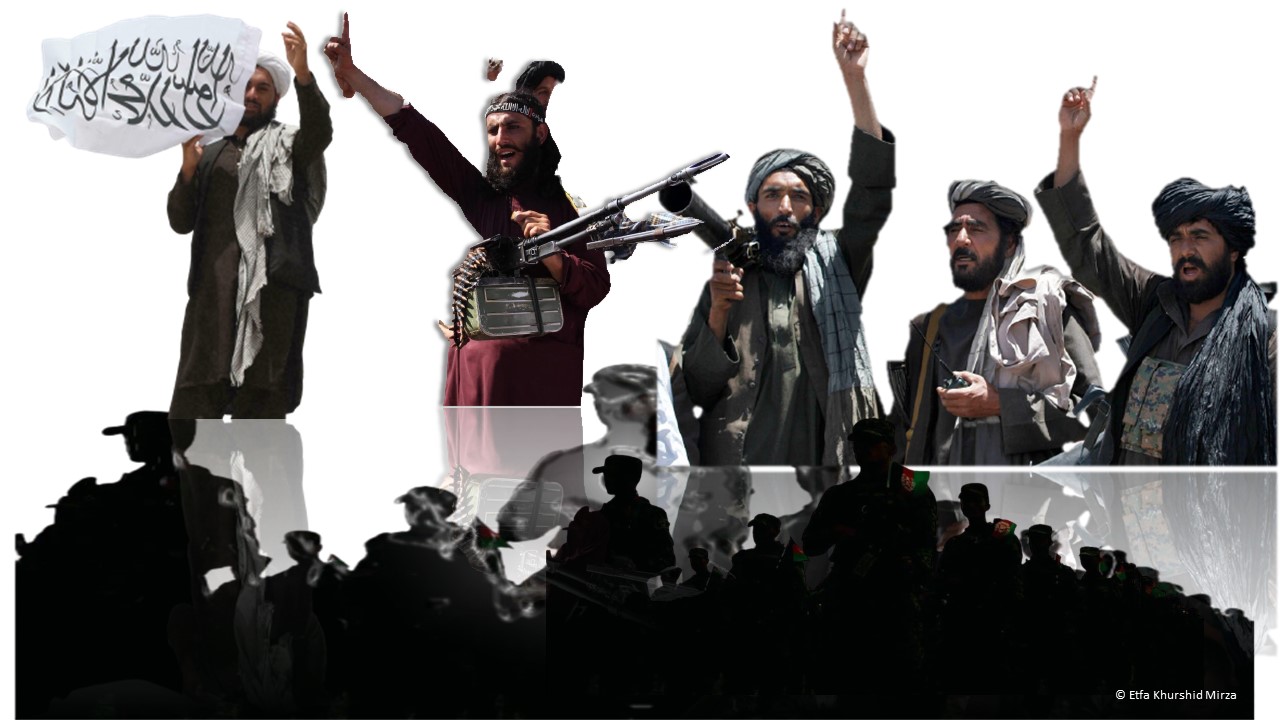
Pakistan and its agencies are once again at the centre-stage of geopolitics. This time for allegedly supporting Taliban offensive against the Afghan National Army (ANA), which has been raised, trained, equipped, and funded by the US, and NATO, over the last two decades.
Pakistan stayed abreast the US in its war on terror in the aftermath of 9/11 tragic events, and was declared as Major Non-NATO Ally (MNNO). During this war, Pakistan suffered some 80,000 casualties, and over USD 130 bn of loss to its economy. Pakistan’s sufferings came due to its allegiance to the US, and NATO, against Taliban.
US President Donald Trump requested Pakistan’s Prime Minister Imran Khan in an official letter, in December 2018, to assist in US troops’ withdrawal from Afghanistan. Pakistan PM, insisted that there is no military solution to Afghanistan, and only Afghan-owned and Afghan-led solution will be supported. Pakistan made relentless efforts to bring Taliban
to table with US, and after a long-drawn process of negotiations, an agreement was signed on 29 February, 2020 in Doha between Taliban, and the US. The Agreement gave legitimacy to Taliban as the sole representative of the resistance movement in Afghanistan.
Afghan War, also the longest US War, is coming to an end after twenty years, in which US has suffered over2500 casualties, and an economic loss of USD 2.5 trillion. During the period, the US forces along with NATO, and other allies, did everything possible to cow down the resistance by Taliban, who were deposed from power in 2001, following the 9/11 attacks. Pakistan remained an ally of the US, provided its bases, its airspace, its port, and its land routes, to support the US war in Afghanistan. US kept demanding to ‘do more’ against Taliban, who were allegedly taking refuge in Pakistan’s tribal areas after attacking US forces in Afghanistan. US carried out drone attacks at will, and successfully conducted Abbottabad operation in which it claimed to have killed Osama Bin Laden, even without taking Pakistan on-board.
Pakistan suffered the backlash for its support to the US against Taliban, which led to the emergence of another terror outfit that is Tehrik-e-Taliban Pakistan (TTP), in 2009. TTP, which had the blessings of Afghan Taliban, joined hands with India’s hybrid war on Pakistan, carried out bomb blasts in Pakistan’s major cities, political assassinations
including that of Benazir Bhutto, multiple attempts on the life of President Musharraf, suicide attacks on malls, mosques, shrines, and even schools. There were at least 40-50 attacks every year from 2003 to 2017.
Inspite of the 20-year war against poorly equipped, barefooted Taliban, the US and NATO troops are leaving Afghanistan after concluding an agreement with those who were not even recognized. The US is leaving Afghan government, and its armed forces, which have plenty of resources, equipment, funds, and a guarantee of air support, if needed, to fight the same Taliban who they were unable to be defeated in last 20 years. The outcome is that the Taliban have taken over Kabul, hence, Afghanistan without facing any significant resistance from the Afghan forces.
Pakistan reappears on the world map, but this time not as an ally, but as a scapegoat. India, having failed to find a role in Afghanistan, has launched a campaign against Pakistan, with an active support of the US. India is spearheading a trend that Pakistan must be placed under sanctions for supporting Taliban offensive. Whereas, the US accepts that Afghan government is unable to provide leadership and its well-trained and well-equipped armed forces are just not applying themselves against poorly equipped Taliban, and therefore, Taliban’s victory in Kabul is much faster than anticipated. The US has finally stated that Afghanistan is their country, and they should defend it, and the US would only provide support where needed. Yet Pakistan’s bashing continues at the behest of India. Pakistan has repeatedly stated that it will support US in the peace process, but not in its war effort against Afghanistan. Pakistan has also reiterated that it does not have any political or military control over Taliban, and does not provide any safe havens along its borders with Afghanistan. However, for now, the US needs a face saving for its failures in Afghanistan, and India needs a role to play in the region.
Pakistan is treading carefully, and has successfully involved other regional players in the entire Afghan peace process, because peace and stability in Afghanistan would directly benefit Pakistan, and other stakeholders such as China, Russia, Iran, and of course Afghanistan.
The writer is the author of a book ‘Nuclear Deterrence and Conflict Management between India and Pakistan’. He is presently working as Director, Centre for Aerospace & Security Studies (CASS).