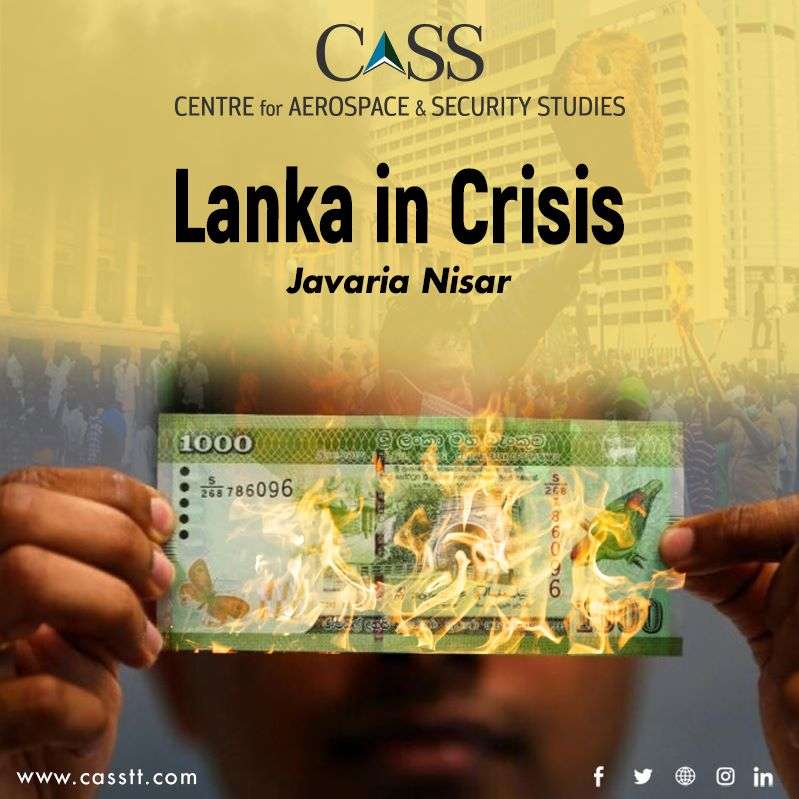
As Sri Lanka runs out of fuel, its people are running out of patience. Ever since it defaulted on its foreign debt, the island nation has lurched from one economic crisis to another. Its economy is trapped in a continuous tailspin with soaring food prices and widespread fuel shortages. For ordinary people, the cost of living has become extraordinary. People are scrambling to buy essential goods due to an inflation rate that has escalated to an astounding 50 percent. A few years back, the country had a booming tourism industry and the highest literacy rate in the South Asian region. Unfortunately, now the country is cited as a textbook case on how not to govern an economy.
The island nation is buried deep in debt. The total debt of Sri Lanka has exceeded USD 51 billion with USD 28 billion due in 2027. However, there are no foreign reserves left to pay back these hefty loans. Targeted economic reforms and overhauls are necessary, coupled with a political determination to salvage the country, but such reforms have their own costs especially when most of the burden of reform policies fall on an already hapless public.
In February, much to the chagrin of the general public, Sri Lanka increased electricity tariffs by 66 percent in order to implement a cost-reflective pricing strategy necessary for securing the International Monetary Fund (IMF)’s USD 2.9 billion bailout package. Despite the measures being taken by the government, the IMF has not released the desired funds. Not surprisingly, this triggered country-wide protests over a steep rise in taxes and spending cuts.
However, no recovery or bailout plan can work unless the government is keen to address core structural issues such as endemic corruption and official extravagance. Doing so would demand far-sighted wisdom and political intent. So far, Sri Lanka’s leaders have exhibited a lack of both. In fact, former President Gotabaya Rajapaksa’s regime was infested with incompetent officials who continued to fill their own coffers at the expense of the larger populace. The Rajapaksa dynasty is believed to be responsible for around 78 percent of Sri Lanka’s financial debt. In spite of this, the warm welcome extended to the ex-President by his political allies on his return to the country – weeks after fleeing – is an indication that the ruling elite is still not prepared to let go of its vested interests, precipitating the country’s humanitarian woes.
Debt and political disasters, coupled with the after-shocks of the COVID-19 Pandemic, have pushed millions of people below the poverty line. According to the World Food Programme (WFP), 33 percent of Sri Lankan households are food insecure and cannot afford healthy diets. United Nations agencies and other Non-Governmental Organisations (NGOs) aim to deliver life-saving support to 3.4 million people and nutrition support to 2.4 million people, including children and pregnant women. The latest approved national budget in December 2022 included a USD 117 million relief package to aid the vulnerable. However, it is not enough to overcome rampant food insecurity and malnourishment.
The road to recovery is challenging but not impossible. Addressing the underlying causes of the debt-laden nation can lead to a resilient recovery. For too long, Sri Lanka has remained dependent upon its tourism sector which accounts for around 12.6 percent of the country’s GDP. It is the third largest source of foreign exchange. As the Pandemic struck, the tourism industry came to an immediate halt, plunging the country into a sudden economic crisis. Moreover, the country lacked economic diversification due to which foreign exchange reserves began to deplete rapidly entrapping the island nation into a vicious debt cycle. Clearly, Sri Lanka needs to strengthen other sectors of the economy, especially the export market to hedge its bets in case of an unforeseen natural catastrophe.
Under a new social contract, a human-centred recovery should be prioritised to integrate employment, socioeconomic development, social protection, and equitable opportunities for all. Moreover, through fiscal consolidation, the government can reduce its expenditure while increasing its revenues. Dismantling dynastic rule and political fiefdoms would result in the diffusion of political power – a necessary ingredient for representative politics. Accompanied by accountability and transparency, macroeconomic and political stability can be achieved to ensure sustainable and inclusive growth.
Javaria Nisar is a Research Assistant at the Centre for Aerospace & Security Studies (CASS), Islamabad, Pakistan. She can be reached at [email protected]