
It is commonly believed that state institutions should never be politicised because it may have implications on the security of the state, depending upon the nature and character of the organisation. Unfortunately, Pakistan International Airlines (PIA), a state-owned entity, had been heavily politicised due to which it has not only lost its true colour, but also suffered on account of credibility, both at home and abroad.
The national flag carrier became a natural part of the newly independent state Pakistan after it earned independence from the British Empire on August 14, 1947. The erstwhile Orient Airways was first declared a Corporation, which soon earned the distinction of becoming the first Asian airline to fly Boeing 707 jet aeroplanes, within few years of its establishment.
PIA set the standards of hospitality, punctuality, and safety in the early years of its operations. It was even invited by nascent regional airlines to help them establish themselves as a viable entity. One such airline was Dubai-based carrier Emirates, which was established by PIA personnel in 1985. Today, it stands as one of the best airlines in the world.
However, PIA started to nose-dive once it was made to do politically motivated recruitments by successive political governments since the late 1980s. PIA lost its financial viability in 2011 due to overstaffing, operational inefficiency, and lack of institutional reforms, and relied heavily on governmental subsidies. PIA’s achievements and accomplishments of early years were lost to regional airlines, perhaps by design, and hence it lost its credibility as a viable entity. PIA started to lose its international routes. The flag carrier of the world’s fifth-largest population of 220 million people, and nearly nine million ex-pats, now operates only a few international destinations. Non-Resident Pakistanis are forced to fly on regional airlines due to the non-availability of PIA flights to desired destinations.
PIA hit the hard deck on June 30, 2020, when it was banned from entering the European airspace for six months for a lack of international standards’ certifications, primarily due to a political blunder in handling a rather sensitive issue. This basically happened soon after the shocking revelation about the issuance of licences to ineligible pilots. It was a matter of time before PIA was banned by the UK and the US as well.
While the incumbent federal government has introduced certain reforms in PIA, and installed apolitical administration, the national flag carrier has started to show promising results since 2019. However, the very purpose of this article is to shower praise on PIA’s performance in the current Afghan crisis.
No sooner had the US troops started to leave Afghanistan, and Taliban’s gains become visible, the Head Offices of the international organisations, and most of the European Embassies became increasingly worried about their staff’s life and well-being. However, they did not have a viable evacuation plan and started to look for help towards the Pakistan Embassy, which remained fully operational and accessible even when most of the missions had closed doors on their nationals and employees.
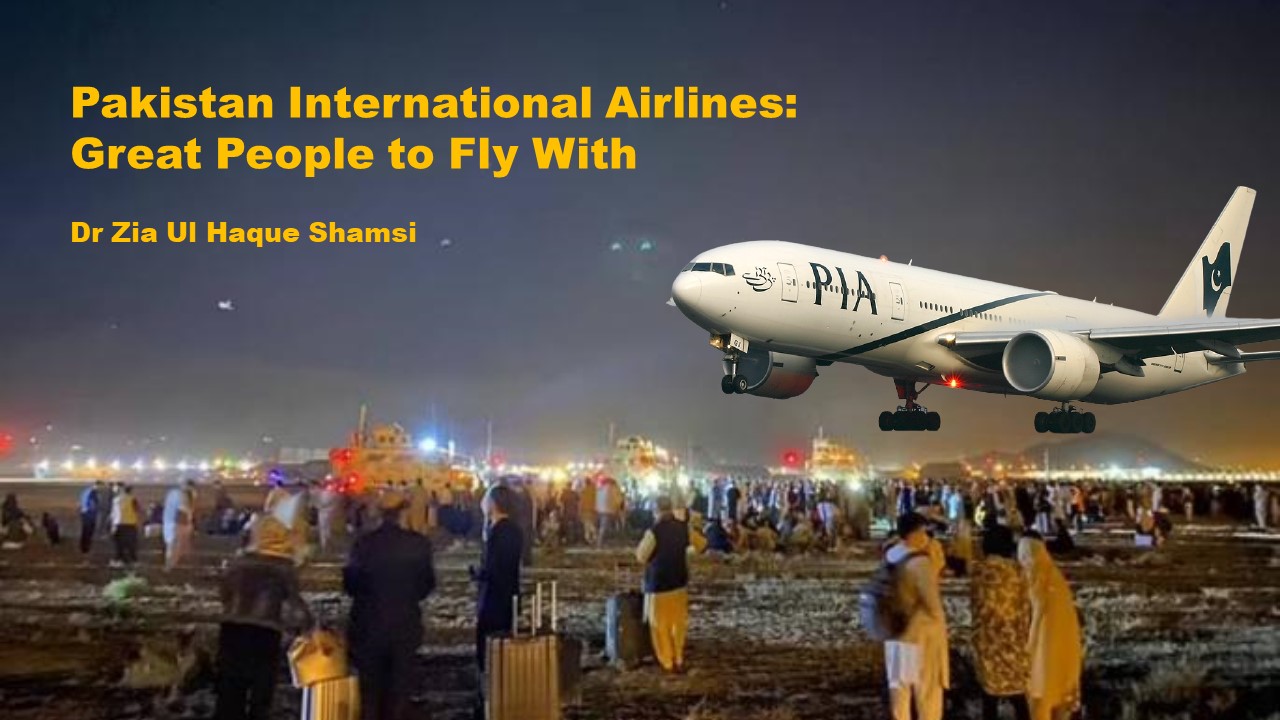
PIA, under the dynamic leadership of its non-political CEO Air Marshal (Retd) Arshad Malik, immediately responded to Pakistan’s call of evacuating its own and foreign nationals from Kabul on humanitarian grounds. PIA conducted the evacuation operations from Kabul airport without the fear of fire and earned worldwide praise. PIA was instrumental in safely evacuating the US nationals, as well as the Missions of the Philippines, Canada, Germany, Japan, Indonesia and Netherlands. Moreover, PIA also provided airlift to international institutions including World Bank, and Asian Development Bank, and International news agencies such as AP, Reuters, CNN and Aljazeera.
PIA continued to make the glorifying headlines and safely evacuated some 1500 people in the first three days of operations after Ashraf Ghani had abandoned Afghanistan on 15 August 2021, without any discrimination of nationalities and political affinities, purely on humanitarian grounds.
While Pakistan’s national leadership has lauded the efforts and heroics of PIA, International media has also noted and praised the positive role played by PIA in times of extreme crises, because Kabul airport was littered with debris and at times was unsafe to operate even the military aircraft, less the commercial flights.
It is heartening to note that PIA, despite its certain weaknesses and poor perception, rose to the occasion, and brought a good name to the country at the most difficult times. PIA’s current performance in Afghan evacuation operations should mark the beginning of a new era as an apolitical, and a true professional flag carrier of Pakistan, true to its tagline “Great People to Fly With.”
The writer is a published author and presently working as Director Centre for Aerospace & Security Studies (CASS). This article was first published in Daily Times. He can be reached at [email protected].
Photo Credits: Etfa Khurshid Mirza



