
A glimpse across Pakistan’s economy today indicates that profitable and productive industries and businesses are struggling in a variety of ways. Yet when probed deeper, those who run such enterprises point not to some temporary or cyclical impediments, but rather to the structure of the economy and the unease of doing business in the country. Highly notable in this regard is how the well-rooted vestiges of the License Raj continue to remain in Pakistan, and how the legal-institutional-political barriers make it extremely difficult to both start and maintain enterprises. They contend that the current economic crisis is only a temporary setback compared to the longstanding anti-business structure of political economy in this society.
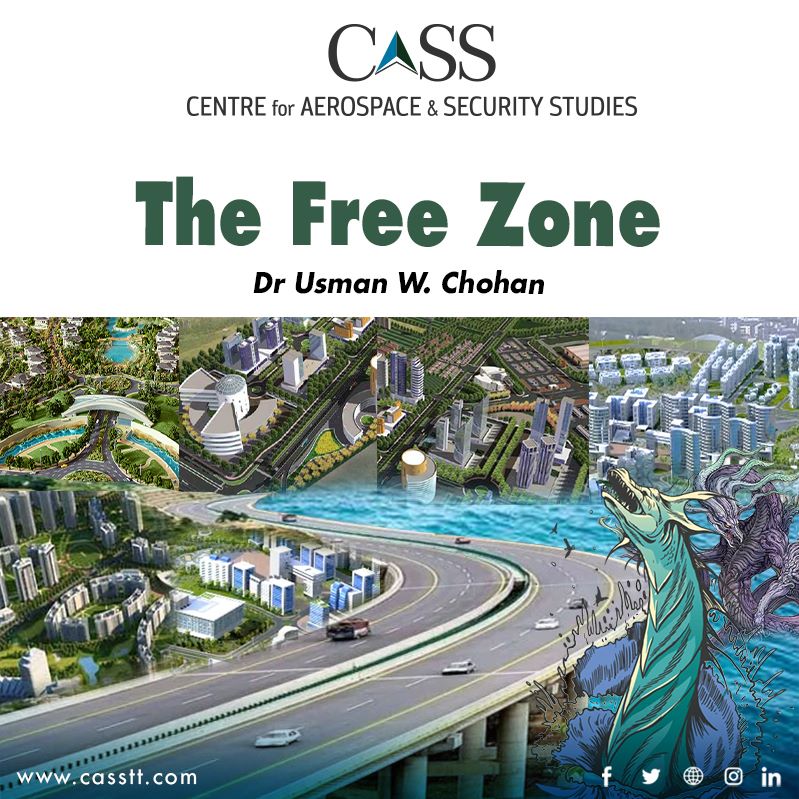
Yet even in the presence of a deep-set institutional leviathan preventing enterprise development, many countries (particularly in the emerging markets category) have set aside truly ‘free zones,’ in the pattern of China’s Special Economic Zones (SEZs) to bypass the leviathan altogether. By creating a designated area that conforms to international rules and laws, and is bolstered by adequate infrastructure and labour provision, one need not overhaul an entire society’s legal architecture, while still creating space for breakneck commercial development, industrial production, and labour force utilisation.
In Asia, this model has been adopted across many countries, even in places that may have been erstwhile restrictive countries (Kazakhstan, Cambodia). The most impressive model in the region may well be the Dubai Business Zones or Free Zones, where a distinct legal-institutional framework operates outside Emirati law, so that companies can easily set-up there without the leviathan’s intrusions or a need to rationalise among different systems.
This model is not new per se, and history offers many guides to what is now a well-understood phenomenon of ‘free-zone development.’ The City of London has operated as a successful financial hub even without the extractions of Imperial England’s former bloodsucking empire, because the City operates under laws that are different from the United Kingdom’s. Hong Kong was also created with the idea of commerce outside Qing oversight, as were Commodore Perry’s first treaties in Shogun Japan. The Dutch Golden Age was also characterised by such micro-societies of entrepreneurship, as were the city-states (particularly Venice and Genoa) that later formed Italy. In the Islamic Golden Age, there was a strict separation between the ‘Sultanate’ and the ‘Bazaar,’ which ushered in tremendous prosperity at the time, and laid the rudiments for what later European enlightenment thinkers would dub the ‘free market.’
However, Pakistan has not yet leveraged the Special Economic Zone model, even as it constitutes an important part of Phase II of the China-Pakistan Economic Corridor (CPEC). Why might this be the case? It would appear to be a problem of mindset. The ‘License Raj’ has conceived of the SEZs as plotting (as in land parcels) opportunities. They view the SEZs as a chance to replicate the residential and commercial archetype in Pakistan of allocating land acreage as a semi-feudal source of rents rather than productive incentivisation.
The solution to stimulating the SEZs, therefore, would be in designing them as independent jurisdictions with business-friendly laws and very little government intrusion except in the assurance of adequate infrastructure provision. The CPEC SEZs would truly need to be ‘free zones’ that would be ‘free’ of the quick-buck bureaucrat mentality that has persisted since the Raj. The sale of such plots in SEZs would, thus, not be a source of rents at PKR three crore per acre, but rather an endowment to stimulate business sold at PKR 30 per acre at most. It is a completely different mindset and would liberate Pakistan of the stagnation that afflicts its anti-enterprise culture.
Dr Usman W. Chohan is Advisor (Economic Affairs and National Development) at the Centre for Aerospace and Security Studies. He can be reached at [email protected].



