India, the world’s largest democracy and a non-NPT nuclear weapons’ state, is plagued with scandals for military procurements. Despite stringent and painstaking bureaucratic processes for the approvals of defence procurements, India has perhaps the most numbers of scandals of corruptions when it comes to buying arms and equipment.
The most famous corruption scandal in Indian military procurements remains that of Swedish Bofors guns during the 1980s. As the narrative goes, Indian military acquired some 410 field howitzer guns of 155 mm calibre from a Swedish firm Bofors AB for USD 1.4 billion. While the selection of the equipment was not questioned, nor the contract package, but it was revealed much later that millions of dollars were paid by the Swedish company to Indian politicians to secure the contract. This bombshell news was actually broken by the Swedish radio on April 16, 1987. The news was immediately reported in Indian media and had an extremely adverse impact on Prime Minister Rajiv Gandhi, who in fact lost the general elections held in November 1989. Interestingly, Janta Dal leader VP Singh who was Gandhi’s Defence Minister when the Bofors scandal broke the ground and had resigned, became India’s Prime Minister in the aftermath of disastrous results for Indian National Congress (INC).
Another Indian military acquisition deal which came to light due to allegations of bribery by the international vendor relates to Thales’ Scorpene-class submarines. The alleged amount was USD 175 million in a total contract deal of USD 3.0 billion, which was made through a middleman. The agreement included transfer of technology also, and according to some reports the amount of the deal was USD 6.0 billion. However, after nearly eight years of litigation process, Indian Courts dismissed the allegations due to weak prosecution.
Quoting Captain GR Gopinath that “dealing with Indian defence is beset with horrendous bureaucratic delays and lack of clarity in policies.” Gopinath supports his assertions by referring to Phil Shaw of Lockheed Martin India, “Lockheed has completed more than 40 billion dollars’ worth of programmes globally, without problems, but is struggling in India and is finding it a challenge,” primarily due to indecision and intra-services infighting for the resources in the procurements of arms and ammunitions.
Deba R. Mohanty, in his article published in April 2012, has summed up the issues related to problems of military procurements in India. Mohanty, without mixing words, has written that two aspects that would haunt India are: “corruption in defence deals and deteriorating civil-military relations in India.” While this article is focused on the corruption in defence procurements in India, therefore only aspects related to the subject of interests are being mentioned. Interestingly, Mohanty has further categorised the shortcomings leading to gross irregularities into arms procurement process that ultimately leads to scandals. Later on such scandals may or may not be proved but have serious politico-moral and legal implications. Some of Mohanty’s categorizations are: “- corruption, delays in procurement, non-transparency and non-accountability, over-lapping institutional mechanisms, civil-military relations and ill-planned spending leading to lopsided military modernisation.”
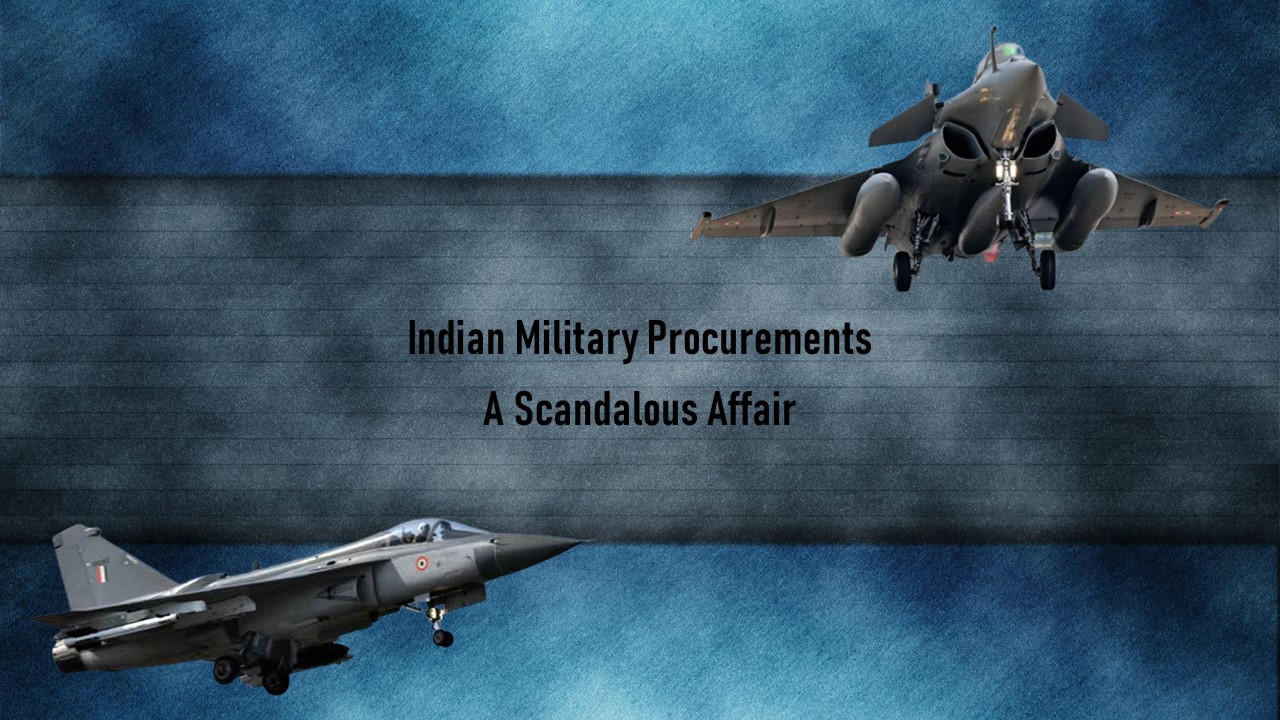
The latest in the sequence are the allegations of corruption and wrong-doings in the much trumpeted acquisition of 36 state of the art French-made Rafale fighter aircraft. Due to the failure of LCA Tejas’ programme, Indian Air Force (IAF) had been studying for years, various Medium Multi-Role Combat Aircraft (MMRCA), in its quest for at least 126 platforms so as to replace its aging fleet of Soviets-built Migs and Sukhoi series. However, typical to India’s working: indecision and inordinate delays led to delayed arrivals of Rafale to beef up IAF capabilities. In fact, India’s opposition leader Rahul Gandhi had been calling for an exhaustive investigation into Rafale deal worth 7.8 billion Euros signed in 2016. Recently, “A French judge has been appointed to lead a “highly sensitive” judicial investigation into alleged “corruption and favouritism” in the Rs 59,000 crore Rafale fighter jet deal with India.” INC has once again demanded that PM Modi should immediately form a Joint Parliamentary Committee (JPC) to investigate into Rafale deal. Gandhi is of the view that Modi-government has overpriced Rafale to earn financial benefits from the middlemen.
Not all the defence procurement deals done by India could be mentioned in this article, however, most of the deals in the past over three decades went into exhaustive investigative process. Defence procurement scandals and failure of LCA Tejas’ programme adversely affected IAF capability and morale of the personnel. The same could be felt during and post Pulwama and Balakot events in February 2019. The calls to investigate into Rafale scandal would also have serious effects on the morale of IAF personnel.
The writer is the author of the book ‘Nuclear Deterrence and Conflict Management Between India and Pakistan.’ He is presently working as Director, Centre for Aerospace & Security Studies (CASS). This article was first published in Daily Times. He can be reached at [email protected].
Photo Credit: Etfa Khurshid Mirza