In today’s complex and uncertain global environment, there is nothing more important than security, whether it is for an individual, community, or state. However, in a changing paradigm, no state can ensure its national security without ensuring human security as well as related aspects of non-traditional security. Each state strives to ensure the well-being of its people alongside its territorial integrity to ensure comprehensive national security. To understand the significance of a comprehensive national security policy, it is necessary to study the governance framework and processes.
The state is the primary unit with a well-defined territory in which a vibrant society resides and is governed by an executive authority recognized by international institutions. States are responsible for creating opportunities for society to develop in the socio-cultural domain as well as economic progress towards prosperity among the comity of nations. To achieve this, states have necessary institutions, political and administrative, with designated authority for the purpose. History has shown that societies have disintegrated from within whenever states became dysfunctional due to a lack of political authority or economic independence.
The conception of a state in Islam is very different from a Westphalian one. An Islamic state is a commonwealth of all Muslims living as one community under the guidance and direction of a supreme executive head. Since the present international system is not aligned with the Islamic state system, this article is restricted to discuss state, society and security according to the prevailing international system.
Barry Buzan is of the view that “security is a contested concept and attempt to provide a precise definition is fruitless.” In my view, security is a condition of any state in terms of threats -external, internal, traditional, non-traditional, and evolving. Therefore, it calls for a comprehensive national security policy, which is a cardinal prerequisite for national survival. National security policymaking is a continuous process that is based on the development, deployment and employment of all elements of national power. Each element of National Security is as important as military or economic security is. Therefore, the process must focus on human security, ultimately leading to national security.
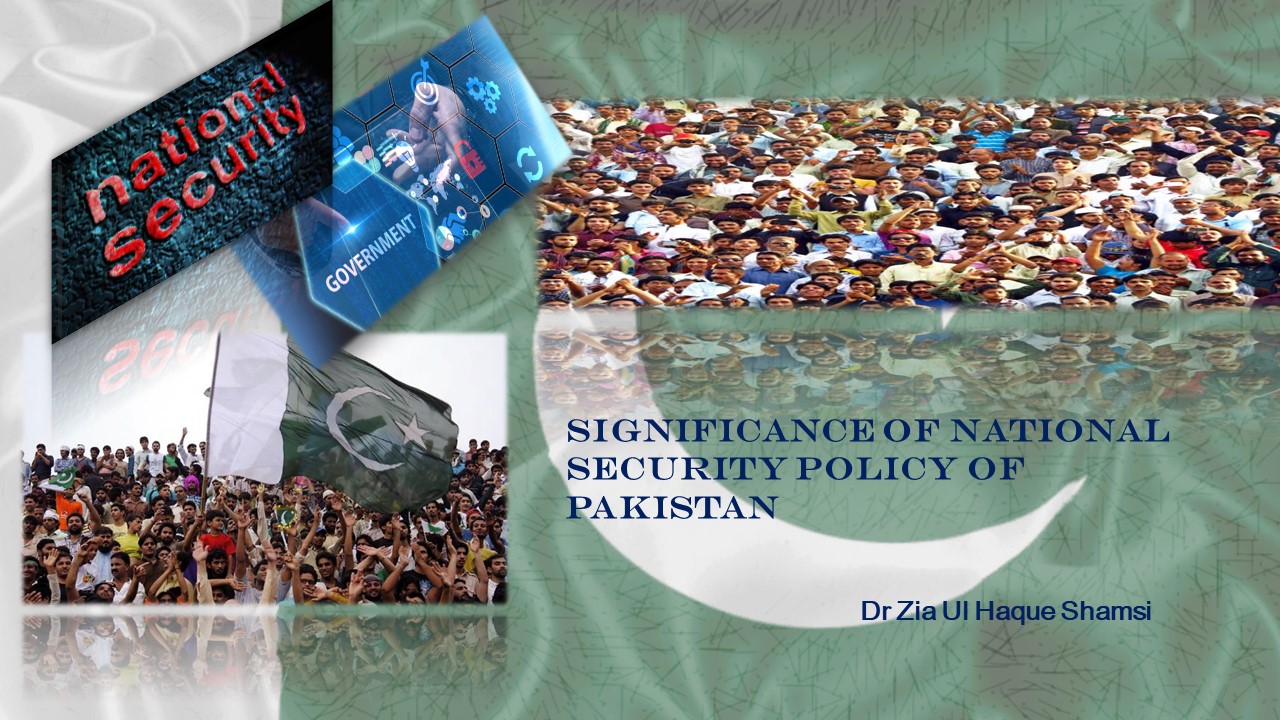
Until now, Pakistan did not have a documented National Security Policy. However, a draft policy has now been approved by the National Security Committee and subsequently by the Federal Cabinet chaired by the Prime Minister of Pakistan on December 27 and 28, 2021. The National Security Advisor Dr Moeed Yusuf, who was responsible for the formulation and presentation of Pakistan’s first national security policy, has declared it a “historic achievement.” According to him, the hallmark of Pakistan’s NSP is that it is “citizen-centric with economic security at the core.” It covers all aspects related to traditional and non-traditional security. The public version of NSP, once released, is likely to generate healthy discussion among academia, state institutions and civil society, for further refinements. It will now serve as a mother document for respective policies covering all elements of national security. Some important elements of national security include economic security, health security, personal security, political security, environmental security, community security, and food security, also referred to as human security. Other important elements include military security, information security, cyber security, and energy security etc. I will briefly explain these elements in the following paragraphs.
In the era of geo-economics, economic security is perhaps as important a part of national security as military security. In today’s complex system of international trade, characterized by multinational agreements, mutual interdependence and availability of natural resources etc., the freedom to exercise choice of policies to develop a nation’s economy in the manner desired, invites economic security. The creation and protection of jobs that supply defence and non-defence needs are vital to national security.
Military security implies the capability of a nation to defend itself, and/or deter military aggression. Alternatively, it implies the capability of a nation to enforce its policy choices by use of military force. It’s a condition that results from the establishment and maintenance of protective measures that ensures a state of inviolability from hostile acts or influences.
Political security is about the stability of social order. It is closely allied to military security and societal security. When it comes to health security, only the right measures can ensure that the citizens of a particular state can endure the hardships or otherwise build on steps needed that can ensure their economic progress, especially when and if faced by evolving global health concerns. The COVID-19 pandemic amply proved the importance of health security, not only for the developing nations for the developed states also.
Pakistan’s NSP is significant due to its timing and content. Regional security is fast evolving in the backdrop of a hasty US withdrawal from Afghanistan. The situation in the country remains precarious due to the failing economy and lack of basic amenities given empty banks and nearly “bank-corrupted” state institutions. On the other hand, India continues to acquire advanced, and lethal weapon systems which are challenging the strategic stability of the region.
In my opinion, the presentation of Pakistan’s first formal NSP is a step in the right direction and it must be debated vigorously at all levels before it is formally adopted by Parliament. This would help all other ministries, departments, and institutions in formulating their strategies to achieve collective national aims, objectives, and interests.
Dr. Zia Ul Haque Shamsi is Director Peace and Conflict Studies at the Centre for Aerospace & Security Studies (CASS), Islamabad, Pakistan. The article was first published in Daily Times. He can be reached at [email protected].
Image Source: Etfa Khurshid Mirza