Spanning over two decades, the end of the Afghan war heralds a new era not just for Afghanistan, but for the entire region and brings forth an opportunity to rebuild and reconnect for a better future. However, regional connectivity is in such disarray that the World Bank has termed South Asia as one of the least integrated regions in the world. In this backdrop, recent remarks by Pakistan’s Prime Minister for a ‘Peaceful and Prosperous South Asia’ seem to be in the best interest of the region. He insisted that Pakistan wants to enhance regional connectivity and also offered to abate the brewing Cold War before it renders disastrous effects on the region. He emphasised that Islamabad won’t ally itself with any bloc in this war. This article looks at the multilateral relationships of major South Asian countries and the potential for an integrated region with no tolerance for becoming a theatre for major power rivalry.
The relationship between Pakistan and India – two of the most important states in South Asia – are primarily responsible for defining the regional security environment, which is essentially hijacked owing to the heated rivalry between the two. Pakistan has repeatedly offered to negotiate contentious issues with India starting from Jammu and Kashmir, especially after the current administration’s indication to pivot to geo-economics and desire to bury the past. Pakistan has also been making overtures to bring about a thaw in its ties with Bangladesh. Meanwhile, extensive efforts have been made to take bilateral cooperation with Sri Lanka, Nepal, Bhutan, and Maldives a step further. Moreover, Pakistan-China ties have always been lauded as those between iron brothers, and as for Afghanistan, Pakistan is one of the few countries advocating an end to the country’s instability.
Although not a part of the geographic map of South Asia, China also holds immense importance when it comes to the regional security calculus. As far as the connectivity of the region is concerned, Beijing is already involved in billion dollar projects (through its Belt and Road Initiative) seeking to connect not just South Asian countries, but the entire Continent. China and India also enjoy growing trade ties, but the security ties between the two have been deteriorating lately, leading to an uptick in tensions between the two regional giants.
India also has extensive trade ties with its neighbours, but the growth in these relations has largely remained stale over the last few years, owing to the protectionist, fascist, and ultra-nationalist policies of the BJP government. Furthermore, India has also adopted a policy of bullying its smaller neighbours through its economic, diplomatic, and military influence. These nations have grown increasingly frustrated by India’s selfish theatrics, which hinders the achievement of paced regional prosperity. However, the issue with a determining impact on ‘an integrated region’ is India’s increasingly hostile attitude towards Pakistan. New Delhi has denounced all rapprochement attempts made by Islamabad for bringing stability in the region.
The reasons behind India’s belligerent attitude towards Pakistan particularly and other neighbours in general lies in the heightening confidence it draws from its close relationship with the US. This New Delhi-Washington partnership has allowed India to continue its ruthless behaviour towards its neighbors as well as its own minorities.
Secondly, India’s inclinations to ally with the US against China in a potential Cold War II has the likelihood to further push the region into another round of uncertainty and instability. India’s polices of transforming this region into a battleground of major powers contending for influence serves a more defining blow to Pakistan’s aspirations of preventing the region from bearing the brunt of superpower rivalry.
Although, India has failed miserably in standing any chance of competing with China militarily, its aggressive policies towards the latter (and countries hosting BRI projects, especially Pakistan) can stall the growth of the initiative. As BRI is the lynchpin of China’s rise, its slowed pace is exactly what would be desired by the US.
It should be noted that alignment with blocs is not problematic in itself. It only becomes so when the aligned country becomes some bigger power’s puppet and doesn’t hesitate from playing dirty politics in its own region for the interests of the greater power, which is exactly what India is doing.
Indian leadership must realize that it cannot possibly become a fully developed state while the whole region that geographically encircles it, is embroiled in a host of issues as also propounded by the Regional Security Complex Theory.
Moreover, the US must not endorse India’s destructive behaviour, since it is the US’ open support for India’s belligerence that causes troubles for South Asia. The US’ objective of China containment by supporting India in its hegemonic assertions can backfire, resulting in heightening frustration among regional actors against Washington.
Therefore, while Pakistan’s liberal sentiments of an integrated region, free from the perils of Cold War II are extremely commendable, they cannot be realized as long as India’s reckless attitude continues. Moreover, this situation puts Pakistan in great predicament, where it is not willing to choose sides owing to its dependence on both the US and China and may not be able to stay non-aligned given regional and international dynamics. Although, almost a Gordian knot, Islamabad must tread extremely prudently to maintain a balance, or it will be doomed to bear the brunt of the emerging power dynamics.
Khansa Qureshi is a researcher at Centre for Aerospace & Security Studies (CASS), Islamabad, Pakistan. She can be reached at [email protected]
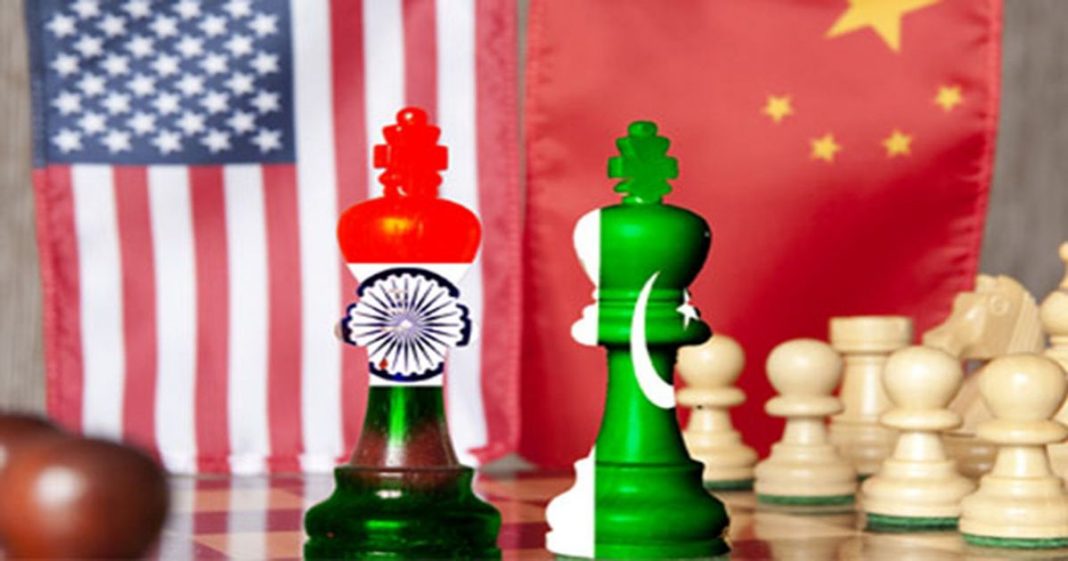
Image Source: Ullah, Barkat. 2021. “Pakistan’s concerns over the growing strategic ties of US India.” Global Village Space, January 1. https://www.globalvillagespace.com/op-ed-pakistans-has-concerns-over-the-growing-strategic-ties-of-us-india/