The newer Blocs are taking shape based on geo-strategy, geo-economics, and geopolitics. While geo-economics cannot be seen as void of geopolitics, India seems to be taking more interest in the geostrategic domain to tackle its regional conflicts with extra-regional support. India’s participation in QUAD (Quadrilateral Security Dialogue) is perhaps in the same vein. However, India is isolating itself in the region, and hence, the South Asian Association for Regional Cooperation (SAARC) remains dormant due to New Delhi’s lack of participation given its enduring rivalry with Pakistan.
The primary purpose of any regional bloc remains interconnectedness for better communication, travel and tourism, movement of people, goods and services, sociocultural connectivity, and information-sharing. However, in spite of the core objectives of SAARC being all of the above, India continues to block the accomplishment of any of these objectives.
The geostrategic location of South Asia as a sub-region has significant attraction due to its connectivity with Central Asia, Europe, Southeast Asia, and the warm waters of the Arabian Sea. Moreover, its linkage with China at multiple points make it extremely business-friendly. Unfortunately, India, with the largest landmass and population, is not participating actively in any of the regional organisations.
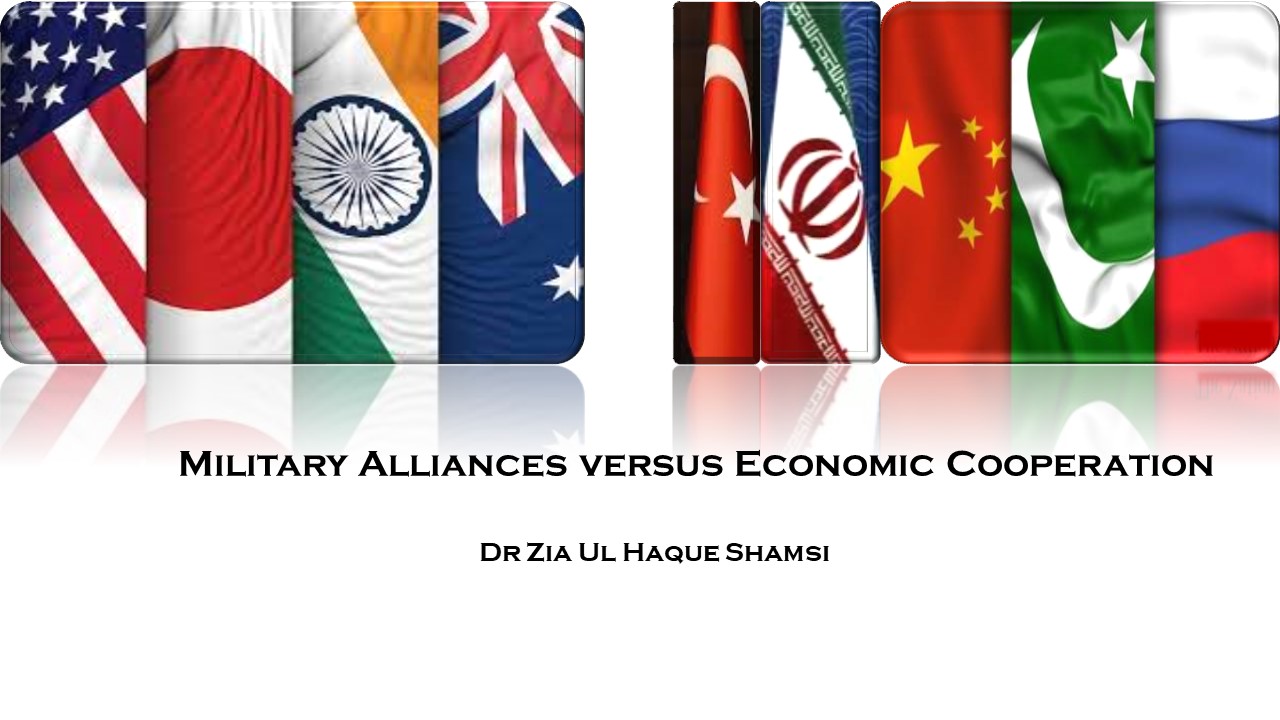
Pakistan appears to be making full use of the opportunity afforded through the China-Pakistan Economic Corridor (CPEC), which is a flagship project under the Belt and Road Initiative (BRI) of China. Pakistan’s landmass, perhaps, young population, has the capacity to offer yet another regional cooperative mechanism, which can have a multitude of benefits for all stakeholders. While reviving the age-old Regional Cooperation for Development (RCD) with Turkey, Iran, and Pakistan as its founding members, it can be expanded to include Russia, China, and Afghanistan. The inclusion of Afghanistan would give access to Central Asia and Russia would have access to the warm waters of the Arabian Sea. While Turkey would give easy access to Europe, Iran would open the doors to the Middle East. Pakistan could, hence, act as a bridge for the North-South, and Westward flow of people, goods and services for a population of over two billion.
On the other hand, India has chosen a path of collaborating with extra-regional and technologically developed states as its strategic partners. QUAD is comprised of the US, Japan, Australia, and India. “The core objective of the Quad is, to secure a rules-based global order, freedom of navigation and, a liberal trading system.” No matter what the stated aims and objectives QUAD holds, its apparent aim is to counter China’s global economic rise and military development in the region. This is because China has several territorial disputes in each of its regions: with India in Arunachal Pradesh in South Asia, and active disputes with multiple countries in the South China Sea. More importantly, though, China’s economic rise to the top is unstoppable now and therefore, US-led alliances are making an effort to slow down Chinese progress as space and military power as much as they can. For this purpose, the US may even be taking the risk of a limited military engagement over Taiwan even though China would be avoiding it.
An Evolving Global Order (EGO) is being drawn along two distinct lines – geostrategic and geo-economic, while geopolitical considerations are omnipresent. Surprisingly, India has chosen to join geostrategic formations which do not have regional linkages. India has active disputes with Pakistan (Jammu & Kashmir, Sir Creek, Siachen, water conflicts, etc.), as well as with China (Ladakh, Arunachal Pradesh, etc.).
India’s participation in QUAD may also be in the hope to get substantial support to settle its scores with Pakistan. However, India’s move would push Pakistan further towards China to address the evolving strategic imbalance in South Asia. India’s acquisition and deployment of the S-400 AD system and induction of French Rafale aircraft has already created a situation where Pakistan has no option but to enter into a conventional arms race unwittingly. For the same purpose, Pakistan is exploring its options and perhaps may soon induct J-10C aircraft from China and concurrently expedite its development and deployment of cruise missiles.
While Pakistan has embarked upon a journey under its developing geo-economic domain to redress its economic woes, India has decided to drag it back into the geostrategic domain where territorial security would eat up efforts necessary to ensure human security. However, India seems to be ignoring its active disputes with China where it is losing ground in Eastern Ladakh. Moreover, India’s claims that it is prepared for a two-front scenario, based on the hope of extra-regional support would increase the probability of a larger conflict in the region, which may not remain restricted to South Asia alone.
Dr. Zia Ul Haque Shamsi is Director Peace and Conflict Studies at the Centre for Aerospace & Security Studies (CASS), Islamabad, Pakistan. The article was first published in Daily Times. He can be reached at [email protected].
Image Source: Etfa Khurshid Mirza