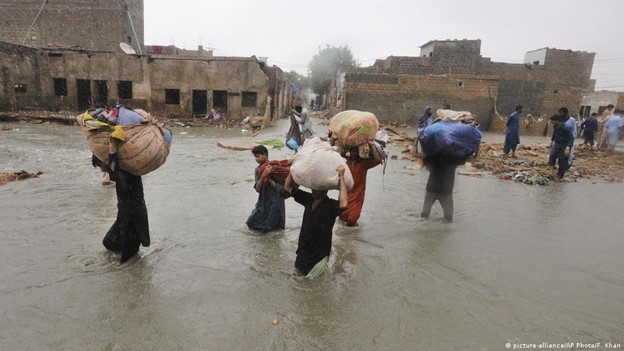
‘I go to get registered as an IDP and they dismiss me. I don’t want to live here. I don’t want my children out on the streets. In my village, I have little but I look after my family. They throw food at me like I am a beggar. I have never begged for anything in my life. Why do they treat me like this?’ Shauquat Ali, a disaster-induced internal migrant from Pakistan.
In their report ‘Moving Stories’, Alex Randall, Jo Salsbury, and Zach White draw upon testimonials of disaster-induced internal migrants to highlight their traumatic and often undocumented experiences. While Shauquat Ali’s narrative presents a relatively older account, it is a powerful example reflective of the disturbing consequences of disaster-induced internal migration from the point of view of the migrants. Such stories are perhaps frequent but often go unnoticed and underreported.
In this backdrop, International Federation of Red Cross and Red Crescent Societies (IFRC)’s 2021 report on Pakistan provides evidence that disaster-induced migrants after being displaced are deprived of their most basic rights ranging from the right to medical facilities and food to the right of adequate housing and livelihood opportunities. Similarly, a 2020 Sustainable Development Policy Institute (SDPI) report, based on their field work in Tharparkar and Muzaffargarh, showed that IDPs also suffer abduction of children and female migrants face sexual violence.
Disaster-induced internal migration is a global reality. Internal Displacement Monitoring Centre (IDMC)’s 2021 ‘Global Report on Internal Displacement’ revealed that a third of all such movements in 2020 occurred within the South Asian region. That said, Pakistan alone recorded 806,000 disaster-induced displacements—the third highest after India and Afghanistan. It is important to note that this figure is likely to be higher given missing data on unreported movements. The World Bank has forecasted that climate-induced migrants (inclusive of disaster-driven migrants) would constitute a quarter of all internal migrants within the South Asian region by 2050. While such future assessments are not definitive, however, the rapidity of climate change and Pakistan being one of the ten most vulnerable countries calls for taking serious policy action to tackle this challenge, especially for reducing vulnerability of the communities at risk as a first priority and granting legal protection to such migrants by enacting domestic legislation aimed at protecting their rights. Such prospects, however, appear bleak as long as disaster-induced migration in Pakistan goes unacknowledged in the policy debates as a human-rights or a human-security concern and the vulnerability of such migrants remains unrecognised.
While some progress is being made, by and large, it remains limited to the academic domain alone. The most recent example of this is the neglect of forced migration in general or climate-migration in particular as a matter of human security in the highly publicised ‘human-centric’ National Security Policy (NSP). As Shauquat Ali’s narrative illustrates, disaster-induced migration can threaten the foundational constituents of human security i.e., freedom from indignity, want, and hazard impacts of the migrants. However, while the formulators of NSP can be excused given the plethora of domains that had to be focused on, the omission of the subject of disaster-induced migration or acknowledgement of the vulnerable status of migrants in the national climate- and disaster-related policies speaks volumes about the invisibility of the plight of disaster-induced migrants within policy circles. Another case in point is the ‘National Policy Guidelines on Vulnerable Groups in Disasters 2014’ developed by the National Disaster Management Authority, according to which Pakistan’s ‘vulnerable segments’ include children, elderly, persons with disabilities, and women while omitting the category of migrants. Without doubt, the aforementioned category of individuals may experience heightened hardships as migrants. However, men—like children, women, and elderly—also encounter the unfortunate consequences of migration and deserve protection. Most importantly, the National Climate Change Policy of Pakistan, 2012 (NCCP) and its subsequent ‘Framework for Implementation of Climate Change Policy (2014 – 2030)’ remains silent on the plight of disaster-induced internal migrants. Even more regrettably, such policy documents by only pointing at the need for addressing rural-to-urban migration demonstrates that majority of the debates on migration within policy circles are not looking at this issue holistically. Given such skewed framing, the fact that Pakistan has not enacted domestic legislation for safeguarding the rights of Internally Displaced Persons (IDPs) in general is no surprise.
The plight of disaster-induced migrants can no longer be ignored, and state actors need to rethink how migration is seen and defined within the Pakistani context. This places a greater obligation on academics, campaigners and activists to increase awareness about this issue. While we need to enhance the resilience of communities at risk, it is equally important to grant legal protection by incorporating ‘UN Guiding Principles on Internal Displacement’ into national legislation and recognising ‘disaster-induced migrants’ as a category of IDPs. The UN principles would help prevent arbitrary displacement, ensure that IDPs are assisted and protected during and after displacement, and are safely returned, resettled or reintegrated.
Zahra Niazi is a researcher at the Centre for Aerospace & Security Studies (CASS), Islamabad, Pakistan. She can be reached at [email protected].
Image Source: Khan, S. 2021, “Is Pakistan Prepared to Deal with Climate Migration,” DW News, January 4, https://www.dw.com/en/pakistan-climate-migration-crisis/a-56126512