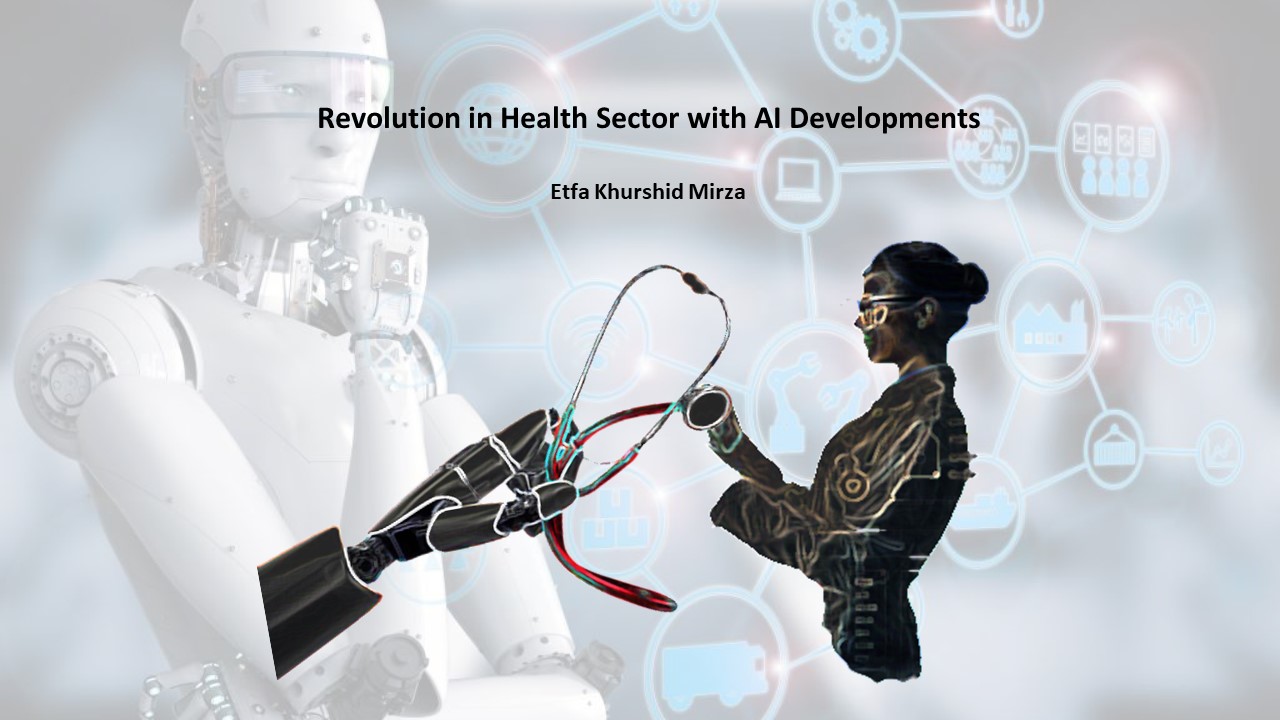
Developments in Artificial Intelligence (AI) have taken the world by storm. Whether for military or civilian use, the hybrid character of AI has placed it in high demand. On the one hand, the world is witnessing an AI arms race to dominate adversaries, while on the other, AI is being used to serve humanity. The widespread applications of AI in various sectors such as health, education and agriculture etc. depicts its significance in the civil sector.
Since AI is invisible to the human eye, it has induced changes in how the security landscape in particular is also adopting this technology. In this regard, a great deal of focus seems to be on its more harmful use. In all fairness, we should also see the benefits we can reap from this technology. One area where AI has proven to be beneficial is the health sector. Contrary to popular perception, AI applications have been used in diagnosing and treating diseases for nearly 50 years. One such example is the Natural Language Processing (NLP) application that is used to understand and classify clinical documentation.
Recently, scientists have found that AI can be used to study impacts of diseases on the human body and how these diseases can ‘alter the human body.’ The integrated system developed will help doctors to ascertain the difference in images down to single cell and study its effects after a disease or an injury. This tool has been named ‘TDAExplore’ and uses topology and AI to recognise alterations in the human body. In light of this, it can be assumed that AI will not only be helpful in solving existing problems in disease identification, but could also be beneficial in future studies.
One such potential use could be studying the cause and impact of the so-called ‘Havana Syndrome’. In the United States, four more cases of this syndrome were reported in Europe this year. According to US Secretary of State Antony Blinken, the government is investigating the matter. The ‘Havana Syndrome’ was first reported in Cuba in 2016, in which 16 US officials fell sick to a possible acoustic attack having symptoms ranging from hearing loss to mild brain injuries. Since, the cause and impacts of this mysterious illness remains unconfirmed, and microwave weapons are suspected to be a prime cause, this AI tool ‘TDAExplore’ could be used to study it. However, since this is a new tool and its effectiveness is as yet unproven, it may take time to reach any definitive conclusion.
Not only this, since the Coronavirus pandemic that World Health Organization (WHO) declared a Public Health Emergency of International Concern (PHEIC) in January 2020, now has a new variant named ‘Omicron’, AI can be used to help health practitioners to study and manage the pandemic’s spread and impacts. A study from last summer describes how AI can optimally be used for pandemic preparedness and response. It finds that 59-92% lives in the US could have been saved if the pandemic had been managed effectively. It concludes that there were machine learning solutions for effective management of the pandemic but some of them were not optimally used in the pandemic’s early stages.
Moreover, regarding the identification of presence of COVID-19 in the human body, scientists at the University of West Scotland have found a way to detect COVID-19 using AI. This method involves X-rays of an infectious person and gives results quicker than the standard Polymerase Chain Reaction (PCR) test and is claimed to be 98% effective. ‘The state-of-the-art technique utilises x-ray technology, comparing scans to a database of around 3000 images, belonging to patients with Covid-19, healthy individuals and people with viral pneumonia. It then uses an AI process known as deep convolutional neural network, an algorithm typically used to analyse visual imagery, to make a diagnosis.’ This method, once operational, will help quickly detect COVID-19 (faster than the 2-hr PCR) and can also ultimately help in curtailing the pandemic.
In the light of this, one can conclude that using AI applications in the health sector will not only help in diagnosis of pandemics such as COVID-19 but can also assist medical practitioners predict disease and damage outcome and longevity. However, the challenge is to ensure adoption of these applications in clinical practice, especially in South Asian settings.
Etfa Khurshid Mirza is a Researcher at Centre for Aerospace & Security Studies (CASS), Islamabad, Pakistan. Her area of interest is warfare and emerging technologies. The article was first published in Modern Diplomacy. She can be reached at [email protected]
Image Source: Etfa Khurshid Mirza