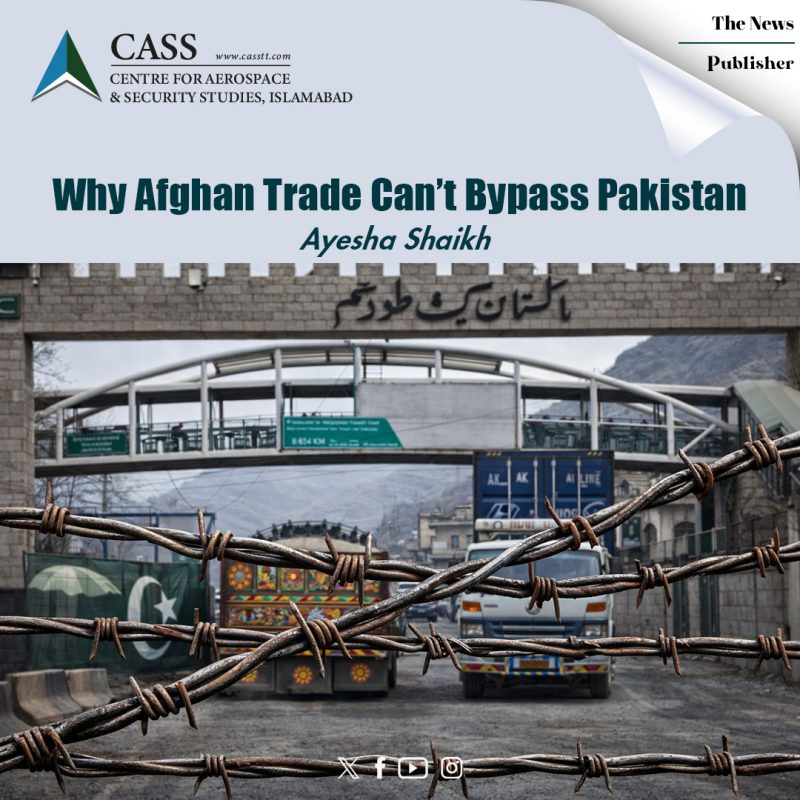
A year ago, the Sarhad Chamber of Commerce Industry (SCCI) and Pakistan-Afghanistan Joint Chamber of Commerce Industry (PAJCCI) reached a Memorandum of Understanding to boost trade between Pakistan and Afghanistan, only to end in doldrums in 2025. Due to the recent geopolitical tensions between the two states, the Taliban’s minister of commerce declared a trade boycott against Pakistan. While the move is compelled by the geopolitical rift, it is a miscalculated decision given the region’s geographical reality.
Despite the contention against the Durand Line, Pakistan has been an indispensable partner for Afghan trade and commerce under the Afghanistan-Pakistan Transit Trade Agreement (APTTA). From 2017-2024, Pakistan remained the largest trading partner as well as the largest export destination for Afghanistan and CARs. In the year 2023-24 alone, the Afghan transit traffic through Pakistan was around 73974 Twenty-Foot Equivalent Unit (TEU). The overall pattern indicates that there is an asymmetric trade interdependence between the two states, with landlocked Afghanistan on the vulnerable end.
The recent decision of Kabul to divert its trade away from Pakistan might be desirable for the Taliban leadership in the context of political tensions, but it is not a viable option. The three major alternatives that the Afghan government can possibly resort to include Iran, CARs, and China. These alternatives, however, cannot substitute Afghan trade through Pakistan but can only supplement indirect Afghan dependence on Pakistan.
While the Iranian route seems an attractive alternative to Pakistan, it is surrounded by numerous challenges. Firstly, Iranian ports do not offer immediate capacity to allow trade inflow to surge, as the Bandar Abbas port is already choked with traffic, whereas the Chabahar port is a relatively cost-intensive option. In the aftermath of the trade shutdown between Pakistan and Afghanistan, the Taliban government has approached India as an alternative. However, given the geographical and geopolitical circumstances, trade with India, either through the 843 nautical miles long route of Chabahar port or through air cargo bypassing Pakistan, is not feasible. Secondly, the recurrent Western sanctions on Iran and the non-recognition of the Taliban government can complicate the transaction process. To add more to it, the economic fallout of the geopolitical tensions in the Middle East can make Iran an even more unreliable trade route. Lastly, while Pakistan provides an efficient gateway to both the Eastern and Western markets, Iran cannot provide transit to the Eastern markets like China.
Similarly, the most critical challenge associated with the Central Asian trade route is that it is non-coastal. To further complicate the case, it is not accessible around the year due to the weather and terrain it is situated in; therefore, the CARs ultimately rely on Pakistan for the transit. For instance, Afghanistan recently had a Memorandum of Understanding (MoU) with Uzbekistan to divert its agricultural trade away from Pakistan. However, Uzbekistan has already signed Transit Trade Agreement (TTA) and Preferential Trade Agreement (PTA) with Pakistan for 17 items, including agricultural goods.
Another prospect that the Afghan government is likely to consider is China as a transit route through the Wakhan corridor. Nevertheless, as per China’s plan to extend CPEC to Afghanistan, Pakistan is the corridor to bridge China with Afghanistan. The route can supplement Afghan trade through Pakistan, but it cannot substitute it.
Furthermore, the domestic economy of Afghanistan does not allow a sudden shift in trade routes or transaction systems. Pakistan has been a reliable source of economic depth for Afghanistan throughout the history. Apart from hosting around 7.7 million Afghan refugees for over a decade, Pakistan has been providing cross-border aid, medical, and educational services to the Afghan nationals. Thus, the trade disruption between the two states can culminate in a humanitarian crisis as well. Therefore, a trade boycott against the core trading and transit partner is not a pragmatic option for the Islamic Emirate of Afghanistan to rely on.
Pakistan is relatively immune to the trade shutdown due to its diversified economy. The country is situated at the regional intersection and serves as an optimal route for regional connectivity. The pharmaceutical exports from Pakistan, denied by Afghanistan, can temporarily be channelized towards alternative markets like the CARs. However, the Pakistan-Afghanistan Joint Chamber of Commerce and Industry (PAJCCI) has appealed to the government of Pakistan to take necessary measures to resolve the issue, to avoid the long-term repercussions. According to PAJCCI, nearly 6000 cargo containers are stuck on both sides of the border, each one of them costing about USD 150-200. Considering the continuous stagnation in the diplomatic talks with the Afghan government, the government of Pakistan has maintained a steadfast position regarding counter-terrorism. However, the economic fallout has pushed the Ministry of Commerce to consider at least one-time movement of the vehicles stranded across the borders, till further orders. Therefore, mutual resolve will guard the stakes of both sides in the long run.
Political tensions are temporary, geo-economic realities are permanent. Therefore, the ultimate outcome of this political tension is going to be determined by the geo-economic reality of the region. Asymmetric trade-interdependence is likely to reorient Afghan decision-making towards reconciliation. While Pakistan remains open to mutual reconciliation with the steadfast stance against cross-border terrorism, for a sustainable regional order.
Ayesha Shaikh is a Research Assistant at the Centre for Aerospace & Security
Studies (CASS), Islamabad, Pakistan. The article was first published in The News. She can be reached at [email protected]