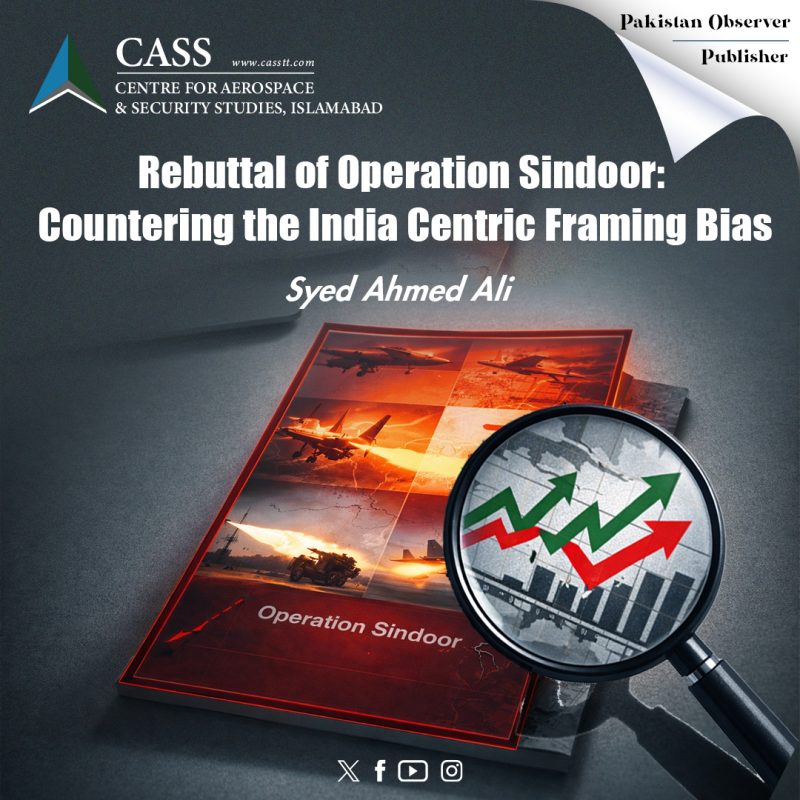
The recent account by the Center for Military History and Perspective Studies (CHPM), Switzerland, on the May 7th conflict between Pakistan and India reflects an over-simplification of a complex issue. The historical account suffers from selective framing and a lack of empirical verification, which skews the understanding of the Indo-Pak conflict.
Citing Operation Gibraltar and the Kargil incident, the article opens by depicting Pakistan’s foreign policy as an ‘instrument of Jihadism’. This is not only intellectually inappropriate but also an inaccurate account of Pakistan’s role in combating terrorism. Since 9/11, Pakistan has been a victim of terrorism, losing an estimated 70 to 80 thousand lives. As such, Pakistani armed forces have a history of combating terrorism, which includes elements of the Indian sponsored Baluchistan Liberation Army (BLA), ISIS-K (Khorasan), and Tehrik-i-Taliban Pakistan (TTP). While the article criticises Pakistan for its challenges in combating terrorism, it disregards its role in counter terrorism operations which have been globally lauded. Former CENTCOM Chief General Michael Kuriila had dubbed Pakistan as a ‘phenomenal ally and a key partner in regional security operations’. Contrary to popular perception, in spite of hostile relations, India and Pakistan have even cooperated and shared intelligence. In March 2016, Pakistani intelligence agencies shared intelligence with the Indian state of Gujarat of a possible terrorist activity in the Maha Shivratri festival. On the other hand, the Indian role in supporting clandestine operations is well documented, such as the case of the assignation of a Sikh leader in Canada, attempts in the US, and the capture of an Indian spy in Pakistan.
Regarding Kashmir, the authors are quick to point out the violence during the political struggle for freedom, but conveniently omit the background that causes such incidents. The valley of Kashmir has been subject to deep-rooted and systematic oppression from the Indian state, from the Jammu massacres of 1947 to the abrogation of Kashmir’s special constitutional status. In 2019, Genocide Watch issued a genocide alert for Kashmir, where it highlighted the use of legal instruments of Article 35A and 370 to change the demography of the region. The constant use of force, suppression, and violence has victimised the people of Kashmir, who are often dehumanised through labels of terrorism. While this in no way excuses the heinous actions in Pahalgam, it provides a much more informed context of the Kashmir crisis.
The CHPM report has embedded Indian strategic assumptions and ignored numerous ground realities about the Kashmiri freedom struggle. Firstly, a successful struggle requires a constant supply of ammunition, communication, and a haven to recuperate. Kashmir valley is considered to be one of the most militarised regions, which is dotted with barbed wires, jammers, check posts, surveillance drones, and around 700,000 heavily armed soldiers occupying the valley. In such conditions, establishing a logistic network is nearly impossible. Secondly, most of the Kashmiri leadership that had deep ties with Pakistan has either been killed or imprisoned. Most notably, Syed Ali Geelani died in 2021 during house arrest, while Yasin Malik, another leader, has been imprisoned for nearly three decades for his support to the Kashmiri struggle for independence. This has left the people of Kashmir isolated with no possible recourse to justice or political outlets, thus forcing them to turn to challenging Indian occupation, making the insurgency mostly homegrown. Ignoring these ground realities, the CHPM report implicates Pakistan in the Pahalgam incident, despite the fact that Pakistan had called for a neutral investigation and India had been unable to provide proof of Islamabad’s involvement. The evidence has not been provided to date. This sets a dangerous precedent where accusations of states and selective framing of history is sufficient grounds for the invasion of another state’s sovereignty.
With regards to the actual operation, the CHPM report lacks empirical verification for the claims made. While the report does acknowledge difficulties in verification, it has mostly relied on Indian citations as its primary source of information, which have not been cross-referenced with empirical evidence. This is despite the fact that the Indian media has been the main source of spreading fake narratives, a fact globally acknowledged. For example, the report displayed an image of the Jacobabad hanger which was reportedly struck, where it credited an F-16 kill without any proof. It may be noted that every F-16 loss can be confirmed by the US authorities. On another occasion, the report claimed a PAF Mirage III/IV was shot down, citing a disputed article with no conclusive analysis despite the fact that the Mirages were not the main PAF interceptor force. These statements, while hyperbolic, lack the necessary methodological rigor to make conclusive remarks.
Lastly, the report claims that the Pakistani authorities requested a ceasefire to the war of May 2026. This statement stands in stark contrast to President Trump oft repeated statements taking credit for brokering a peace agreement between Islamabad and New Delhi. This is particularly discomforting for the Modi government, which has positioned itself as a regional strongman, a narrative that has been reiterated on numerous occasions. To date, Mr Modi has shied away from meeting President Trump, who would most likely confront him about the seven aircraft losses in the initial hour of the Indian Strike.
The CHPM report on Operation Sindoor, while comprehensive and insightful, seriously suffers from an Indian centric framing bias. From its almost exclusive reliance on Indian references to adopting New Delhi’s strategic framing, the authors have created a distorted perspective of the conflict. Partisan framing does not help academic discussions; rather, it fuels a conflict-driven narrative, preventing a broader understanding of the clash between two nuclear states.
The article was first published in Pakistan Observer.