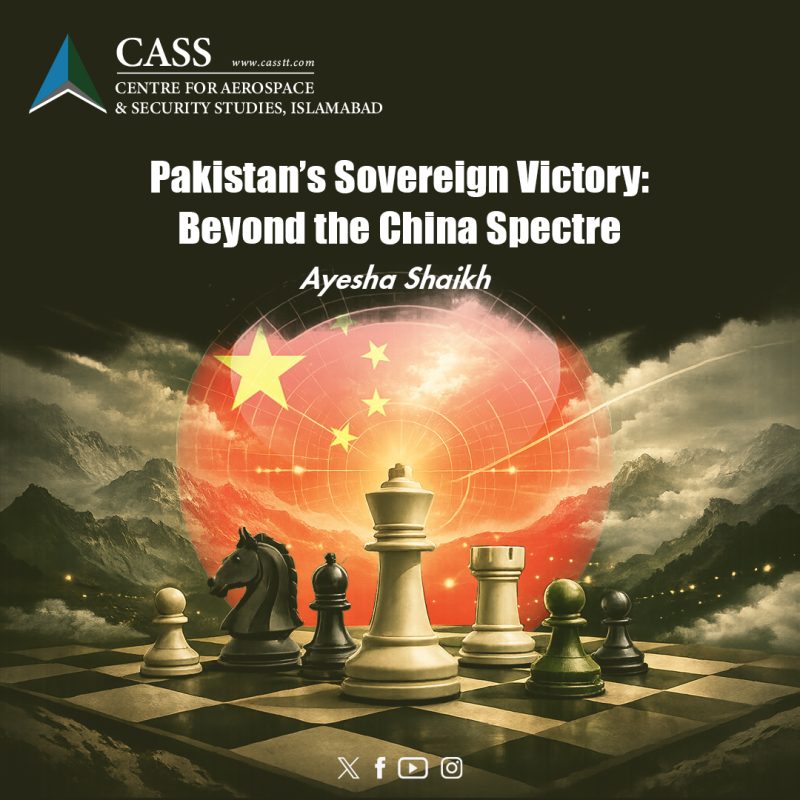
In an annual bid to review U.S.-China relations, the U.S.-China Economic and Security Review Commission’s (USCC) report for the year 2024-25 has overplayed the role of China in the Indo-Pak conflict of May 2025 to play down Pakistan’s Sovereign victory. Pakistan has been a prosperous market for Chinese defence equipment; however, the battlefield strategy of a state cannot be attributed to the arms provider. The report is a culmination of Indian narrative and Western anxiety, which can instigate regional instability.
The USCC submits a report to the U.S. Congress every year to review the trajectory of US-China relations. It is a comprehensive report, covering multiple dimensions of the antagonism between the two great powers. Chapter 2 of this year’s report regarding U.S.-China Security and Foreign Affairs has designated a section to the May 2025 conflict between India and Pakistan. It has not only portrayed the conflict as a test-bed for China’s defence technologies, but has also exaggerated China’s direct involvement in the conflict. Overall, it has projected to cast an apprehensive shadow over Pakistan-China relations as well as the involvement of China in regional conflict as a destabilising factor. However, the argument presented in the report is founded on miscalculated premises.
In May 2025, India instigated an intense 4-day war against Pakistan, which ended with a decisive advantage to Pakistan. In response to India’s escalation, Pakistan Air Force (PAF) successfully shot down several Indian aircraft, including French Rafales, and destroyed Indian military targets inside Indian territory. Resultantly, the Indian Air Force (IAF) faced embarrassment both at home and abroad. Ever since, Indian authorities have been shadowing Pakistan’s success under the false attribution of China’s involvement in the conflict, as a face-saving mechanism.
Pakistan and China have shared a relationship based on mutual cooperation for decades. Nonetheless, neither state has any commitment to battlefield support during a military crisis. The claim of China’s direct involvement in the conflict lacks convincing evidence. The USSC report cites false Indian claims of Chinese ‘live inputs’ to Pakistan regarding the movement of Indian forces.The claim is neither based upon evidence nor confirmed by China.
The report also alludes to the joint drills like WARRIOR-VIII and AMAN as an indicator of increased defence engagement between Pakistan and China, prior to the conflict. However, neither of these ventures can be related to the May conflict, as AMAN is a multinational naval exercise held by Pakistan in the Arabian Sea, and WARRIOR-VIII was a Sino-Pak counter-terrorism drill. Thus, the fall of Indian fighter jets cannot be attributed to any of these military exercises.
Furthermore, the report has referred to the concerns of French intelligence that China leveraged the conflict as a test-bed for its J-35 fighter jets, to hinder the sales of French Rafales. Whereas, the International community, including French and American authorities, have authenticated the fall of Indian Rafale jets. Nevertheless, if the conflict was a test bed for defence technologies, then the fall of Rafale jets can either be attributed to the failure of the IAF or French technology.
Therefore, the allegations of direct involvement of China in the May conflict are based upon the mutual anxiety of India and the West. India intends to shadow the victory of PAF under false claims of Chinese involvement as a face-saving mechanism. It will not only deflect the attention of domestic pressure but can also make India relevant in the Western circle again. By amplifying the Chinese spectre, India can present itself as the potential balancer in the region. Whereas, the U.S wants to engage China in a direct military confrontation, against the Chinese policy of restraint. Securitizing the China spectre serves the interests of the military-industrial complex of the U.S., which accounts for 40 per cent of the global arms export. The recent defence deal between the U.S and India, worth USD 92.8 million, is in line with other major benefits that the American Military-Industrial complex has reaped out of the China spectre. Therefore, projecting China as the mastermind behind the conflict as well as a destabilizer in the region is a convergence of the Western and Indian interests.
Moreover, the report has raised apprehensions regarding the 20 per cent surge in the defence budget of Pakistan, after reported offers from China to sell 40 J-35 fifth-generation fighter jets, KJ-500 aircraft, and ballistic missile defence system. Pakistan’s defence budget, after the hike, amounts to around USD 7.55 billion. Whereas the cost of one J-35 fifth-generation fighter jet is around USD 55 to USD 70 million per unit. Overall, the whole equipment reportedly offered by China requires tens of billions, while the inconsequential increase in Pakistan’s defence budget is for a regular operational activity. Therefore, the correlation established by the report is based on a miscalculated premise.
In a nutshell, Pakistan’s use of Chinese weapons is a matter of procurement choices, while the performance of the PAF deserves the credit for the sovereign victory of Pakistan against India. Casting miscalculated strategic shadows over sovereign wars cannot alter the battlefield reality; instead, it can instigate regional instability. Furthermore, mischaracterising war can also inflate great power tensions. Thus, strategic clarity is essential to ensure regional stability.