The nature of Indo-Pak relations has been turbulent right from the onset. Numerous events have influenced the trajectory of this bilateral relationship over time. In this regard, February 2019 stands out as both countries were on the verge of military escalation and nearly went to war, was it not for the foresight and restraint of Pakistan’s leadership. Five years on, the impact of those events is clearly visible in the region at the operational as well as political front.
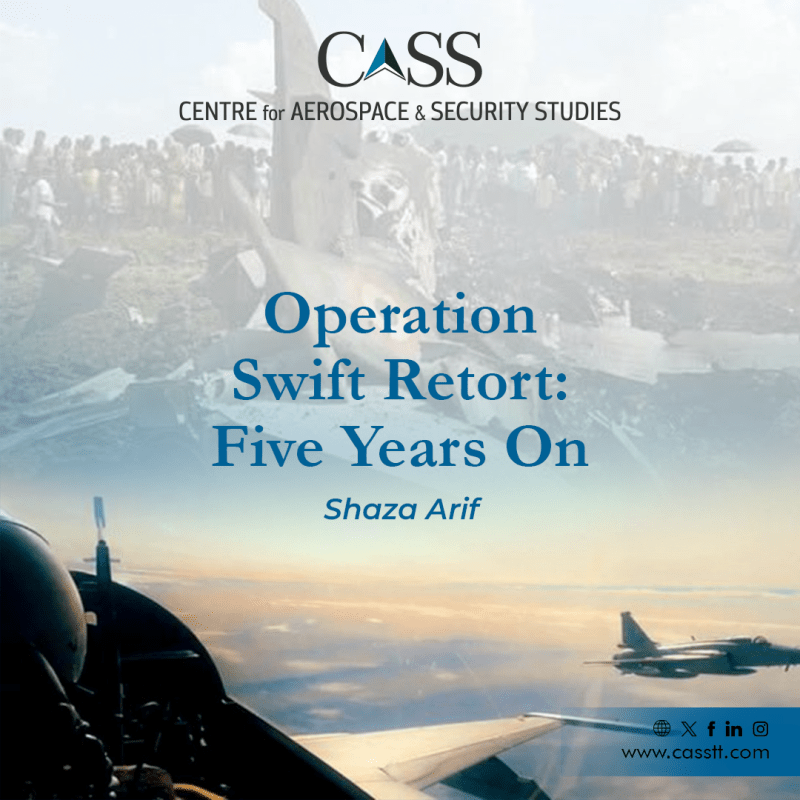
On 26 February, the Indian leadership tried to test Pakistan’s deterrence by violating the country’s airspace by a few miles. Pakistan Air Force’s response through ‘Operation Swift Retort’ the very next day resulted in downing two Indian aircraft. It was this act and the fear of another humiliation at Pakistan’s hand which has restrained India from carrying out another military adventure in the last five years despite the fact that bilateral relations are at a standstill. However, in future, probability of Indian aggression cannot be ruled out given the current regime’s hegemonic ambitions, new military acquisitions and a history of miscalculations.
On the political front, a continuous deadlock exists between the two states. Bilateral talks have been terminated, trade is negligible and people-to-people contact is sparse. This impasse has been further reinforced by New Delhi’s repressive approach towards Jammu and Kashmir. Abrogation of Article 370 and Article 35A on 5th August 2019, atrocities against Kashmiris at the hands of the Indian Armed Forces, electoral engineering and demographic changes continue to impinge relations.
At the moment, prospects of any constructive dialogue remain bleak. Apart from the February 2021 ceasefire agreement between Director Generals of Military Operations (DGMOs), there has been absence of any meaningful engagement between the two countries. A prime reason for this bitter atmosphere is the arrogant attitude of the Indian side. The Bharatiya Janata Party (BJP) sees India-Pakistan relations through its self-devised ultra-nationalistic lens and Pakistan is perceived as an unyielding neighbour in stark contrast with other South Asian countries. While Pakistan has repeatedly stressed that Pakistan desires peace with India, the same is not reciprocated by New Delhi. Aggression and hostility are defining elements of India’s foreign policy towards Pakistan. Jammu and Kashmir, which remains a core issue, is the last thing which India wants to discuss with Pakistan. Moreover, in the run to the General Elections in India scheduled this year, the stance has become even more intense.
In reality, as long as BJP is in power, such attitude ought to be expected. Unfortunately, there is absence of a strong opposition in India that can challenge the current government regarding its rigid and extremist policies. The main opposition party – Indian National Congress (INC) – is considerably weak, which has allowed the BJP leadership to unilaterally impose its will. Hence, the current Indian state is busy fuelling a polarised society and is least interested in mending relations with Pakistan.
The increasing antagonism from India is concerning. Various bilateral problems need to be sorted by the two states. A risk-tolerant regime, failure to address existing problems, and acquisition of new military technologies can increase the probability of another escalation, particularly when negotiations are out of sight. The presence of nuclear weapons further amplifies the cost of any potential conflict. Moreover, peace and progress will continue to suffer as a result of this rivalry and the region will be held back economically if there is persistent absence of bilateral engagement between India and Pakistan.
There is no room for dangerous military adventures. The Indian side must realise that it is headed in the wrong direction and its current policies are detrimental in the long run for the entire region. There is pressing need for a conducive environment where both states can have a rational approach towards each other. Pakistan has always demonstrated its positive intent and it is up to the Indian side to adopt a reasonable and responsible policy in this regard.
For Pakistan, 27th February is a day to celebrate the leadership and heroic bravery of the PAF. As part of its face-saving optics, across the border India will also revere its downed, captured and then released pilot. While it does so, one can only hope that it also rethinks the lessons from this important day.
Shaza Arif is a Research Associate at the Centre for Aerospace & Security Studies (CASS), Islamabad, Pakistan. She can be reached at [email protected].