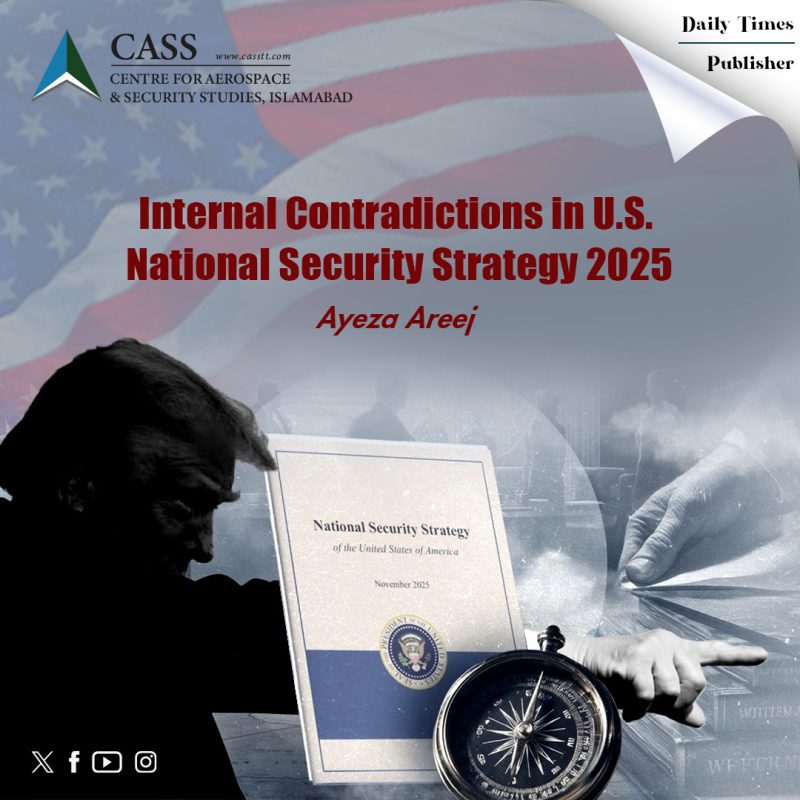
National Security Strategy (NSS) of United States, released by President Trump, intends to reform the miscalculations of past leaders and improve decades of Washington’s reach. Trump administration, as per the document, promises respect for sovereignty, restraint and renunciation of protracted global involvement. However, upon closer examination, the 33-pager document is full of internal inconsistencies. In contradiction to NSS, which vows to pull back from taking global responsibilities and adopts the policy of non-intervention, the U.S. pressurises other states through economic, military and political coercion.
Firstly, Trump highlighted non-intervention as the core principle of NSS, which states that the country should avoid foreign entanglements until its core national interests are at stake. Nevertheless, the strategy intrinsically opposes its own principles as the U.S. intervenes, militarily, politically and economically, in other state’s affairs. Trump proudly claims that the U.S. not only destroyed Iran’s enrichment capability through military strikes but also resolved eight international conflicts. Moreover, U.S. mobilization of aircraft carrier against a small country like Venezuela, which is already grappling with economic challenges, contradicts with its policy of non-intervention.
Secondly, NSS criticizes past American leaders for overstretching U.S. power, which resulted in diminished U.S. pre-eminence. The strategy claims that Trump has changed the direction by focusing on a more realistic foreign policy. Principally, if U.S. wants to reduce its reliance on military, it must use cooperative, diplomatic and persuasive modalities to expand its area of influence. However, to achieve this transition, the strategy does not explain any explicit mechanism. Rather, Trump plans to pressurise other states through coercive measures, like sanctions, tariffs and threats. Yet, these coercive means can only cultivate transient compliance, not durable cooperation.
Moreover, U.S. preference for coercion is further exacerbated by policies that erode its soft power. As depicted by Mr. Trump’s retreat from USAID, Voice of America, World Health Organisation, and Paris Climate agreement. NSS is not only weakening U.S. credibility but also limiting its soft power by overtly disliking and contesting the role of international organizations and multilateral frameworks.
Another major self-contradiction lies between ‘Flexible Realism’ and political intervention. According to flexible realism, which is a core principle of NSS, U.S. will respect governance systems, religions and cultures of other states. The strategy criticizes past U.S. approach of hectoring of Gulf monarchies. Yet, the principle stands in stark contrast with U.S. approach towards Europe. The document criticizes European governments for subversion of democratic systems and explicitly shows support for ‘patriotic European parties.’ It states, ‘U.S. will be cultivating resistance to Europe’s current trajectory within European nations,’ which portrays its desire of interfering in internal political dynamics of Europe.
This selective respect for sovereignty exposes a strategic contradiction in NSS. Europe, as per the NSS, should increase its defence spending and strengthen its economy while simultaneously it strongly opposes immigration. This goal of making Europe economically resilient is challenged as immigration plays a crucial role in maintaining the workforce of Europe. Restricting immigration would result in deterioration of economic growth and reduction in defence spending. By associating migration with ‘civilizational erasure,’ the White house is trying to shift the narrative from actual concerns towards ethno-nationalism. U.S. intervention in Europe will not only shatter the global image of U.S. but also jeopardize the transatlantic relationship.
Apart from that, the strategy promotes ‘burden sharing’ by demanding allies to spend more on defence rather than relying on America. Yet, simultaneously, U.S. wants to monopolize economic benefits, which shows incongruity in the national framework. The strategy following the principle of ‘America First,’ aims to achieve this objective by bringing ‘industries back to America’ and monopolising defence contract solely for U.S. Furthermore, the document asserts, ‘propping up the entire world order like Atlas are over,’ which presents America as a sovereign and independent state. However, at the same time, the document claims dependence on coalitions to secure First Chain Islands and critical minerals in the African Region, showcasing a clash between operational reality and ideology of Mr. Trump. These actions can undermine credibility of U.S. while impacting alliances, eventually resulting in reduced American influence.
Next, NSS has shifted the trajectory of U.S. by giving atypical attention and priority to Western Hemisphere. It has framed drug trafficking and transnational criminal actors as the major threats for national security. These issues are important. However, internal reforms and regional cooperation can mitigate these threats. By securitizing these threats, the White House is raising important question of whether these peripheral issues are compromising strategic imperatives and becoming a reason for misallocation of resources.
Lastly, the strategy points out Iran as the ‘chief destabilizing actor’ in the Middle Eastern region. Nonetheless, instead of presenting a concrete action plan for countering Iran, the report places primary emphasis on Europe and Western Hemisphere.
The NSS of U.S is at war with itself. The self-contradictory document promises deference for sovereignty while practicing political interference. It urges restraint but relies on coercive diplomacy, promotes burden sharing while also aiming to monopolize advantages. President Trump, while asserting dominance, wants to get rid of global responsibilities. Fundamentally, NSS is a contradictory document, which reveals a power paradox in the U.S. approach towards the world.
Ayeza Areej is a Research Assistant at the Centre for Aerospace & Security Studies (CASS), Islamabad, Pakistan. The article was first published in Daily Times. She can be reached at [email protected]