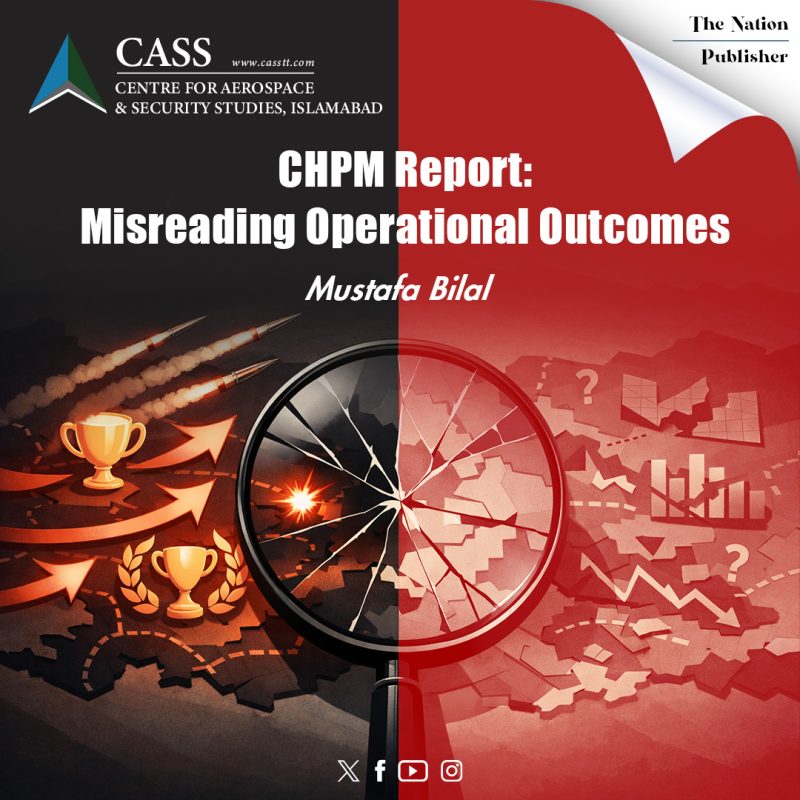
In modern conflicts, the fog of war does not clear as ceasefires commence; it only gets thicker and becomes a fog of narratives. It is in this post-conflict situation that military historians have the responsibility of undertaking impartial analysis as they scramble to find coherence in chaos. As a caution, they should avoid prematurely echoing any one side’s narrative and instead endeavour to interrogate all claims with balanced scepticism. The Centre for Military History and Perspective Studies’ (CHPM) exploratory note on Operation Sindoor falls short of this mark.
It reads like an amplification of the aggressor’s narrative and, in turn, emboldens further aggression. Without understanding the basics of air warfare, the author declares that India had achieved air superiority and coerced Islamabad into requesting a ceasefire. He issues this verdict despite conceding that cross-referencing claims and undertaking accurate battle damage assessments is extremely difficult, if not impossible. Herein lies the central paradox of the study.
The CHPM note does not attempt to resolve this underlying contradiction. Instead, it tries to make sense of the ambiguity through a biased, selective framing. The detailed press conferences of the Pakistani Air Force (PAF) are introduced as exaggerated claims. The author ignores how Pakistan’s military success over India in the four-day conflict and the loss of 7 IAF aircraft have been recognized internationally, notably in numerous reports, including in a report of the US-China Economic and Security Review Commission, which acknowledges some losses. Moreover, PAF successes are being studied by global aviation experts such as Alan Warnes of Air Forces Monthly for their strategic and tactical brilliance.
On the other hand, all fabricated claims propagated by the Indian Air Force (IAF) are presented as documented or corroborated. For example, the note repeats claims of IAF’s S-400 intercepts, forgetting that the claims surfaced months after the actual war and were not even declared in the Indian Parliament’s Monsoon Session, where the IAF’s embarrassing performance was thoroughly discussed. Whereas Pakistani counterclaims of an S-400 radar hit are considered as unverified assertions.
Notably, the discovery of PL-15 debris on Indian soil is interpreted in a way that highlights the expertise of Indian pilots in evading missiles. Not as evidence of successful kills by the PAF. This would remind readers of a running pun in online military aviation circles in which the side incurring heavy losses states that their aircraft successfully intercepted the incoming missiles.
Relatedly, claims of downed aircraft are introduced deceptively. The author only acknowledges the loss of one Rafale by the IAF instead of the four lost in action, whereas the IAF’s fabricated total of downed PAF aircraft tends to take on the mantle of a settled fact. The author totally disregards the fact that there is widespread skepticism within the Indian academia itself regarding the veracity of claims made by the Indian military leadership in press conferences convened under pressure months after the actual war.
There are also glaring similarities between the exploratory note and the Indian government’s operational account of Sindoor based on how it analyzes the dynamics of escalation and restraint. India’s strikes are characterised by terms like calibrated, demonstrative, and prudent. Meanwhile, Pakistan’s retaliation is considered ineffective or escalatory, forgetting that for the first time in the subcontinent’s history, the entire Indian geographic depth was in PAF’s strike range. The author does not consider the possibility that, after US involvement, both sides mutually agreed to step back from a dangerous precipice. Instead, he has devoted more attention to the assertion that one side imposed its will on the other to request a ceasefire.
This framing comes to a head in the most concerning operational misreading of the exploratory note: its implicit consideration of the ceasefire as proof of the primacy of conventional superiority over nuclear deterrence. To say that a four-day conventional exchange is an affirmation of freedom of action in a nuclearised environment is not only analytically careless, but it is also strategically reckless.
De-escalation was grounded in the recognition by both sides of the disastrous possibility of nuclear spillover, rather than because of the achievement of one-sided decisive dominance. Recasting mutual restraint as unilateral coercion contributes to a dangerous illusion that the escalation ladders in any conflict between Pakistan and India are longer and safer than they really are.
The institutional context offers a magnifying glass to examine the overall biased analysis in the exploratory note. The translator of the publication is a former French Air Force officer who had professional links to the Rafale programme and Indian educational institutes. It is important to highlight this background because one’s analytical frameworks are shaped by a history of professional and institutional connections.
Therefore, it is reasonable to question whether the operational interpretations of the conflict have been influenced by institutional predispositions. In this context, if the side that enjoys better access to Western satellites, Western media reach and Western institutional alignment has its narrative portrayed as baseline reality, then biased analysis becomes narrative power projection.
Drawing from the previous discussion, the major takeaway of the CHPM exploratory note on Operation Sindoor is that scholars analysing conflicts must resist the temptation to turn ambiguity into biased affirmation. True rigour is the application of symmetrical skepticism and questioning one’s institutional predispositions while undertaking such a study. More broadly, the exploratory note underlines how modern wars are fought twice in the age of social media, first in the physical battlespace and then in cyberspace. If military scholarship surrenders the second fight to the convenience of the aggressor’s narrative, then it doesn’t merely misread the past; it helps to initiate the next crisis by further emboldening the aggressor.
Mustafa Bilal is a research assistant at the Centre for Aerospace & Security Studies (CASS), Islamabad.
The article was first published in The Nation.
He can be reached at: [email protected]