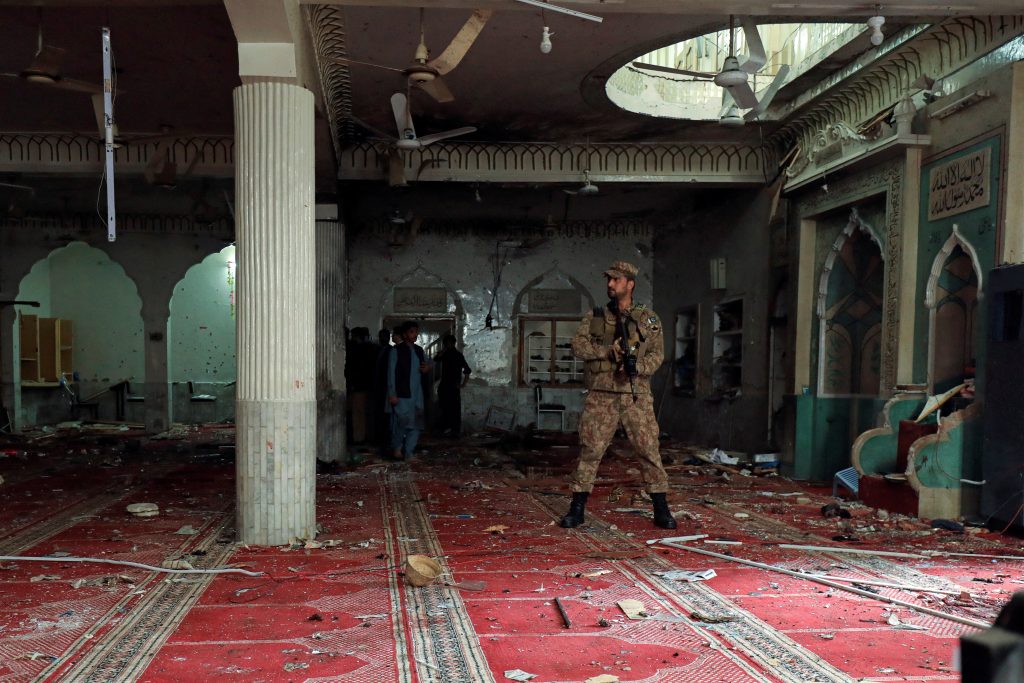
While Pakistan remains engrossed in the ongoing political alterations, the nation’s enemies unabatedly continue to carry out terrorist attacks across the country. Terrorist attacks on a wide range of targets, including security forces, VIP convoys in Balochistan, a mosque in Peshawar, police checkpoint in the capital Islamabad, buzzing Anarkali market of Lahore, and many others indicate the return of another dreadful wave of terrorism. The security forces seem to be the primary targets on the terrorists’ hit list. In just three months of 2022, 97 security personnel have embraced martyrdom in different terror incidents across the country. The diverse nature of targets also indicates that the terrorist outfits behind these attacks originate from a diverse set of political, religious, and sectarian ideologies.
One of major such outfits, Tehrik-Taliban Pakistan (TTP) is mainly focused on targeting security forces. The group recently announced a Ramadan offensive under which it warned of conducting ‘suicide operations, ambush attacks, mine operations, counter-attacks, target attacks, laser and sniper operations’ against the security forces of Pakistan. Meanwhile, responsibility of the attack on a Shia Mosque in Peshawar was claimed by ISIS. The Baloch separatist factions are targeting both security forces, such as attacks on security check posts in Kech, Naushki and Panjgur as well as on the general public, e.g., the Lahore blast.
TTP’s linkages with the Afghan Taliban explain their safe havens there and their intensified ability to launch attacks against Pakistan despite the latter’s repeated demands of action against it. Since the withdrawal of foreign forces, Pakistan has been seeking the resumption of aid for millions of Afghans who are on the brink of a humanitarian catastrophe. Pakistan’s biggest concern is that an impoverished and unliveable Afghanistan will result in another wave of Afghan refugees which will cause grave economic and security issues for the country all anew. However, many considered this as a gesture of recognising the Taliban regime in Afghanistan also known as the Islamic Emirate of Afghanistan (IEA). But the fact is Islamabad made Kabul’s handling of TTP a ‘test case’ for the new Afghan rulers to build their anti-terrorism repute. Now that TTP’s activities against Pakistan are intensifying, Islamabad has urged the Afghan Taliban to secure the Pakistan-bordering region. The recent drone strike in the latter areas was a result of the surge of lethal attacks across the country. While the talks with the Afghan Taliban on Pakistan’s red lines when it comes to its territorial integrity have been conveyed time and again, the drone strike targeting the TTP base near the border should come as a warning sign that Pakistan will not allow any breach of its sovereignty.
The Afghan Taliban must realise that Pakistan is one of the very few actors that are willing to help it come out of its mammoth political, diplomatic, economic, and security difficulties. The government should also understand that Kabul largely depends on Islamabad for a number of affairs. To alienate a nation that is one’s only gateway to the rest of the world for economic aid, refugees as well as transit matters is very detrimental for one’s survival. Therefore, Afghanistan must be clearly intimated that any assistance or aid is conditional on fulfillment of its promise to not allow Afghan soil to be used against Pakistan.
Moreover, reinforcing of ISIS in Afghanistan and its resultant contest for power against the Taliban present both countries an opportunity to cooperate against this extremist outfit. This approach can also garner dividends for Afghanistan as this factor can also be used to garner support from the international community sorely needed by the country.
The resurgence in ethno-nationalist and sectarian violence is also highly damaging for national cohesion and integrity. Any internal rifts may again bring Pakistan face to face with the challenges it has been fighting for the past many decades. The state should be extra cautious in apprehending extremist ethno-nationalist elements particularly in the socioeconomically marginalised communities so as not to alienate them further. In this backdrop, the state must target the terrorists’ recruiting base which thrives on appealing to the economically and ideologically exploitable section of society. The sincerest efforts must be made to address the poor socio-economic conditions in such sections to curb extremist elements that may further fuel anti-state sentiments.
Additionally, to curb the ideological appeal of terror outfits, effective public awareness campaigns should be launched to weaken their narrative on religious and political ideologies. Public must be fully made aware of the state’s anti-terrorism policies. Grievances of communities which are most at risk of being manipulated against such policies must also be catered.
The changing security dynamics in the region are having a direct impact on Pakistan. If a comprehensive terrorism prevention strategy is not adopted immediately, the fatal surge of terrorism will have huge social, economic, and diplomatic consequences. Therefore, a multi-pronged approach is needed as soon as possible to not let the gains of the last two decades get undone.
Khansa Qureshi is a researcher at Centre for Aerospace & Security Studies (CASS), Islamabad, Pakistan. The artice was first published in Global Village Space. She can be reached at [email protected]
Image Source: Ansari, Neha. 2022, “A terror redux in Pakistan?,” Atlantic Council, March 15, 2022 https://www.atlanticcouncil.org/blogs/southasiasource/a-terror-redux-in-pakistan/