
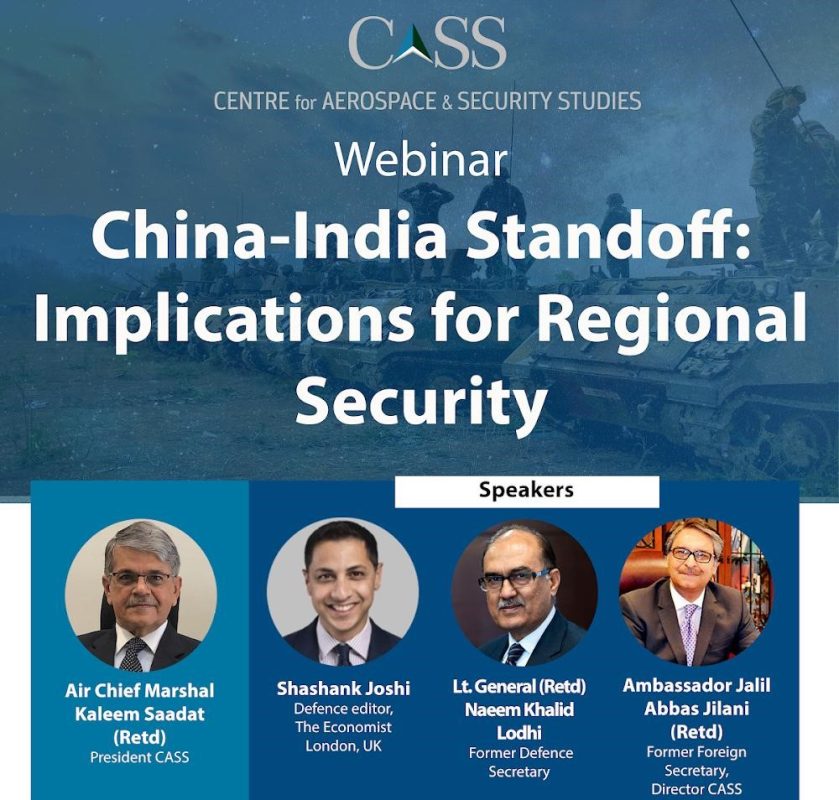
Centre for Aerospace and Security Studies (CASS) hosted a webinar titled “China-India Standoff: Implications for Regional Security” on June 18, 2020. The event was organized to analyse the evolving crisis between China and India and
its impact on regional security. President CASS, Air Chief Marshal Kaleem Saadat (Retd) chaired the session. The panelists included Mr Shashank Joshi, Defence Editor, The Economist, Professor Shen Dingli, Fudan University, Lt. General (Retd) Naeem Khalid Lodhi, Former Defence Secretary, and Ambassador (Retd) Jalil Abbas Jilani, Former Foreign Secretary, Director CASS. Senior Research Associate Ms Sitara Noor moderated the session.
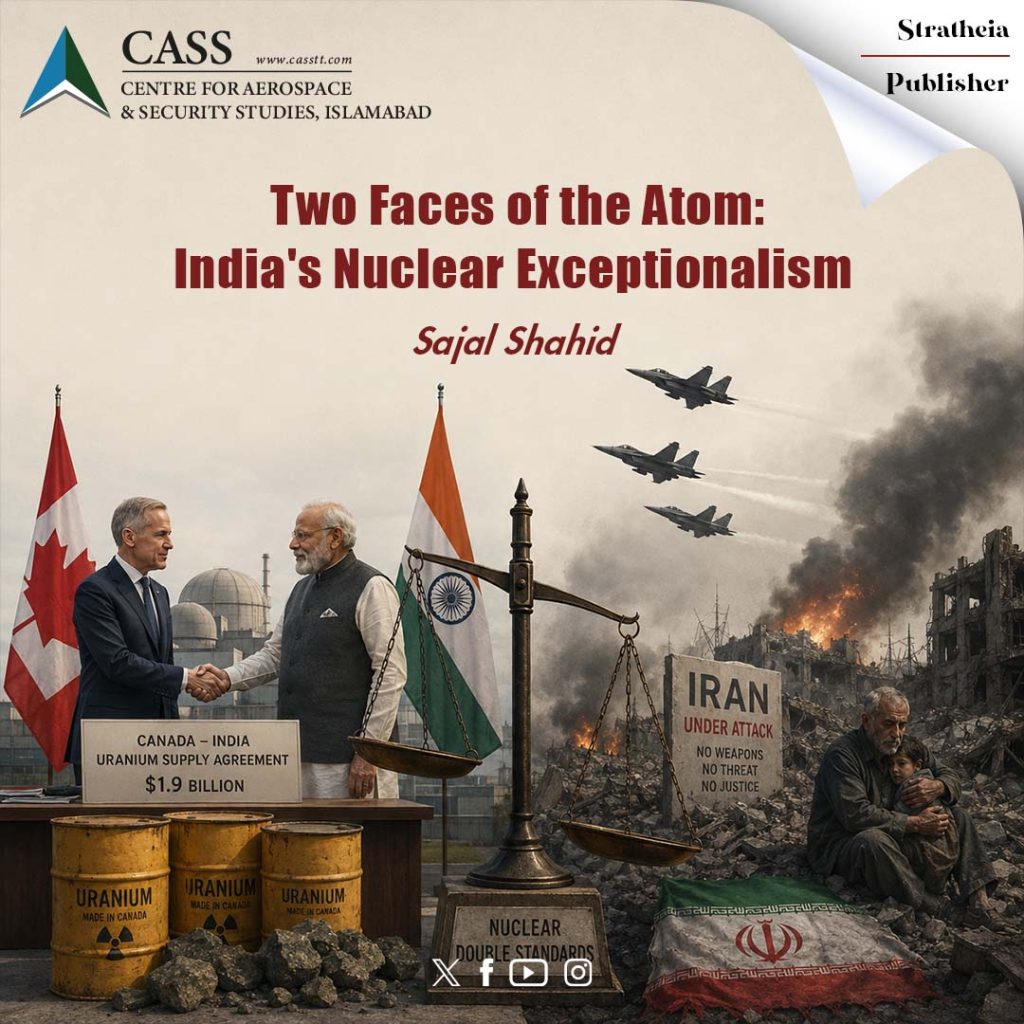
Two Faces of the Atom: India’s Nuclear Exceptionalism
ew examples capture the inconsistencies of the nuclear world order more starkly than the events of 2 March 2026: as Prime Ministers’ Mark Carney and Narendra Modi signed a landmark 1.9 billion USD uranium supply deal for India’s civil nuclear sector, Iran was subjected to the third day of indiscriminate airstrikes by the US and Israel under the banner of nuclear non-proliferation, despite Iran agreeing to zero stockpiling of enriched uranium just days prior. This event, unfortunately, was not an isolated one, rather it reflects a pattern of nuclear exceptionalism where certain states such as India, continue to be rewarded for non-compliance with international regulations, while others such as Iran, are censured and even subjected to military action based on hypothetical realities.
The latest deal would see Canada sell close to 22 million pounds of uranium concentrate to India over 8 years, starting in 2027, a sale more than ten times the last Canada-India uranium agreement of 2015, which supplied 7 million pounds of concentrate over 5 years.
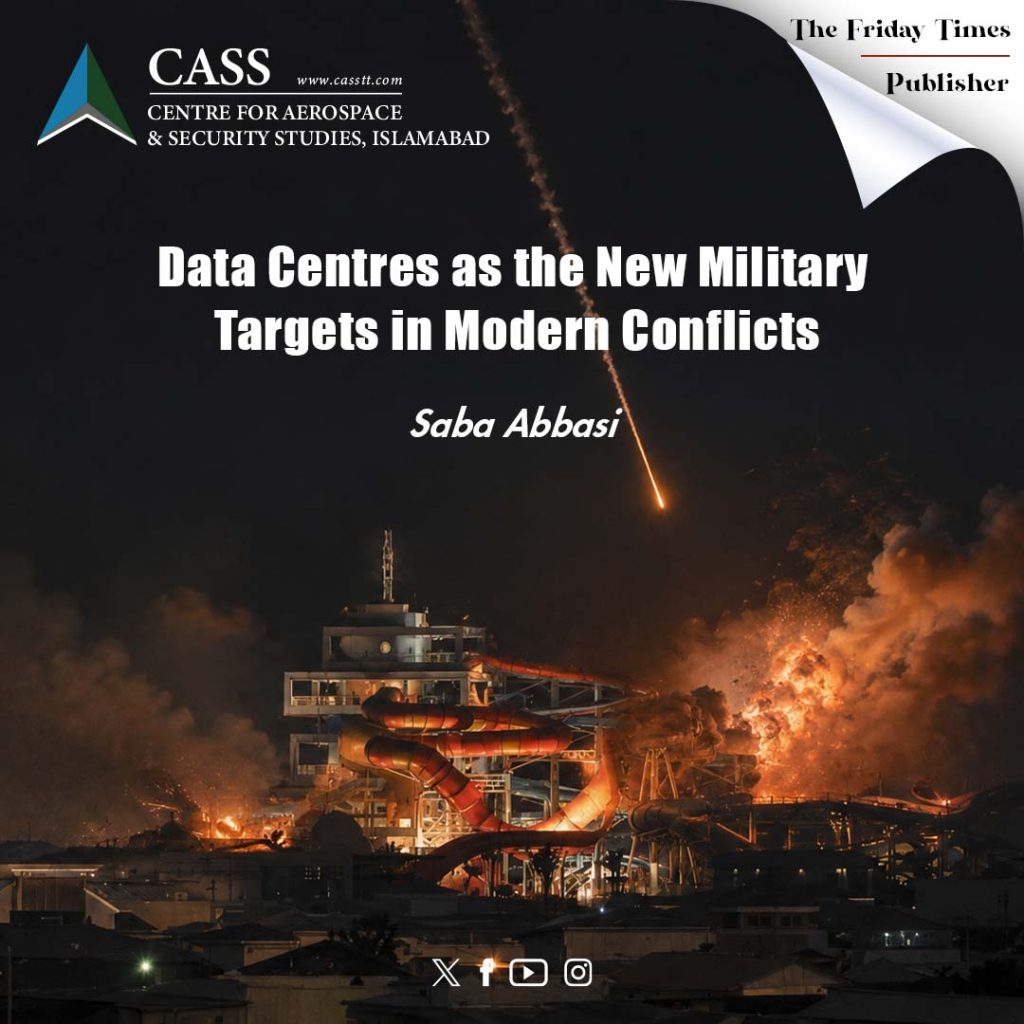
Data Centres as the New Military Targets in Modern Conflicts
The character of warfare has evolved in tandem with the changing nature of military targets. In early March 2026, Iran bypassed traditional military targets and struck the physical part of the digital infrastructure at Amazon Web Services (AWS) data centres in the UAE and Bahrain. Until now data centres had been considered an unassuming target, as they did not house any military equipment or hardware. However, the US-Israel war on Iran, has transformed these billion dollar sites into high-value targets because of their ability to act as server farms on which adversaries’ websites, apps, AI systems and the entire digital infrastructure run.
Data centres are digital ecosystems where the delivery of cloud services depends on the integrity of physical infrastructure. Disruption in any one part of the shared infrastructure does not remain isolated and risks triggering widespread systemic failure. In the case at hand, Amazon operated multiple availability zones within each region in the United Arab Emirates and Bahrain. Iran struck two of the three availability zones in the UAE, while in Bahrain, a zone was damaged by drone debris causing an extended power outage and connectivity problems that further disrupted service across the Gulf.

The Sovereign Shield
Pakistan’s defence industry is gearing up from a localised purchase requirement to a globalising high-tech export industry. For long the military-industrial complex of Pakistan had been dominated by military needs of the border security and the costly importation of foreign technology. This tendency, however, seems to be reversing slowly. Pakistan is attempting to edge closer to a model of self-reliance in this regard in terms of tactical security and geoeconomic rebalancing that is spearheaded by the JF-17 Block III, the Super Mushshak, and the unmanned systems. This is very clear in its international defence contracts of between 10 to 13 billion dollars.
But export headlines simply aren’t enough to succeed. The defence ecosystem of Pakistan is built on the basis of a strategic triangle in which the PAF is the challenging end-user and technological enabler of the defence ecosystem, a nascent domestic defence sector with focus on platforms such as the JF-17 and the overall economy that will have to eventually underpin and benefit of the activity. The first two legs have demonstrated great strength. The most challenging one is the economic leg, however. Export spikes can be short lived unless structural reforms are adopted. It is the work to be done by chance, that is to assemble these three factors in a self-sustaining system.
