The ongoing conflict between Afghanistan and Pakistan is also rooted in colonial divides and the incomplete American project in Afghanistan. The 2640 km long Durand line, between the two states, has a long history ingrained in political contention and geographical challenges. However, the solution to this contention lies beyond historical shadows and conventional tactics of border management.
The legal foundation of the Durand Line is based on the agreement reached between the representative of the Imperial British colony in the subcontinent, Sir Mortimer Durand, and the Emir of Afghanistan, Abdur Rahman Khan, on 12 November 1893. However, the legal foundation faced contention from the Afghan side in 1947, as soon as the Radcliffe award announced the contours of the decolonised state of Pakistan. The Afghan authorities declared that the agreement was signed under colonial duress. Thus, following the decolonisation of the subcontinent, they denied legal compliance with the agreement.
The contention of subsequent Afghan authorities is based on political considerations, against any legal premise. Firstly, the Afghan authorities argued that the Durand line agreement was reached with the British authorities, and the decolonised state of Pakistan was not an eligible party to the agreement. Secondly, they considered it an outcome of colonial hijack. Lastly, it has also been claimed that the agreement was supposed to last for a hundred years till 1993. Therefore, they denied the legal status of the Durand line.
On the contrary, Pakistan has maintained its stance in compliance with international law. The status of the Durand Line was consolidated as an international border in the Geneva Accord of 1988 and numerous resolutions of the United Nations Security Council, like Resolution 1276. Furthermore, the legal duty of Pakistan to inherit the Durand Line agreement is well established by Article 62 of the Vienna Convention on the Laws of Treaties, and Article 11 of the Vienna Convention on the Succession of States. Pakistan has not only inherited the external boundaries of the former British colony but also the agreements reached by the British crown, as a recognised legal personality. Nevertheless, Afghan authorities have kept this issue confined to the political narrative, as Afghanistan has never contested the issue at any international forum.
Furthermore, the consecutive waves of instability in Afghanistan, created multitude of challenges. From Soviet invasion of Afghanistan to the rise of the Taliban after the withdrawal of the U.S., Pakistan has been on the receiving end of instability in Afghanistan. The permeable border has allowed transfusion of threats across the border. From the influx of refugees to the rise of militancy, Pakistan has paid the highest cost of instability on the other side of the Durand Line. Attempts at consolidation of the border through conventional modes, however, have intensified the grievances and militancy across the border. Pakistan started fencing the contested border in 2017 and completed more than 85 per cent of the project by the time Taliban government took over again. The frequency and intensity of the terrorist incidents, nonetheless, has been on the rise with highest number of attacks in 2025. Thus, the issue also requires unconventional modes of border management.
The rugged terrain of the North-western frontier, the ethnic distribution across that terrain, and the tribal organisation of society demand an unconventional mode of border management, for instance the SMART (Secure, Measureable, Automated, Risk-based Technological) mechanism. Cutting trade and ties off has not only attracted criticism and anti-Pakistan sentiment in the areas proximal to the Durand line, but also a surge in economic and humanitarian costs. Furthermore, kinetic actions to curb the terrorist threats have restrained the hostile elements for the time being, but the threat persists.
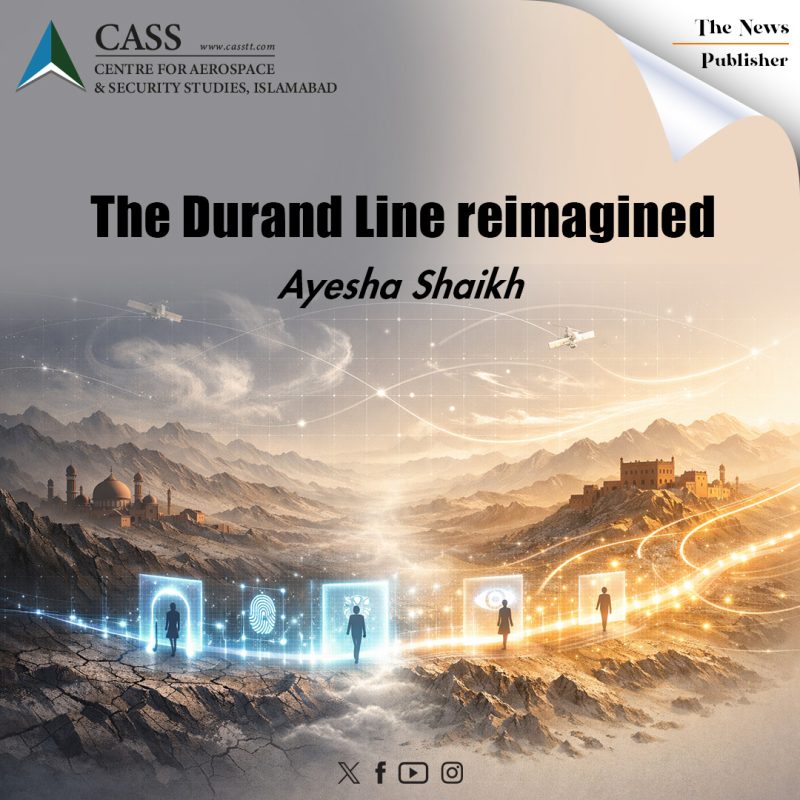
The solution to the problem lies beyond the hostile history of the Durand Line. Modern technology has provided convenient modes of border management, unlike the conventional fencing and patrolling. Traditional border fencing can only turn out to be effective if coupled with technology, including drone and satellite-based surveillance, through AI-integrated systems. Furthermore, digital systems can be embedded at the border through a Geographical Information System (GIS) for keeping a record of weather and terrain-related aspects of the Durand Line. Finally, an integrated biometric system can be used to avoid illegal border crossing. However, this upgradation is only possible with the mutual consent and commitment of both states.
Therefore, Pakistan and Afghanistan should optimise the temporary ceasefire to reach a firm ground of mutual resolve to settle the issue, given that geography is a permanent reality, but political frictions are transient. With a permanent legal and technologically implemented solution to the political contention, the Durand Line can serve as a corridor for trade, connectivity, and people-to-people linkage, provided the convergence of authorities from both sides on the eradication of militancy materializes. On long term basis the common grounds of ethnic, religious, and civilisational linkages are bound bring the states together.
Ayesha Shaikh is a Research Assistant at the Centre for Aerospace & Security
Studies (CASS), Islamabad, Pakistan.The article was first published uin the News. She can be reached at [email protected]