
On April 22 an incident was reported in Pahalgam – a tourist destination in Indian Illegally Occupied Jammu and Kashmir (IIOJK), where 26 tourists, were killed. The Resistance Front, allegedly, claimed responsibility, shattering the Indian government’s claims that the situation in IIOJK was normal. Despite heavy presence of LEAs and media projection, the Indian government failed to suppress the public outrage in the Valley, post-abrogation of Articles 370 and 35A in 2019. It is, however, believed that the Pahalgam violence is not a standalone act of unrest; it could be the outcome of repression simmering over the years due to underlying grievances in local Kashmiris.
Article 370 grants an empowered status on a special basis; that is, absolute autonomy of the State of Jammu and Kashmir in all affairs except defence, communication, finance, and foreign affairs. Article 35A, for its part, gives special rights and privileges to the Kashmiris associated with it, including property ownership and employment. The article barred persons other than Kashmiris from purchasing and owning properties in IIOJK. Kashmiri women marrying outside were not even allowed to have property ownership in IIOJK. In practice, such clauses granted a range of privileges to the indigenous population, supporting the preservation of their identity, demographic composition, and cultural heritage in the Indian occupied territory. However, with the abrogation, many of these rights and protections previously afforded to Kashmiris were withdrawn.
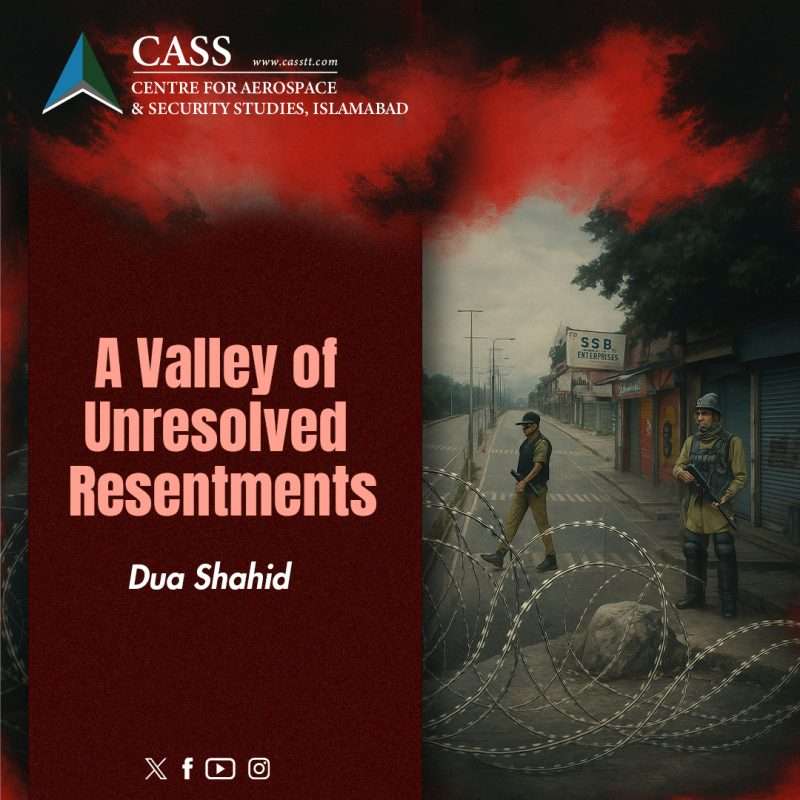
The unilateral decision of the BJP-led Indian government was seen as a betrayal of trust. Mass protests erupted. The BJP-led Indian government took several measures to stop the mobilisation of mass protests. The government sealed IIOJK with stringent lockdowns, and dozens of local political leaders were put under house arrest right after the decision, and even the months that followed. Thousands of political activists and journalists were taken into police custody. Similarly, the government restricted internet access and banned public gatherings. All these restrictions serve as evidence of mass human rights violations in the region, giving rise to never-ending resentments.
With the imposition of direct rule by New Delhi, local political leaders experienced complete disenfranchisement, stripped of their rights and excluded from any meaningful political process. Simultaneously, IIOJK’s economy deteriorated, as frequent lockdowns and prolonged internet restrictions led to the closure of businesses. Unemployment, socioeconomic challenges, and poverty surged, exacerbating an already dire situation and deepening the sense of despair, particularly among the youth.
The situation was further aggravated by unfulfilled promises of economic rejuvenation made by the BJP government, which many Kashmiris perceived as disingenuous. The continued denial of political rights, coupled with worsening economic conditions, further eroded public trust in the Indian state.
The Pahalgam incident is an illustration of a flaw in the policy that mistakes stringent security measures for peace. It is a known fact that perpetual peace cannot be achieved with force. The use of force continues a cycle of repression and resistance. For years, the people of IIOJK were suppressed and marginalised, and the revocation stole their autonomy and strengthened a sense of alienation. Resurgence of violence suggests that deep-seated resentments in the local population have reached a threshold that has surpassed the mode of silence and can be seen visibly on the surface in the form of the Pahalgam incident.
Sustainable peace in the occupied region remains unattainable without the initiation of a genuine political dialogue. International bodies have a critical role to play in urging the Indian government to uphold the right to self-determination for the Kashmiri people, as outlined in relevant United Nations Security Council resolutions. A just and lasting resolution in IIOJK is essential not only for the well-being of its inhabitants but also for the broader stability and security of the South Asian region.
Dua Shahid is a Research Assistant at the Centre for Aerospace & Security Studies (CASS), Islamabad, Pakistan. She can be reached at [email protected].



