
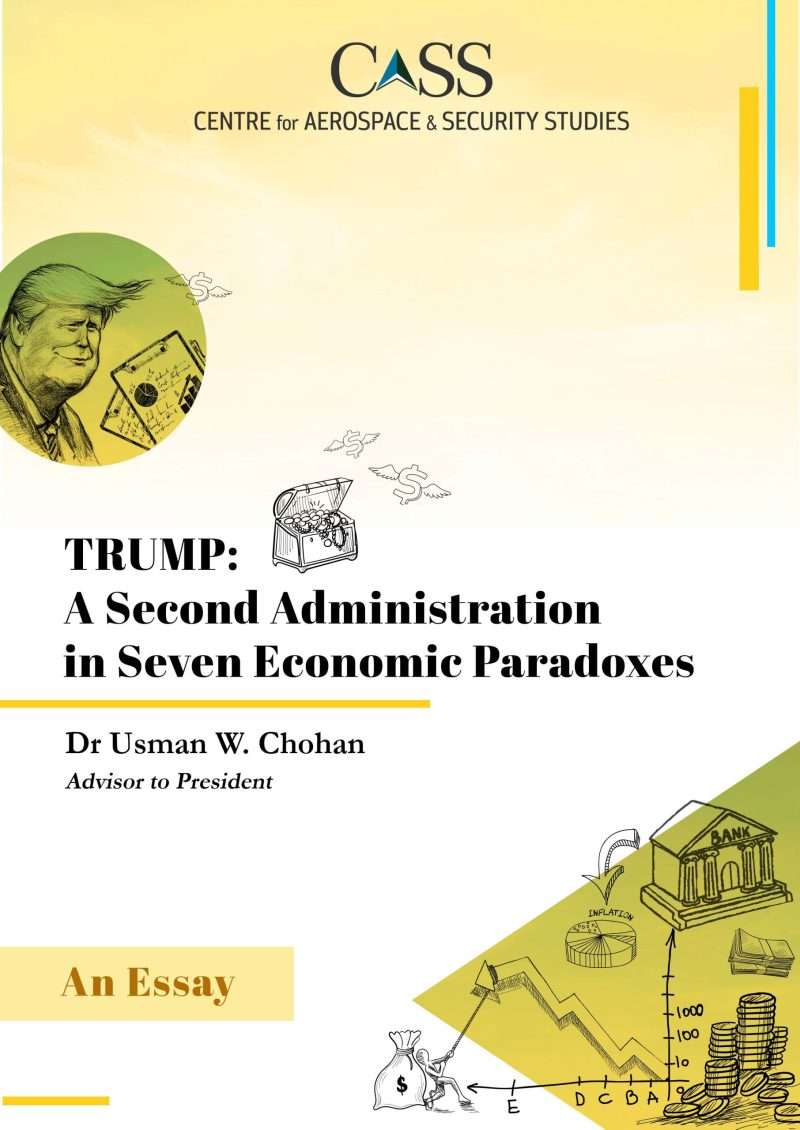
The aim of this essay is to shed light on the economic and political implications of a second administration under Donald Trump, by exploring seven key paradoxes that may characterise his approach to complex socioeconomic, sociopolitical, and geoeconomic decisions. In highlighting these paradoxes, the essay aims to emphasise the paradoxical modes of governance and conflicting ambitions that the Trump administration will wrest with based on the multiplicity of its stated objectives. In particular, Trump’s blend of populism, protectionism, and nationalism will manifest in policies that may work at cross-purposes, because they emanate from disparate ideological sources and interest groups: the nativism of Project 2025, the disenchantment and rebellion of the downtrodden, the pragmatism of the corporatocracy, the protectionism of working class voters, the recidivism of male voters, and the technofeudalism of big tech. The paradoxes that emerge from such a mish-mash will nevertheless reshape both American as well as global economics, politics, and society, which is why this essay may serve an equally prescient purpose for those that did vote for him as did not, and for those who can vote in US elections as those that cannot. There are seven paradoxes that warrant examination in this essay and will be addressed in the following sequence. First, the essay will consider the paradox of restricting both legal and illegal immigration with the promise of driving innovation and economic competitiveness. Second, the essay will address Trump’s ambition to sustain dollar hegemony while simultaneously reducing America’s trade deficit, a paradox that will likely accelerate dedollarisation efforts globally. Third, it will explore Trump’s desire to project America’s global economic leadership without the traditional largesse extended to allies, a shift likely to provoke new geopolitical realignments as the cost-benefit equation of following along with America becomes increasingly disfavourable for other nations. Fourth, the essay will examine the paradox articulated by Project 2025 of expanding the American population without a corresponding investment in human capital (‘growing numbers, shrinking futures’) —a dynamic that would product more Americans but worse ones. Fifth, the essay will discuss the paradox of strengthening family structures under Project 2025 while simultaneously imposing restrictive policies that may erode personal autonomy and increase domestic stressors, tighter family units that are tightened by force. Sixth, the essay will explore Trump’s efforts to ease economic hardship through protectionist policies (sweeping tariff measures raising import costs in an import-dependent country, and tougher migration policies raising labor costs), which could paradoxically worsen rather than ease conditions for consumers. Finally, and seventh, the essay will examine Trump’s reliance on scapegoating societal groups, a strategy that may foster divisions rather than address underlying economic issues, and on the need for problems to exist in order to appear as the ‘fixer,’ this giving the semblance of fixing problems than actually solving them. Each section will analyse these paradoxes in terms of their potential impact on either economic growth/stability, social cohesion, and America’s global standing; which is to say: economics, society, and both domestic and international politics. The essay concludes by reflecting on the broader consequences of these paradoxes, noting that they reflect a nation that is at odds with itself, and that the resolution of the paradoxes may not occur in ways advantageous to America’s long-term interests.
How the Nature of Warfare Affects the AI Optimism
Since the advent of Artificial Intelligence (AI), a pressing question is being asked: Is Clausewitz still relevant? The game-changing potential of AI and the idea of human-machine teaming (centaur systems) have led many to doubt the seemingly unchanged nature of war. Apparently, it has given rise to the belief that AI-powered systems will replace humans (generals) in the command loop. However, this view is detached from the complex nature of warfare, which remains fundamentally a human endeavour guided by violence, chance and friction.
Just like other social institutions, war is generally an interpretivist paradigm rooted in complex human nature. It is a non-linear phenomenon whose conduct and outcomes cannot be determined by analytical predictions or algorithmic patterns. In other words, war usually does not proceed on pre-determined rules of engagement, prescriptive manuals, established patterns and predictive modelling. Instead, it is fought on judgment, adaptation to changing realities, commander’s intuition and paying attention to the unfolding of the unknown.
Two Faces of the Atom: India’s Nuclear Exceptionalism
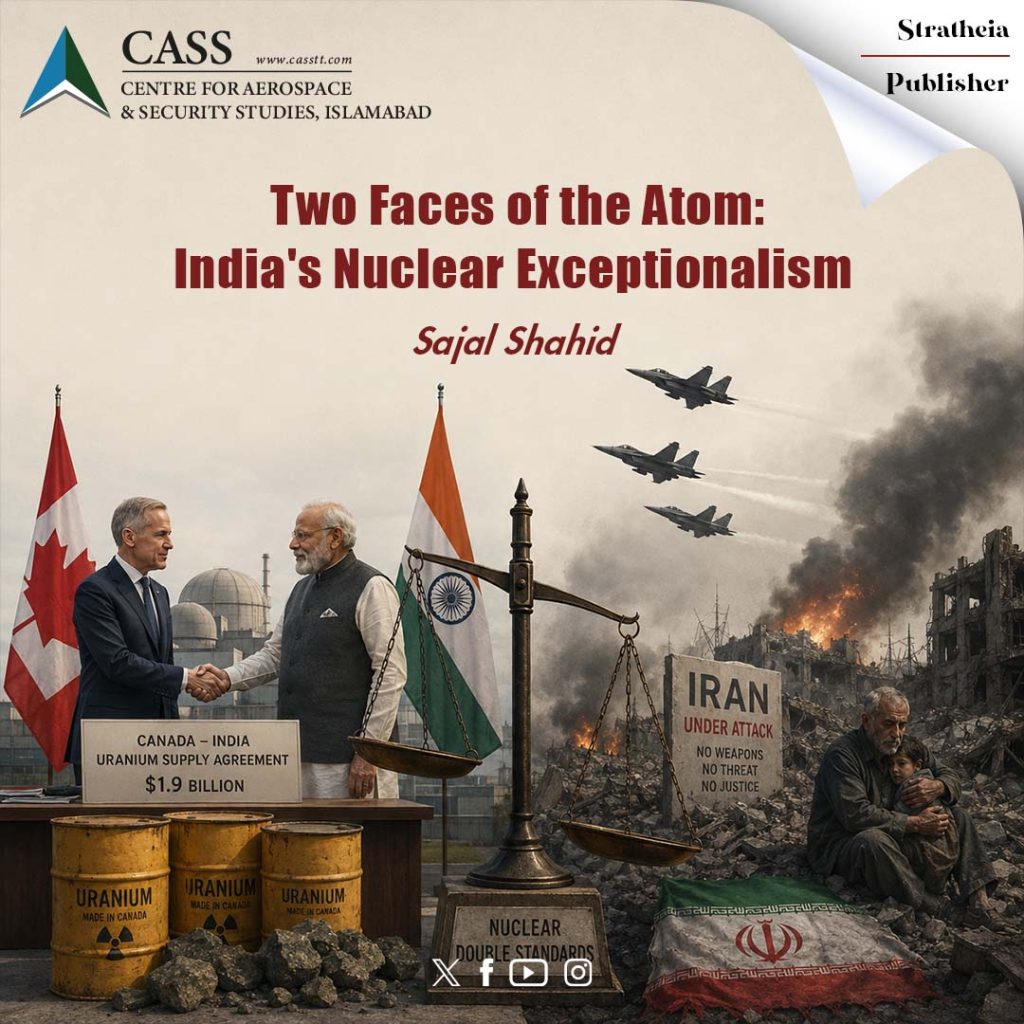
ew examples capture the inconsistencies of the nuclear world order more starkly than the events of 2 March 2026: as Prime Ministers’ Mark Carney and Narendra Modi signed a landmark 1.9 billion USD uranium supply deal for India’s civil nuclear sector, Iran was subjected to the third day of indiscriminate airstrikes by the US and Israel under the banner of nuclear non-proliferation, despite Iran agreeing to zero stockpiling of enriched uranium just days prior. This event, unfortunately, was not an isolated one, rather it reflects a pattern of nuclear exceptionalism where certain states such as India, continue to be rewarded for non-compliance with international regulations, while others such as Iran, are censured and even subjected to military action based on hypothetical realities.
The latest deal would see Canada sell close to 22 million pounds of uranium concentrate to India over 8 years, starting in 2027, a sale more than ten times the last Canada-India uranium agreement of 2015, which supplied 7 million pounds of concentrate over 5 years.
Data Centres as the New Military Targets in Modern Conflicts
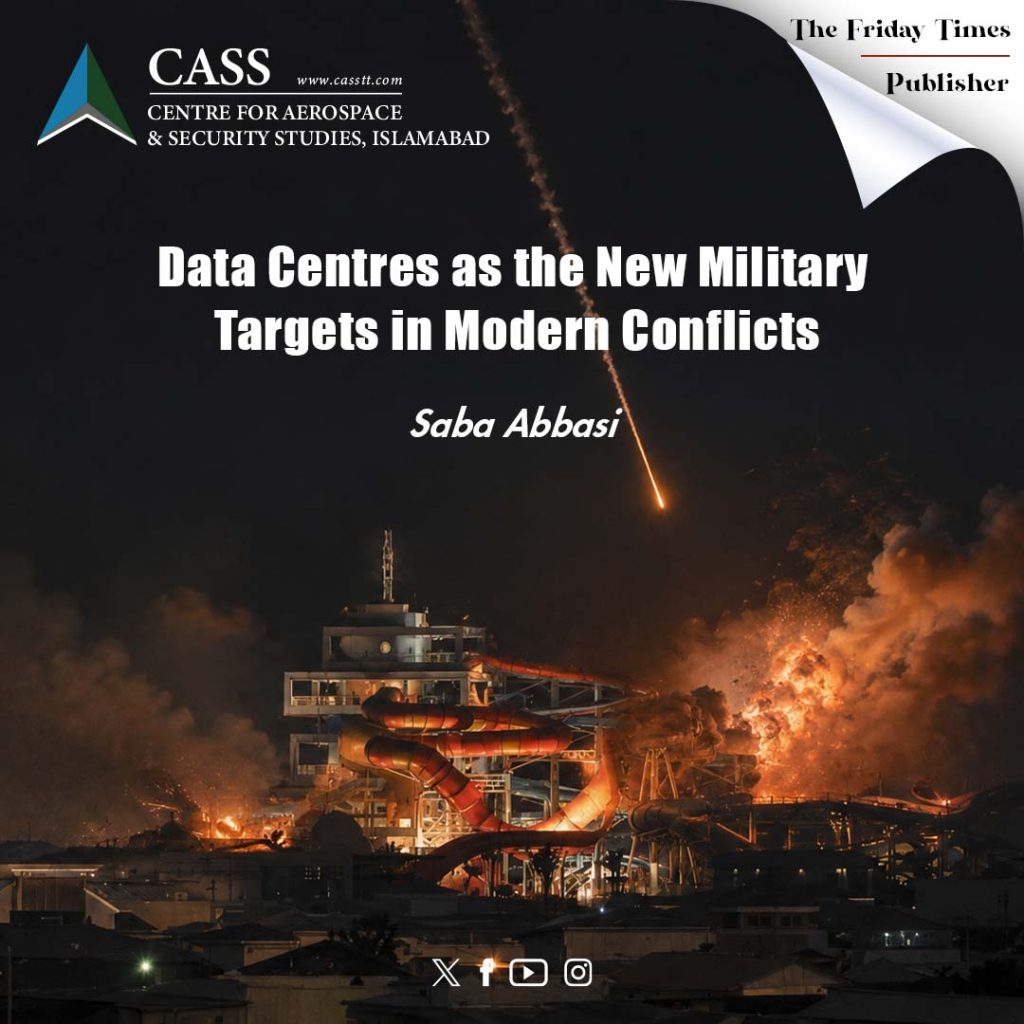
The character of warfare has evolved in tandem with the changing nature of military targets. In early March 2026, Iran bypassed traditional military targets and struck the physical part of the digital infrastructure at Amazon Web Services (AWS) data centres in the UAE and Bahrain. Until now data centres had been considered an unassuming target, as they did not house any military equipment or hardware. However, the US-Israel war on Iran, has transformed these billion dollar sites into high-value targets because of their ability to act as server farms on which adversaries’ websites, apps, AI systems and the entire digital infrastructure run.
Data centres are digital ecosystems where the delivery of cloud services depends on the integrity of physical infrastructure. Disruption in any one part of the shared infrastructure does not remain isolated and risks triggering widespread systemic failure. In the case at hand, Amazon operated multiple availability zones within each region in the United Arab Emirates and Bahrain. Iran struck two of the three availability zones in the UAE, while in Bahrain, a zone was damaged by drone debris causing an extended power outage and connectivity problems that further disrupted service across the Gulf.
