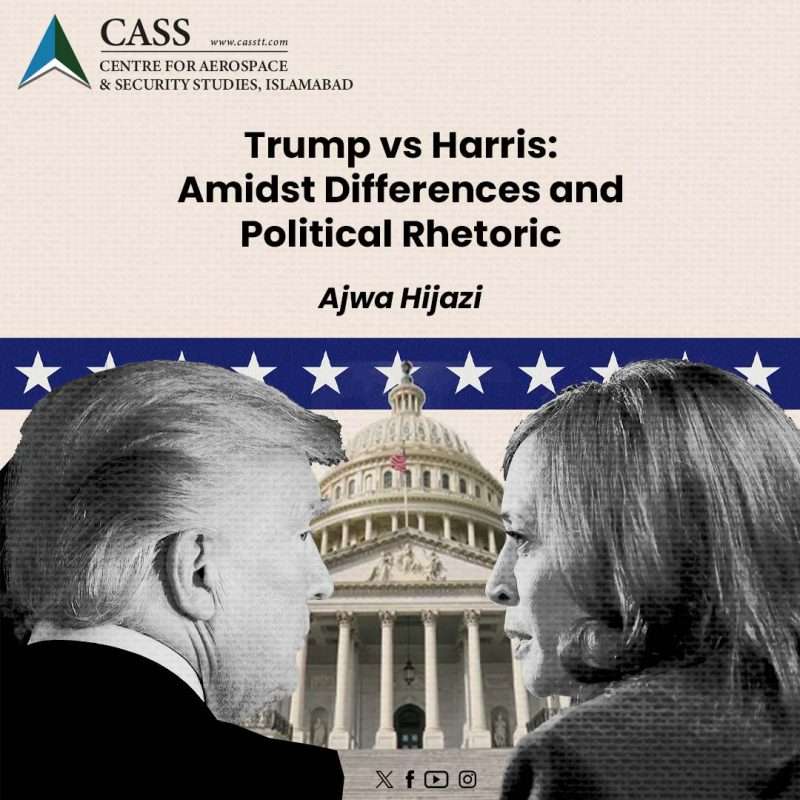
Global attention is fixed on the US presidential elections 2024, scheduled to roll out on 5th November. Since the presidential election campaign began, several notable events have occurred – the Democratic Party’s decision in July to nominate Vice President Kamala Harris in place of President Joe Biden, and two security incidents involving Republican candidate and former President Donald Trump.
According to various pre-election surveys from media outlets, academic institutions, and think tanks, the two main candidates are in a tight race – especially in swing states where they are separated by margins as slim as 1%. Amidst this, Trump and his VP candidate JD Vance, and Harris, along with her running mate Tim Walz, are inching closer to the last leg of the campaign trail.
The candidates’ contrasting personalities, as showcased during the ongoing campaign, are reflected in their differing policy positions on both domestic and foreign fronts.
On the domestic front, there are significant policy differences on several issues, such as immigration, Social Security, healthcare, and abortion. Moreover, their contrasting positions on key economic issues like taxation and housing have been a prominent focus of their election campaigns.
Both candidates have put forward populist taxation proposals with divergent plans. For instance, Democratic nominee Kamala Harris has pledged tax cuts for more than 100 million working and middle-class families. She plans to increase corporate taxes to 28% from 21%. In contrast, Donald Trump vows to extend and expand his 2017 tax cuts and reduce corporate tax to 15% for companies making products in the US.
Regarding the housing crisis, both candidates agree on addressing the underlying cause of the issue, which is limited supply, but they hold different approaches to tackle that. Harris’s plan mainly involves the construction of 3 million homes in collaboration with the private sector, along with down payment assistance for first-time home buyers. On the other hand, Trump plans to get rid of regulations to increase new home construction and utilise federal land for housing projects, along with banning undocumented immigrants from getting mortgages.
These proposals may foster high hopes among their support base, but their unilateral implementation would be challenging due to lack of pragmatism. According to many independent observers, their economic plans would further increase the national debt, which already stands at USD 28 trillion. However, their campaigns have surprisingly neglected the debt issue, which used to be a central focus of presidential debates in previous elections. This shows that the candidates are fighting this election based on rhetorical assertions instead of practical solutions.
During the ongoing campaign, in addition to domestic issues, considerable attention is being given to the candidates’ stances on major foreign policy challenges, including the Ukraine war, the conflict in Gaza, and the complex dynamics with China. The candidates hold notably different positions, particularly on the key issue of the Ukraine war.
While continuing the Biden government’s stance, Kamala Harris vows to support Ukraine in its war with Russia through continuous assistance. Conversely, Donald Trump has stated that he will end the war immediately, even on terms favourable to Russia. He has also criticised Ukrainian reliance on US aid.
On the Israel and Hamas war, both Trump and Harris support Israel’s right to what they call ‘self-defence’. But they have also highlighted the need to end the war, with Harris being more vocal about Palestinian sufferings than the Biden administration. However, during their presidential debate on 10th September, both candidates deflected the question regarding what they would do differently to end the year-long war in Gaza.
Interestingly, both candidates have accused each other of being weak on China. Building upon his earlier China policy, Donald Trump has been calling for an escalation in trade war, rise in tariffs on Chinese goods, and revocation of China’s MFN (Most Favoured Nation) status. Conversely, Kamala Harris is in favour of de-risking rather than decoupling US-China economic ties and advocates for keeping communication channels open despite the ongoing competition.
Kamala Harris has built her political identity under the banner of ‘A New Way Forward,’ while continuing several of Biden’s policies. In contrast, Donald Trump seeks to reclaim his 2020 legacy, positioning himself as a challenger to the current administration. In doing so they have somewhat distanced their campaigns from factual and pragmatic discourse on many issues.
For Pakistan, the implications of either a Trump or Harris presidency would be significant yet distinct. A potential Trump return could introduce unpredictability into Pakistan-US relations, with the possibility of either a warming of ties or heightened tensions depending on his foreign policy shifts. Conversely, a Kamala Harris presidency would likely bring a more measured and consistent approach, aligning with the existing policy framework of the Biden Administration.
The outcome of this presidential election will hinge largely on key swing states like Wisconsin, North Carolina, and Pennsylvania. Yet, the shadow of previous controversies over electoral legitimacy looms, suggesting that similar challenges could arise. Whoever ultimately claims victory, the stark contrast between Trump and Harris in decision-making will undeniably shape the course of US domestic and foreign policy in the years to come.
Ajwa Hijazi is a Research Assistant at the Centre for Aerospace & Security Studies (CASS), Islamabad, Pakistan. She can be reached at [email protected].