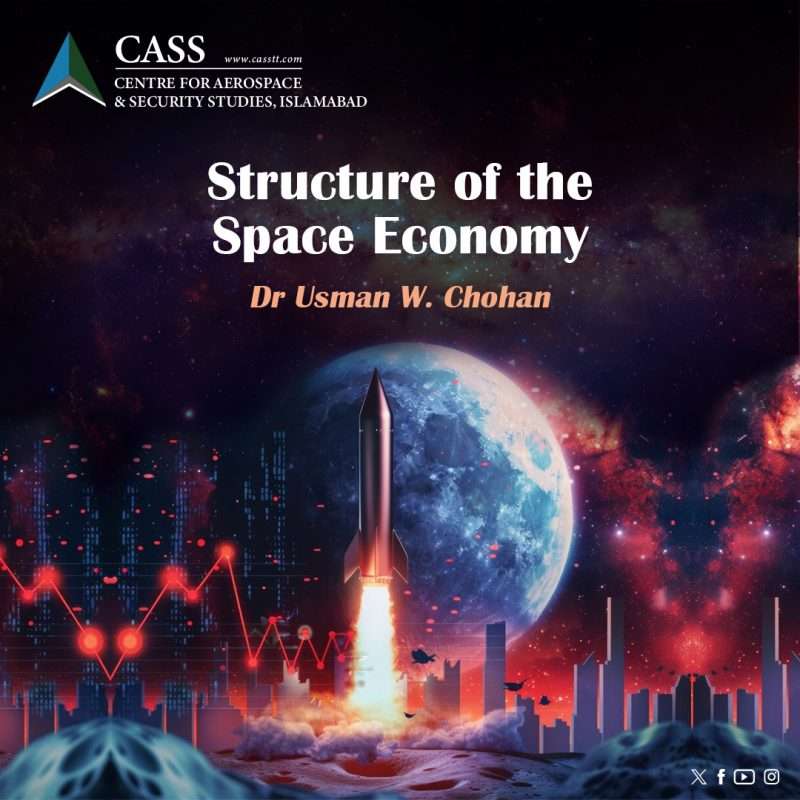
To understand the space economy, it is crucial to first define its scope. What exactly constitutes the space economy? Where is it located, and how large is it? These questions highlight the pervasive nature of the modern space economy as we move further into the 21st century. The space economy for the purpose of discussion here is that portion of the economy which is directly and indirectly associated with, driven by, or contributive to space technology. It is as much a part of everyday life as it is a part of the man-made constellation of objects hovering above us. Much like the digital economy, which has transformed all aspects of economic life to the point where one can no longer clearly separate the ‘analog’ from the digital, the space economy has similarly become woven into various sectors through its technological advancements. However, the widespread influence of space technology should not lead to the assumption that all economic activity is directly dependent on or driven by space technology. Instead, the impact of space technology varies across different sectors in both its intensity and relevance.
In that regard, one incipient effort to map the space economy has been by the World Economic Forum (WEF) in partnership with McKinsey. From their calculations, the current size of the space economy is USD 0.68 trillion, and their forecast is that this shall grow at a 9% Compound Annual Growth Rate (CAGR) out to 2035, meaning that it shall be roughly USD 1.79 trillion in size (tripling) by that date. Although this is a massive amount, it should be seen in terms of the wider estimated global GDP, which as of 2022 was USD 100 trillion. Yet any forecast at 9% CAGR implies growth well in excess of global GDP as a whole, and indeed the space sector will drive that growth in multiple ways. To understand this, the size of the space economy can itself be disaggregated into the direct and indirect portions of economic activity (the ‘backbone’ and ‘reach,’ as the consultants say), with the indirect reach accounting for a larger growth rate (11% CAGR out to 2035).
The disaggregation of the space economy into backbone (direct) and reach (indirect) is telling in its own right. The backbone (direct portion) comprises a public and private (commercial) component, wherein the public has both civil and defence elements (which helps to underscore the interplay between defence and economics), while the private has a service or end-user component on the one hand and infrastructure or support on the other. These are broad-based categories, even within the purview of the space economy’s backbone. Then, the indirect ‘reach’ elements derive from the constitutive parts of the backbone, and by way of example, the commercial services include those that assist in navigation, communication, positioning, timing, or observation.
It helps, therefore, to look at the space economy in terms of economic sectors. There are seven sectors that are projected to account for 80% of the global growth between now and 2035, namely: supply chain & logistics (made more efficient), food & beverage (last-mile delivery efficiencies), ‘state-sponsored defence’ (i.e. military applications in surveillance and resilient communications), retail (e-commerce and electronics), media/entertainment, ‘state-sponsored civil’ (disaster management, environment, scientific research), and digital communications (connectivity). Meanwhile, some industries that do not receive adequate mention, and whose growth may well be larger than expected, are the energy sector (including oil & gas), banking/finance, insurance, and materials (mining).
All of these industries are expected to grow due to certain trends that are already visible in the present day. First, there is a decrease in launch costs (a ten-fold decrease in two decades), allowing a wider assortment of public and private sector players to enter the field, while also making newer use-cases of space technology into economically viable ventures. Second, there is the miniaturisation of space technology, such that smaller devices launched have greater potence and economic value per unit of weight deployed. Third, there is the expansion of private sector investment complementing public sector outlays for the space economy. Fourth, public sentiment, especially in several emerging countries, is very favorably disposed towards greater progress in space.
Proceeding with this framework, then, one can consider the scope and depth of the space economy for Pakistan in the years ahead. Detailed analyses and commentaries on specific categories will be the subject of future writings, but one can draw inferences from the WEF space economy framework. Summarily, one may observe that there are promising areas of engagement in at least seven sectors: agriculture, transport, defence, disaster management, communications, banking, and resources.
First, agriculture is a mainstay of the Pakistani economy, both in GDP composition and especially in labour force participation, while climate change is unduly affecting crop yields and crop sustainability. On that front, greater usage of space technologies in agriculture (building upon work already done by SUPARCO) would work towards both resilience and productivity metrics in the agriculture sector, not just in the planting and harvesting phases but also in storage and transportation. If agriculture alone employs greater space technology along with mechanisation, the change in Pakistan’s economy would be one of extreme significance.
Second, supply chain & logistics issues are rampant and cause a severe bottleneck for the Pakistani economy, where loads of trucks (not even railways) form the transportation backbone in the country, which is neither energy efficient, environmentally friendly, nor economically independent (as it is heavily dependent on fuel imports and thus fuel prices). Last-mile efficiencies would greatly ease this bottleneck, which is seldom considered when envisaging what I have termed the redesign of our economy.
Third, in-line with our security requirements, space technologies for surveillance and resilient communications would also have economic benefits, whether in terms of economic activity generated in employment and contracting, or in terms of security benefits in ensuring a more regularised and safe environment for business activity at large. Fourth, and in a similar vein, investments in space for civil usage by the government would, in disaster management contexts, help reduce the damage or risks to economic activity. Environmental issues could also be more readily addressed and protected from degradation (a preservation of economic resources).
Fifth, an improvement in communications and connectivity through space tech would translate into significant economic gains in domestic commerce, international commerce, service delivery, and the expansion of connectivity services. Pakistan has witnessed tremendous growth in its connectivity penetration (mobile and internet) over the past two decades, and telecom companies have been some of the most successful commercial entities over that period, but there are still citizens who are off the grid or who have yet to maximise the connectivity benefits that the urban middle class already enjoys. Space technology will be crucial in addressing that gap.
Sixth, the banking sector will benefit both in ‘backbone’ (infrastructure and connectivity) as well as ‘reach’ (consumer use and service quality) through denser networks of space technology in the economy. Financial inclusion, financial risk management, and cybersecurity in the finance sector all remain challenges that require comprehensive approaches, and space technologies can partially assist (though better connectivity, data management and oversight, and network resilience) in that regard.
Seventh, the resource sector has multiple and profound use-cases for space technology in Pakistan, truly a ‘game changer’ to borrow the oft-used expression. Consider the offshore oil exploration, drilling, and extraction benefits that have a significant possibility of altering the economic destiny of the next generation of Pakistanis. Additionally, the use-cases for mining, which offers tremendous potential in various regions of Pakistan, benefit tremendously from the possibilities offered by space technologies, not least in the exploratory/prospective phase.
In sum, there is no shortage of possibilities for the space economy to grow and thrive in Pakistan, particularly when framed in light of the gains they promise for key economic sectors over the coming decade. Globally, the most plausible forecast is that the space economy will triple in size by 2035, driven by major economic (costs), technological, and political (sentiment) forces that are already at play today. While it may be claimed that the space economy is already everywhere (as with the digital economy), a sectoral analysis (such as WEF/McKinsey) points to many areas with specific growth theses. Not all of these apply to Pakistan neatly because of the unique stage of its economic complexity, but in the areas where the space economy’s benefits can be already identified, the potential is indeed astronomical.
Dr Usman W. Chohan is Advisor (Economic Affairs and National Development) at the Centre for Aerospace & Security Studies, Islamabad, Pakistan. He can be reached at [email protected].