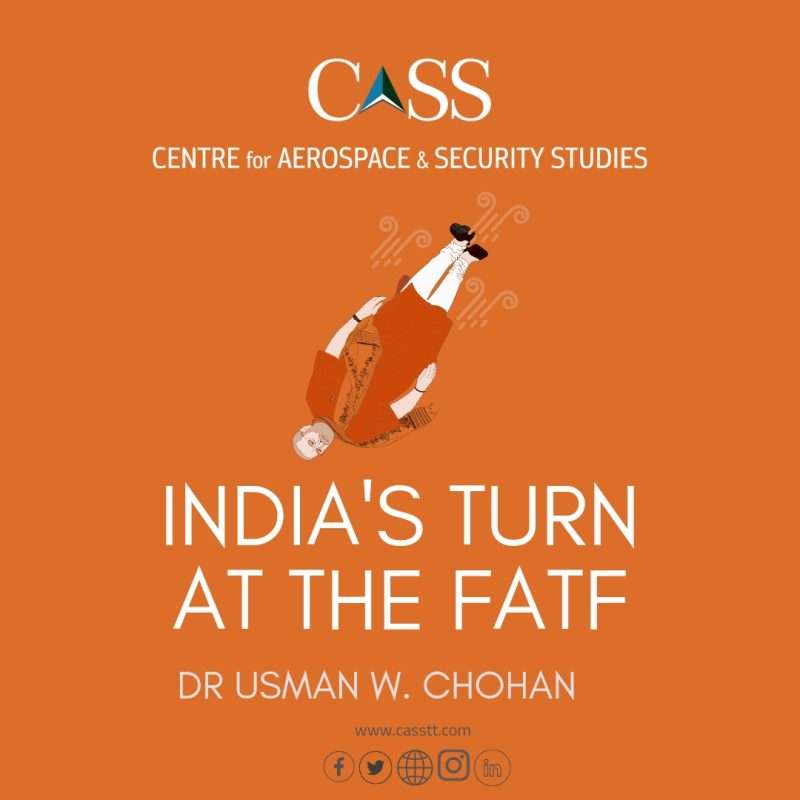
The saga of Pakistan and the FATF is one that I have written about extensively, having been an ardent contributor and advocate for the strategy that led to the country’s ultimately successful exit from the dreaded gray-list. The crux of that strategy involved a twofold approach: (1) improving financial oversight, legal frameworks, and institutional coordination for the intrinsic benefit to the financial regime, but also (2) calling out the deeply-politicized and corrupt agenda of the FATF as a transboundary body run amok. This dual-approach yielded excellent results for Pakistan, and incidentally, the agent-provocateur of that tussle with the FATF is now up for a similar review.Because it is India’s turn at the FATF, it is important for the organization to conduct an honest and forthright appraisal of the financial oversight system in India, which is mired in deep-set structural problems pertaining to money-laundering and terrorist financing. As I have discussed at length in an IPRI podcast, these issues require serious remedial action.
One may begin by considering the scope of the problem, where it becomes evident that India faces a monumental challenge in reforming its black economy. the absolute size black economy, according to a figure quoted by a CBI official, is at least $500 billion (Rs.25 lakh crore rupees), while the IMF estimates it being twice that amount. Even using smaller estimate, one must realize that this would be larger than the entire economyof Malaysia, or the UAE, or Denmark. The sheer magnitude of the black economy is enough for India to be thrown straight into the blacklist of the FATF, and one must wonder why the FATF hasn’t already done so. Aside from the dirty politics of the FATF, in which India, by the admission of its own Foreign Minister Jaishankar, is the dirtiest player, the fact is that India was only partially compliant on FATF standards in its last review in 2013, with many serious flaws identified at the time. India would have come up for review sooner were it not for the pandemic, and emergent problems with India are being flagged across the board.
Various detailed studies demonstrate the multiple counts on which India is non-compliant with FATF standards and has failed to act upon the recommendations made by in the FATF dating back to a 2010 Mutual Evaluation Report. In addition, a burgeoning concern is in how FATF-oriented laws are being abused by the Indian government to stifle civil society. A 46-page shadow report by a consortium of civil society members has been submitted to the Global NPO Coalition on FATF, apprising it of the fact that India has weaponized its laws to target and stifle non-profit organizations (NPOs). Drawing upon interviews with over 700 representatives from civil society organizations and field experts, the report finds that the Indian government, without engaging or informing the NPOs about supposed “FATF requirements,” has been indiscriminately targeting them on “unproven” and “frivolous claims”. One can also see the indication in how licenses have been denied to NPOs in recent years, where in 2010 there were only 41 rejections, in 2023 there were more than 20,000 rejections. This signifies a broader pattern of hostility of the government towards non-profit civil society movements, and an authoritarian streak that contributes to public value destruction.
The problem from the FATF perspective is that rules made supposedly in its name are being used for such clampdowns. In particular, it is the Foreign Contributions (Regulation) Act (FCRA) of 2010. The original aim of the FCRA was to prevent foreign funding interference in India’s domestic elections. However, the notion of transparency in elections was already subverted by the Finance Bill 2018, which was passed without debate, and which made political parties exempt from the scrutiny of overseas funding. Nevertheless, the FCRA is now instead used to flag NPOs, which makes it impossible for formal banking channels to extend and disburse funds to the NPOs. India’s Prime Minister Modi sees NPOs as part of an agenda to remove him from power, and has therefore mobilized FATF-related laws to clamp down on civil society organizations, which has had severe public value-destructive consequences, as I had analyzed in my fourth book. For example, India’s Covid-19 response was tragically poor due to both sweeping governmental policies, as well as severely crippled NPO capabilities. By contrast, in Pakistan the government’s policies were moderate (e.g. targeted lockdowns), and civil society was able to successfully fill the gap where state capacities were limited.
At the same time, while the Indian government is using FATF-related laws as a pretext to tyrannize civil society, there are many BJP and RSS sympathizers who are deeply involved in money laundering. Political workers and functionaries are being found with severe criminal infractions of money laundering. In addition, many businesses with owners sympathetic to the BJP are also involved in such activities. There is a vast web of such direct BJP workers and sympathizer businessmen that needs to be dismantled, and the FATF must pay heed to this danger. The bigger question, of course, is India’s state-sponsored terrorism which is evident in the Kulbushan Yadav case and many others. The footprint is not just in South Asia; but rather the tentacles also span onto other continents, as the recent Canada-India spat over the murder of a Sikh separatist leader illustrates.
These factors must be brought into the FATF Mutual Evaluation (MER) and plenary’s considerations. We are seeing a country that weaponizes the FATF’s rules to tyrannize its own people, and then weaponize the FATF itself against countries all over the world. None of this bodes well for international regimes of anti-money laundering and countering the financing of terrorists (AML/CFT). It only bolsters the widely-held notion that the FATF is a self-aggrandizing, illegitimate body with a mission creep run amok. It doesn’t actually improve AML/CFT outcomes, but instead goes about creating further instability and economic damage wherever it chooses to conduct its supposed evaluations – economic arson at its worst. To remedy this image problem and bring concrete improvements to its practices, when the FATF evaluates India’s AM:/CFT conditions, it should proceed with the knowledge that it is dealing with an essentially rogue state, and should treat the myriad Indian problems of AML/CFT as symptomatic of a larger malaise, one which is detrimental to the world at large.
Dr. Usman W. Chohan is Advisor (Economic Affairs and National Development) at the Centre for Aerospace & Security Studies, Islamabad, Pakistan. He can be reached at [email protected].