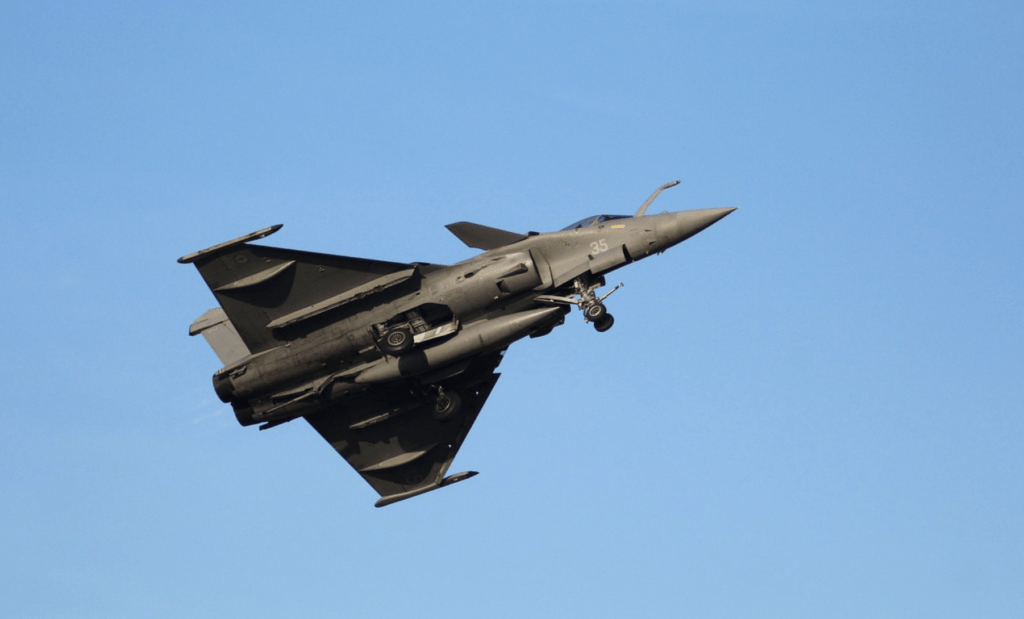
The first batch of 5 Rafale jets landed at the Ambala airbase in India on 29th July, 2020. The induction of these fourth-generation jets has been hailed widely in India and the notion prevails that a decisive technology has been acquired which will add significantly to existing Indian capabilities.
Developed and designed by Dassault Aviation, the Rafales are twin-engine, multi-role fighter jets. They are nuclear-capable and can undertake both air-to-air and air-to-ground combat missions. For air-superiority missions, India has ordered the European-manufactured ‘Meteor’ air-to-air missiles which have a range of 120-150 km. Besides, these jets can also be armed with the ‘Scalp’ fire-and-forget cruise missile which can hit ground targets at a distance of 300 km.
The deployment of American AMRAAMs (Advanced Medium-Range Air-to-Air Missile) gave Pakistan first-shot capability. This edge proved to be a decisive factor in the aerial encounter between India and Pakistan on 27th February, 2019 when the latter shot down an Indian Mig-21 Bison and Su-30 MKI. This resulted in expedited induction of the Rafale jets by the Indian government. It is widely touted by the Indian media that the induction of long-range missiles will help the Indian Air Force (IAF) in offsetting this advantage of the Pakistan Air Force (PAF).
The hype that has been created around this acquisition is considerably exaggerated and is reflective of India’s embarrassment which the IAF had to face when it lost its two aircraft in February last year. The introduction of these aircraft in the IAF should not be used to spread despair in Pakistan. In reality, the mere induction of these jets will neither set the future trajectory of the regional environment nor will they have an immediate impact. It is worth pointing out that these jets will not even be fully operational and integrated into the existing Indian systems for another two years.
Labelling this technology a “game changer” for the strategic stability of the region is problematic since similar propaganda was created following India’s acquisition of the Russian-made Sukhoi (which although a highly advanced aircraft), was downed by PAF on 27th February through better utilisation of technology, employment and tactics. Hence, Prime Minister Modi’s statement that the aerial engagement would have led to a different result if Rafales were employed is questionable, since the Rafale is not a fifth-generation jet. Furthermore, technology can be offset by training and tactics as was amply highlighted when PAF surprised IAF and proved itself better in all aspects of combat.
Indian policymakers continue to claim that this technology will enable India to dominate Pakistan. However, India has always maintained numerical advantage as well as technological edge over Pakistan in the past. In aerial engagements, these factors do not ensure victory as the results are context-driven.
The recent Ladakh episode demonstrated that India is hesitant to escalate with China given the consequences of such an escalation. The aerial engagement of 27th February and the standoff at Ladakh are illustrative of the reality that India lacks the capabilities to tackle Pakistan or China separately, let alone together. The acquisition of technology, a new “toy” is a means to create nationalistic, anti-Pakistan hysteria in its citizenry by demonstrating an aggressive posture.
Apart from augmenting its offensive capabilities, India is also investing in its defensive capabilities. In 2018, the Modi government inked a deal with Russia for the purchase of 5 regiments of S-400 air defence systems, which are due to be delivered in 2021. What is concerning is that a combination of such weaponry and systems could be extremely destabilising for South Asia even if it will be quite some time before things play out according to Indian desires.
Firstly, it will take considerable time to device a deployment plan for the newly acquired technologies. Secondly, India is acquiring its systems from different states: S-400 from Russia; NASAM II missiles system from the United States; Phalcon AWACS from Israel; and Rafale jets from France. Such technologies and systems are highly advanced and diverse which would require mammoth integration plans in the existing IAF network. Apart from being a challenging task, NATO countries may be reluctant to integrate their systems with Russia’s military equipment. India initially planned to integrate the Meteor missiles on the Mirage 2000, the Su-30 and the Tejas Mark II. However, India was informed by the manufacturers that French-made Mirage 2000 and the Russian Su-30 MKI were not suitable for the long-range missile. Hence, compatibility problems will pose challenges to aggressive Indian ambitions. Moreover, this diversity will also put pressure on training and maintenance tasks.
The introduction of the Rafales will put pressure on Pakistan to add to its inventory to counter this threat. Consequently, the acquisition of new technology will become a dire necessity.
In an aerial engagement, first-shot capability is crucial – whoever has this edge forces an adversary into deceptive manoeuvring or take the risk of being intercepted. Cognizant of the evolving strategic environment, Pakistan is already exploring avenues to address any and all aerial threats from the Indian side.
The PAF is in the process of acquiring Chinese PL-15 long-range missiles, with a range of 250-300 km for JF-17 Block III which will offset this balance by giving first-shot capability to Pakistan. The attainment of fifth-generation fighter jets is the most befitting response in this regard.
Pakistan is also pursuing the development of fifth-generation fighter jets with China under the AZM stealth fighter program. If Pakistan is able to develop a fifth-generation aircraft, it will be a significant step towards countering belligerent Indian actions. At the end of the day, it will be a matter of time and resources which will ultimately play a crucial part in regional stability of South Asia.
– Shaza Arif is researcher at Centre for Aerospace & Security Studies (CASS). This article was first published in Strafasia. She can be reached at [email protected].