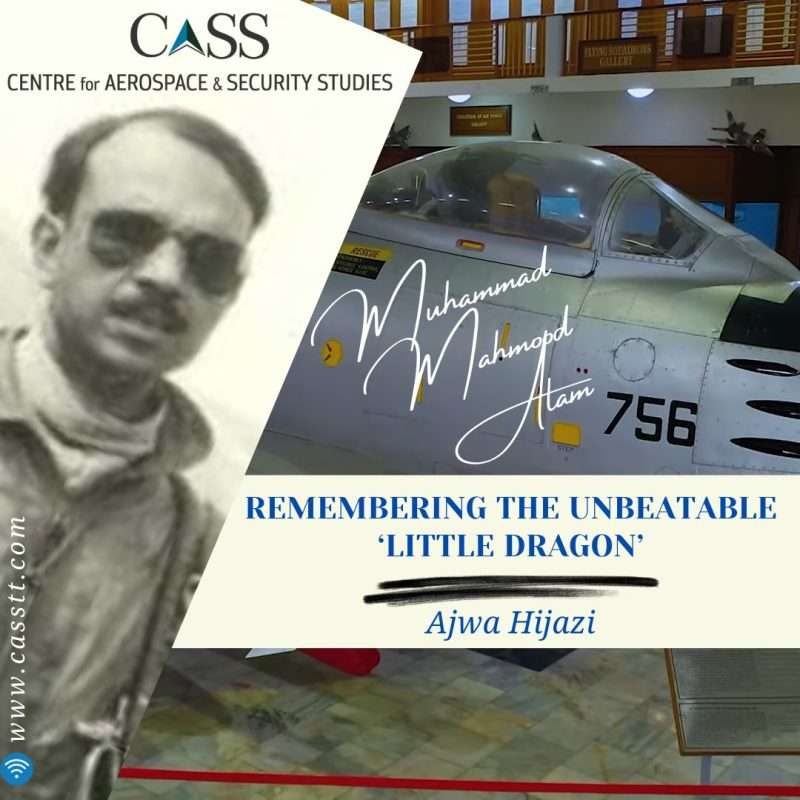
Whenever there would be reminiscing about the events of September 1965, it would be incomplete without mentioning the heroics of then-Squadron Leader Muhammad Mahmood Alam (M.M. Alam) of the Pakistan Air Force (PAF), who defended the airspace of the country with unmatchable gallantry and resilience. Popularly nicknamed as ‘Little Dragon’, M. M. Alam, during the Indo-Pak War of 1965, shot down five Indian warplanes in less than a minute, an unbeatable record that would become one of the glowing cornerstones of the PAF’s combat history. Due to his remarkable depiction of bravery in the war, M.M. Alam was awarded the prestigious ‘Sitar-e- Jurat’ (the third highest military award in Pakistan) and the BAR medal. Moreover, he was also the first fighter pilot ever to be ranked at the top of the Hall of Famers list at the PAF Museum, Karachi.
Born in East Bengal in 1935, M.M. Alam graduated from the Government High School of Dhaka and later, in 1952, joined the Royal Pakistan Air Force, now known as the Pakistan Air Force, as a flight cadet. He was the first person in his family to join the military. According to his brother, Dr M. Zubair Ahmed, M.M. Alam had the aspiration to become a fighter pilot since the age of 14, when he used to build wooden models of aircraft. His profound dedication to this career would be reflected in his demeanour throughout his service, both on and off the battlefield.
M.M. Alam was designated as the commander of No. 11 Fighter Squadron in January 1964. He led this squadron during the War of 1965 when he was posted in Sargodha. Under his exceptional command, the squadron flew 227 sorties in 17 days of the war. Overall, the squadron shot down ten Hawker Hunter aircrafts and three Gnats, and also damaged three Hunters of the enemy’s air force.
Amidst the upheaval of the war, Squadron Leader M.M. Alam defended the skies of his country with utmost valour and unmatchable rigour. Out of the total downed aircraft by his squadron, he is credited with shooting down nine Hawker Hunters, while flying his F-86 Sabre. Moreover, from his overall kills, five Hawker Hunter aircraft were downed by him, on 7th September, 1965, in a single sortie in less than a minute, while performing an interception mission against the Indian intruders, which were headed towards the Sargodha airbase for the attack. He accomplished this remarkable feat despite the technical superiority of Hunter jets over the F-86 Sabre, which further manifested his unprecedented skillset in aerial combat for times to come.
While discussing the legacy of M.M. Alam, British aviation writer, John Fricker underscored that the combat record established by him in the Indo-Pak War of 1965 had few equals in history. He maintained that many pilots have been credited with accomplishing notable air victories in a single sortie, but few are likely to match M.M. Alam’s feat of taking down several enemy fighter planes in record time. M.M. Alam’s daring record further solidified the PAF’s stature in air-to-air combat with India and granted it the due leverage over the IAF in the 1965 War, hampering its quest to overwhelm the PAF.
In the following years, he continued his exemplified conduct in the PAF through hard work and dedication. He logged around 3,300 hours of flight time across 12 different aircraft. Furthermore, in 1968, he also had the opportunity to form and lead PAF’s first-ever Mirage Squadron.
During his service, he was assigned various important positions, including Officer Commanding of No. 11, No. 5, and No. 26 Squadrons, Assistant Chief of the Air Staff (Flight Safety), and Assistant Chief of the Air Staff (Plans). In 1982, Alam’s notable career, which spanned over three decades, culminated at the distinguished rank of Air Commodore. However, his legendary achievements in jet combat continue to be a hallmark in aerial warfare history. He breathed his last in March 2013 after a protracted illness.
In the Indo-Pak War of 1965, the PAF effectively countered an adversary triple its size. Among the many tales of courage and resilience, M.M Alam’s distinguished heroism holds a prominent position alongside the esteemed achievements of other PAF personnel. Owing to his sheer tactical acumen and distinguished ability to out-manoeuvre the adversary, he remains an inspiring guiding light for the budding fighter pilots of the PAF.
Ajwa Hijazi is a Research Assistant at the Centre for Aerospace & Security Studies (CASS), Islamabad, Pakistan. The article was first published in Daily News Lark. She can be reached at [email protected]
Design Credit: Mysha Dua Salman